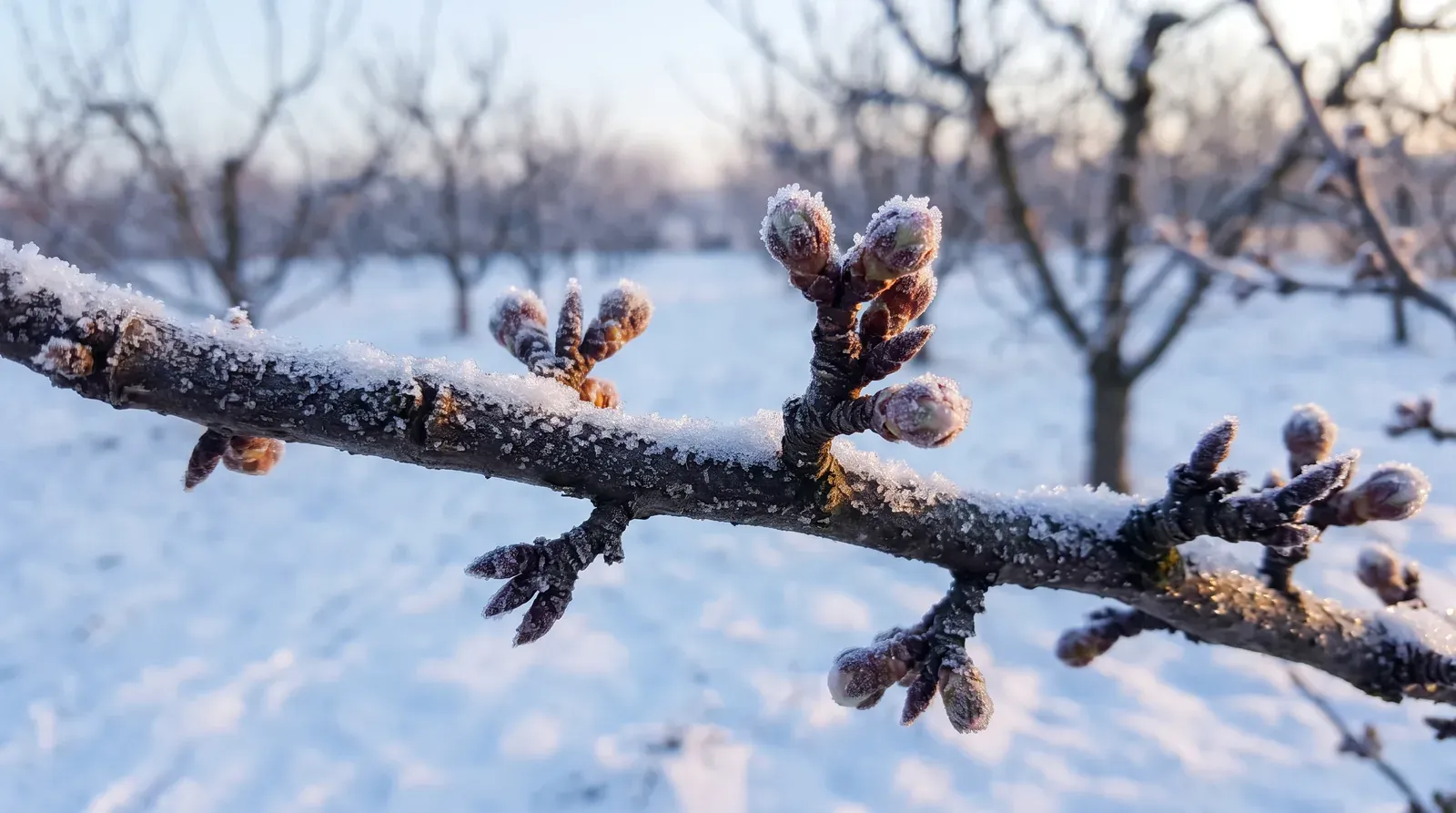
Dormant, fully acclimated fruit trees survive far colder temperatures than the same buds can in spring. WSU Extension says apples, tart cherries and American plums tolerate winter lows of about −30°F (−34°C), pears and European plums about −20°F (−29°C), and sweet cherries, Japanese plums and apricots −10 to −15°F (−23 to −26°C). Peach and nectarine trees can be injured at −8 to −12°F (−22 to −24°C), and peach flower buds usually die first. Fully dormant figs are hardy to about 15–20°F (−9 to −7°C) and most citrus to 16–28°F (−9 to −2°C). Roots are the least hardy part of an apple tree. Moran et al. (2011) froze seven ungrafted apple rootstocks, and the temperature that killed half the trees ranged from −7.8 to −18.8°C (18 to −2°F). Quamme and Brownlee (1997) found root injury in the widely planted M.7, M.9 and MM.106 stocks below about −7.2 to −9.6°C (19 to 15°F).
Last updated: 21 October 2026.
This page collects the temperatures that kill dormant fruit buds, wood and roots in midwinter. Every number comes with its source, its year and the conditions it was measured under. Hardiness shifts with the weather before a freeze, so read the conditions alongside each value. In Proebsting’s model for ‘Elberta’ peach, flower buds reach an LT50 of −28°C (−18°F) after a cold spell and fall back to about −21°C (−6°F) after mild weather (Proebsting 1970, in Westwood 1993).
Winter hardiness vs spring frost: what is the difference?
Winter cold hardiness is the lowest temperature a dormant, cold-acclimated tissue survives. Spring frost damage happens once buds start to swell and open, after most of that hardiness is gone. In WSU critical temperature data (Proebsting and Mills 1978), apple blossoms at full bloom reach 10% kill at 28°F (−2.2°C), while dormant apple flower buds in January have LT50 values of −22.4 to −30.4°C (−8 to −23°F) (Szalay et al. 2022). For bud-stage kill temperatures from silver tip to post bloom, see our frost damage temperatures for fruit trees and vegetables page.
How to read these numbers
- LT50 is the temperature that kills 50% of the buds or plants tested. LT10 and LT90 are the 10% and 90% kill points.
- Minimum survival temperature (MST) is the lowest temperature a tissue survives without measurable injury, so it is warmer than the LT50 for the same tissue.
- “Hardy to” and “can withstand” statements from extension services describe field survival of whole trees, not a laboratory kill point.
- Field survival percentages come from a real freeze, so they reflect that winter’s weather as well as the cultivar.
- Laboratory values were measured on cut shoots, buds, roots or whole young trees frozen in a programmable freezer, then scored for tissue browning, electrolyte leakage or regrowth.
- The grape values use differential thermal analysis (DTA). DTA detects the heat released when supercooled water inside a bud freezes, which is usually the moment the tissue dies.
- Temperatures are air or chamber temperatures. Roots experience soil temperature rather than air temperature, and most recorded apple root kill happened on soils without snow cover (Quamme 1990, cited in Quamme and Brownlee 1997).
Winter kill temperatures by fruit species
The table summarises the most quoted dormant-season thresholds. Detailed tables per crop follow below.
| Fruit | Tissue and measure | °F | °C | Conditions | Source |
|---|---|---|---|---|---|
| Apple | Whole tree, can withstand | −30 | −34.4 | Midwinter, dormant | WSU Extension PNW Gardener’s Handbook |
| Apple, cold-hardy cultivars | Maximum cold hardiness | −35 | −37.2 | Fully acclimated | MSU Extension 2013 |
| Apple | Flower buds, LT50 | −8 to −23 | −22.4 to −30.4 | January, 8 cultivars, Hungary, 2016–2020 | Szalay et al. 2022 |
| Apple rootstocks (7 tested) | Roots, LT50 | 18 to −2 | −7.8 to −18.8 | Whole ungrafted young trees, soil rinsed off the roots; M.26, P.2, B.9 and four Geneva stocks | Moran et al. 2011 |
| Pear | Whole tree, usually tolerates | −20 | −28.9 | Midwinter, dormant | WSU Extension PNW Gardener’s Handbook |
| Pear (Pyrus communis) | Stems killed | −20 | −29 | Stems collected in December, frozen at 1°C per hour | Rajashekar et al. 1982, in Westwood 1993 |
| Peach and nectarine | Tree injured | −8 to −12 | −22.2 to −24.4 | Midwinter | WSU Extension PNW Gardener’s Handbook |
| Peach | Flower buds begin to die | −13 to −15 | −25.0 to −26.1 | Midwinter, Michigan | MSU Extension 2013 |
| Peach | Flower buds, LT50 | −2 to −8 | −18.8 to −22.1 | January–February, 33 cultivars, New Hampshire | Moran et al. 2024 |
| Peach | Tree damaged | −20 to −25 | −28.9 to −31.7 | Midwinter | MSU Extension 2013 |
| Apricot | Flower buds, LT50 at maximum hardiness | 2 to −11 | −16.5 to −23.7 | December–January, 16 cultivars, Hungary | Bakos et al. 2024 |
| Apricot | Whole tree, survives | −10 to −15 | −23.3 to −26.1 | Midwinter | WSU Extension PNW Gardener’s Handbook |
| Sweet cherry | Dormant flower buds | −4 to −31 | −20 to −35 | Range depends on preceding air temperatures | Westwood 1993 |
| Sweet cherry | Whole tree, survives | −10 to −15 | −23.3 to −26.1 | Midwinter | WSU Extension PNW Gardener’s Handbook |
| Tart (sour) cherry | Whole tree, can withstand | −30 | −34.4 | Midwinter | WSU Extension PNW Gardener’s Handbook |
| American plum | Whole tree, can withstand | −30 | −34.4 | Midwinter | WSU Extension PNW Gardener’s Handbook |
| European plum | Whole tree, usually tolerates | −20 | −28.9 | Midwinter | WSU Extension PNW Gardener’s Handbook |
| Japanese plum | Whole tree, survives | −10 to −15 | −23.3 to −26.1 | Midwinter | WSU Extension PNW Gardener’s Handbook |
| Fig | Dormant tree, no severe damage | 15 to 20 | −9.4 to −6.7 | Properly cold-conditioned, fully dormant | UF/IFAS Extension (Sarkhosh and Andersen) |
| Citrus (by type) | Tree, no damage | 16 to 28 | −8.9 to −2.2 | Kumquat hardiest, lime least hardy | Mississippi State University Extension |
| Highbush blueberry | Flower buds, LT50 | −17.5 | −27.5 | 7 February, ‘Bluecrop’, mean of 2006–2008 winters | Ehlenfeldt et al. 2015 |
| Grape (Vitis vinifera) | Primary buds, LT50 at maximum hardiness | −7.4 to −15.0 | −21.9 to −26.1 | Midwinter, 21 cultivars, Prosser, Washington | WSU, from Ferguson et al. 2014 |
| Grape (‘Concord’) | Primary buds, LT50 at maximum hardiness | −21.1 | −29.5 | Midwinter, Prosser, Washington | WSU, from Ferguson et al. 2014 |
Conversions between °F and °C are ours; the methodology note explains the rounding.
Peach and nectarine: what temperature kills peach buds in winter?
Peach flower buds are usually the first part of a peach tree to die in a cold winter. Michigan State University Extension (2013) says peach flower buds begin to freeze and die at −13 to −15°F (−25.0 to −26.1°C). The same article says most peach flower buds are dead below −16°F (−26.7°C), while the tree itself is not damaged until about −20 to −25°F (−28.9 to −31.7°C). Iowa State University Extension says temperatures below −18°F (−27.8°C) destroy peach flower buds and temperatures of −25°F (−31.7°C) or below may damage or kill the tree.
| Measure | °F | °C | Conditions | Source |
|---|---|---|---|---|
| Flower buds begin to die | −13 to −15 | −25.0 to −26.1 | Midwinter, Michigan | MSU Extension 2013 |
| Most flower buds dead | below −16 | below −26.7 | Midwinter, Michigan | MSU Extension 2013 |
| Flower buds tolerate, at maximum hardiness | about −13 | about −25.0 | Midwinter, after full acclimation | MSU Extension 2026 (Dick and Plotkowski) |
| Flower buds destroyed | below −18 | below −27.8 | Iowa winters | Iowa State University Extension |
| Flower bud LT50, 33 cultivars | −3 to −8 | −19.5 to −22.1 | Shoots cut 24 February 2021, New Hampshire | Moran et al. 2024 |
| Flower bud LT50, 22 cultivars | −2 to −5 | −18.8 to −20.6 | Shoots cut 28 January 2023 after mild days | Moran et al. 2024 |
| Flower bud survival near 100% / 0% | above −4 / −13 and colder | above −20 / −25 and colder | Artificial freezing, 2021 and 2023 | Moran et al. 2024 |
| Flower bud LT50, baseline during rest | −6 | −21 | ‘Elberta’, early November onward, no cold preconditioning | Proebsting 1970, in Westwood 1993 |
| Flower bud LT50, after cold preconditioning | −18 | −28 | ‘Elberta’, cold spells at −2.2°C or below | Proebsting 1970, in Westwood 1993 |
| 10% of flower buds killed (most cultivars) | −7.2 | −21.8 | 4 hours below −5°F, 1 January 2011, New Mexico | Yao 2011 |
| 90% of flower buds killed (most cultivars) | −7.2 to −11.3 | −21.8 to −24.1 | Between the 1 January and 3 February 2011 freezes, Alcalde, New Mexico | Yao 2011 |
| Over 99% of flower buds dead (every cultivar) | −11.3 | −24.1 | 3 hours below −10°F, 3 February 2011, after 5–7 days at 50–60°F; counted 10 February | Yao 2011 |
| 100% of flower buds killed (20 cultivars) | −13.9 | −25.5 | 4.5 hours below −12°F, 3 February 2011 | Yao 2011 |
| Tree injured | −8 to −12 | −22.2 to −24.4 | Midwinter | WSU Extension PNW Gardener’s Handbook |
| Tree damaged | −20 to −25 | −28.9 to −31.7 | Midwinter | MSU Extension 2013 |
| Lower trunk and crotch cambium injured | 16 to 21 | −9 to −6 | Freeze after a warm period, Georgia | Savage 1970, in Westwood 1993 |
In Proebsting’s model for ‘Elberta’ peach, dormant flower buds reach a hardiness of about −21°C (−6°F) by early November (Westwood 1993, pp. 394–396). Cold weather can push peach bud hardiness to −28°C (−18°F), but peach buds do not lose hardiness above −21°C (−6°F) while they are still in rest (Westwood 1993). Moran et al. (2024) measured a warmer range of peach flower bud LT50 values in 2023 than in 2021 and attributed it to warmer weather before sampling.
Peach wood is hardier than peach flower buds. In the New Hampshire trial, the temperature of the steepest increase in xylem injury in the hardiest cultivars was below −24.0°C (−11°F) in 2021 (Moran et al. 2024). ‘Redhaven’ shoot xylem was hardy to −27.6 to −33.0°C (−18 to −27°F) when hardened artificially but was severely injured by a natural freeze to −26°C (−15°F) (Layne 1982, 1989 and 1994, cited in Moran et al. 2024).
Hardiest and least hardy peach cultivars
| Cultivar group | Cultivars | Evidence | Source |
|---|---|---|---|
| Hardiest flower buds | ‘BuenOs’, ‘Contender’, ‘Cresthaven’, ‘Redhaven’, ‘Scarlet Rose’ | Controlled freezing (2021, 2023) and the 2022 natural freeze, New Hampshire | Moran et al. 2024 |
| Least hardy flower buds | ‘Brigantine’, ‘Desiree’, ‘Emeraude’, ‘Evelynn’, ‘Galaxy’, ‘Glenglo’, ‘Jade’, ‘PF5D’, ‘PF23’, ‘Silverglo’, ‘Spring Snow’, ‘Sugar May’ | Controlled freezing (2021, 2023) and the 2022 natural freeze, New Hampshire | Moran et al. 2024 |
| Best bud survival after a natural freeze | ‘Contender’, ‘Redhaven’ | −23.3°C (−10°F) on 22 January 2022 | Moran et al. 2024 |
| No surviving flower buds after the same freeze | ‘Brigantine’, ‘Galaxy’, ‘Glenglo’, ‘Jade’, ‘PF5D’, ‘Saturn’, ‘Silverglo’ | −23.3°C (−10°F) on 22 January 2022 | Moran et al. 2024 |
| Consistently tender buds and shoots | ‘Evelynn’, ‘Galaxy’, ‘PF5D’, ‘Sugar May’ | Three winters, 2021–2023 (‘Galaxy’ and ‘PF5D’ 2021–2022 only) | Moran et al. 2024 |
| Live flower buds after −7.2°F (−21.8°C) | ‘China Pearl’ 87%, ‘Encore’ 85%, ‘PF-1’ 25%, ‘Blazingstar’ 11% | Counted 10 January 2011, Alcalde, New Mexico | Yao 2011 |
| Among the hardiest peach genotypes known | ‘Reliance’, ‘Siberian C’ | Earlier hardiness studies, poor fruit quality | Cited in Moran et al. 2024 |
The New Hampshire collection included both peaches and nectarines (Moran et al. 2024). WSU Extension groups peaches and nectarines together as injured at −8 to −12°F (−22.2 to −24.4°C). We did not find a source that gives a separate midwinter kill temperature for nectarines alone.
Apricot: winter flower bud hardiness
Apricot flower buds reach their highest hardiness in late December or early January (Bakos et al. 2024). In a three-winter study of 16 apricot cultivars at Soroksár, Budapest, the most hardened flower buds had LT50 values between −16.5°C (2°F) and −23.7°C (−11°F) (Bakos et al. 2024). The coldest apricot flower bud LT50 in that study was −23.7°C (−11°F), in ‘Harlayne’ in December 2019.
| Season (Hungary) | 15 October LT50 | Maximum hardiness LT50 | 15 February LT50 |
|---|---|---|---|
| 2019/2020 | −10.6°C (13°F) ‘Petra’, ‘Tsunami’ to −14.6°C (6°F) ‘Harlayne’ | −17.5°C (0.5°F) ‘Primaya’ to −23.7°C (−11°F) ‘Harlayne’ | −9°C (16°F) ‘Petra’ to −17.6°C (0°F) ‘Harlayne’ |
| 2021/2022 | −7.5°C (18.5°F) ‘Sweet Red’, ‘Primaya’ to −10.5°C (13°F) ‘Harlayne’ | −16.5°C (2°F) ‘Sweet Red’, ‘Primaya’ to −19.6°C (−3°F) ‘Rózsakajszi C.1406’ | −8.9°C (16°F) ‘Primaya’ to −12°C (10°F) ‘Rózsakajszi C.1406’ |
| 2022/2023 | −10°C (14°F) ‘Sweet Red’ to −13.3°C (8°F) ‘Rózsakajszi C.1406’ | −16.6°C (2°F) ‘Aurora’ to −20.2°C (−4°F) ‘Rózsakajszi C.1406’, ‘Harlayne’ | −4.2°C (24°F) ‘Sweet Red’ to −10.6°C (13°F) ‘Rózsakajszi C.1406’ |
Source: Bakos et al. 2024, Folia Horticulturae 36(1), pp. 84–85. Artificial freezing at 2°C per hour.
Bakos et al. (2024) classed ‘Harlayne’, ‘Kurezia’ and ‘Rózsakajszi C.1406’ as very frost hardy in winter. The same study classed ‘Bergarouge’, ‘Bhart’, ‘Farbaly’, ‘Goldrich’, ‘Hargrand’, ‘Harogem’ and ‘Magyar kajszi C.235’ as slightly frost resistant. ‘Sweet Red’ and ‘Primaya’ were very frost sensitive in every year of the study (Bakos et al. 2024).
In New Mexico in 2011, ‘Harglow’, ‘Harlayne’ and ‘Sunglo’ kept 8 to 16.8% live flower buds on the middle and lower canopy after −11.3°F (−24.1°C), while ‘Goldcot’, ‘Perfection’ and ‘Puget Gold’ kept less than 1% (Yao 2011). A low of −13.9°F (−25.5°C) on 3 February 2011, after a mild January, killed 98 to 99% of apricot flower buds at Los Lunas, New Mexico (Yao 2011). Yao (2011) cites Purvis (2006) as reporting that apricots dehardened by 40–50°F days tolerate only 0°F (−17.8°C) and lose almost all flower buds at −12°F (−24.4°C).
Sweet and sour cherry: winter bud kill temperatures
Dormant sweet cherry flower buds range in hardiness between −20°C (−4°F) and −35°C (−31°F), depending on fluctuating air temperatures (Westwood 1993, p. 402). Iowa State University Extension says the flower buds of some sweet cherry varieties survive −20 to −25°F (−28.9 to −31.7°C). WSU Extension says sweet cherry trees survive −10 to −15°F (−23.3 to −26.1°C) and tart cherry trees about −30°F (−34.4°C). Iowa State University Extension says January lows of −20 to −25°F (−28.9 to −31.7°C) should not damage tart cherry flower buds.
Sweet cherry cultivar bud survival after −21°F (−29.4°C)
On 29 December 1968 the Summerland Research Station in British Columbia fell to −21°F (−29.4°C). Lapins and Schmid (1969) then counted the surviving fruit buds on sweet cherry cultivars.
| Cultivar | Fruit bud survival |
|---|---|
| ‘Hudson’ | 85% |
| ‘Giant’ | 81% |
| ‘Seneca’ | 65% |
| ‘Starking Hardy Giant’ | 63% |
| ‘Compact Lambert’ | 57% |
| ‘Star’ | 51% |
| ‘Sam’ | 49% |
| ‘Jubilee’ | 49% |
| ‘Van’ | 44% |
| ‘Stella’ | 23% |
| ‘Venus’ | 23% |
| ‘Royal Ann’ | 21% |
| ‘Windsor’ | 20% |
| ‘Sue’ | 14% |
| ‘Noble’ | 9% |
| ‘Bing’ | 1% |
Source: Lapins and Schmid 1969, Fruit Varieties and Horticultural Digest 23(3), Table 1, p. 49.
Cherry rankings depend on the freeze. In New Mexico in 2011, more than 80% of ‘Stella’ sweet cherry flower buds bloomed, compared with under 30% for ‘Rainier’ (Yao 2011). In the same New Mexico winter, tart cherry survived better than sweet cherry, and sweet cherry survived better than peach, apricot and Japanese plum (Yao 2011). Pistil damage in tart cherry was 3 to 5% in ‘Balaton’ and ‘Danube’ and 34% in ‘Montmorency’ (Yao 2011).
Plum: European, Japanese and American plums in winter
WSU Extension ranks American plums among the hardiest fruit trees at about −30°F (−34.4°C). The same source says European plums usually tolerate −20°F (−28.9°C) and Japanese plums survive −10 to −15°F (−23.3 to −26.1°C).
| Plum | Type | Flower bud survival after −11.3°F (−24.1°C) | Source |
|---|---|---|---|
| ‘Castleton’ | European | 98% | Yao 2011, Table 3 |
| ‘NY6’ | European | 99.6% | Yao 2011, Table 3 |
| ‘Stanley’ | European | 87% | Yao 2011 |
| ‘Methley’ | Japanese | 4.8% | Yao 2011 |
| ‘Santa Rosa’ | Japanese | 0.2% | Yao 2011, Table 3 |
The freeze was on 3 February 2011 at Alcalde, New Mexico, after several mild days in late January (Yao 2011). University of Maine Cooperative Extension recommends ‘Superior’, ‘Alderman’, ‘Toka’, ‘Black Ice’ and ‘South Dakota’ for hardiness zones 3 and 4, where winters reach −20 to −40°F (−28.9 to −40°C) (UMaine Bulletin 2034). The same bulletin says ‘Methley’ and ‘Early Golden’ have been damaged by fluctuating winter temperatures in southern Maine.
Apple and pear: how cold can they get?
Apple and pear trees are among the hardiest temperate fruit trees. WSU Extension says apples withstand about −30°F (−34.4°C) and pears about −20°F (−28.9°C). Michigan State University Extension (2013) says the maximum cold hardiness of cold-hardy apples is about −35°F (−37.2°C).
| Measure | °F | °C | Conditions | Source |
|---|---|---|---|---|
| Apple flower buds, LT50 | −8 to −23 | −22.4 to −30.4 | January, 8 cultivars, 4 winters, central Hungary | Szalay et al. 2022 |
| ‘Gala’ wood, lowest survival temperature | −32 | −35.6 | Vegetative organs, literature value | Cited in Szalay et al. 2022 |
| ‘Fuji’ wood, lowest survival temperature | −36 | −37.7 | Vegetative organs, literature value | Cited in Szalay et al. 2022 |
| ‘Jonagold’ wood, lowest survival temperature | −24 | −31.2 | Vegetative organs, literature value | Cited in Szalay et al. 2022 |
| ‘Summerland McIntosh’ scion xylem, MST | −13 to −19 | −25.2 to −28.5 | Lower limbs, November to February; on M.7 (−25.2) to Robusta 5 (−28.5) rootstock | Quamme and Brownlee 1997, Table 4 |
| Apple trunk damage on young trees | 0 or slightly below | −18 or slightly below | Early freeze on 11 November 1955 after mild weather, leaves still on | Westwood 1993, p. 396 |
| ‘Haralson’ trunks killed | −9 | −23 | Trunks kept under snow in November, then uncovered | Westwood 1993, p. 399 |
| ‘Delicious’ and ‘Golden Delicious’ killed to the framestock in the coldest orchards | −47 (regional low) | −44 (regional low) | December 1968, Washington and British Columbia; one Vernon orchard of the same cultivars was not seriously injured at −39°C (−38°F) | Westwood 1993, pp. 396–398 |
| Pear stems killed (P. communis) | −20 | −29 | December stems, stored 3 weeks at −6°C, frozen at 1°C per hour | Rajashekar et al. 1982, in Westwood 1993, Table 16-1 |
| Pear stems killed (P. pyrifolia, P. ussuriensis, P. betulifolia) | −18 | −28 | Same test | Rajashekar et al. 1982, in Westwood 1993, Table 16-1 |
| Pear stems killed (P. calleryana) | −15 | −26 | Same test | Rajashekar et al. 1982, in Westwood 1993, Table 16-1 |
Gala and Florina had the hardiest apple flower buds in the Hungarian trial, and Prima, Cordelia and Idared the least hardy (Szalay et al. 2022). Idared has good wood hardiness but tender flower buds, so wood and bud rankings do not always match (Szalay et al. 2022). After −43°C (−45°F) on 29 December 1968 at Vernon, British Columbia, ‘Antonovka’, ‘Heyer-12’, ‘Heyer-20’ and ‘Dr. Bill’ showed no injury, while ‘Haralson’ and ‘McIntosh’ showed slight to moderate injury (Westwood 1993, p. 398). Iowa State University Extension says January lows of −20 to −25°F (−28.9 to −31.7°C) should not damage apple or pear flower buds. Pyrus ussuriensis survives −50°C (−58°F) in its native Siberian climate but was injured by late-winter freezes of only −7 to −4°C (19 to 25°F) in Oregon after its chilling requirement was met (Westwood 1993, p. 401).
Apple rootstock cold hardiness: root kill temperatures
Roots are much less hardy than stems above ground (Westwood 1993, p. 387). Apple roots have a limited ability to acclimate to cold and can be injured below −8°C (18°F) (Wildung et al. 1973 and Embree 1988, cited in Moran et al. 2011). Moran et al. (2011) froze seven ungrafted rootstocks, and the temperature that killed half the trees ranged from −7.8°C (18°F) to −18.8°C (−2°F). The widely planted Malling stocks M.7, M.9 and MM.106 were not part of that test. Quamme and Brownlee (1997) found that M.7 roots survived without injury only down to −7.5°C (18.5°F), MM.106 roots to −7.2°C (19°F) and M.9 roots to −9.6°C (15°F).
| Rootstock | Root kill or injury temperature, °C | °F | Measure | Source |
|---|---|---|---|---|
| M.7 | −7.5 | 18.5 | MST, ‘Summerland McIntosh’ scion, December and February mean | Quamme and Brownlee 1997, Table 2 |
| M.7 | −6.7 | 20 | MST, mean of November, January and February | Quamme and Brownlee 1997 |
| MM.106 | −7.2 | 19 | MST, mean of November, January and February | Quamme and Brownlee 1997 |
| M.9 | −9.6 | 15 | MST, December and February mean | Quamme and Brownlee 1997, Table 2 |
| M.26 | −10.0 | 14 | MST, mean of November, January and February | Quamme and Brownlee 1997 |
| M.26 | −11.9 to −14.1 | 11 to 7 | LT50, four experiments | Moran et al. 2011, Table 1 |
| Alnarp 2 (A.2) | −11.2 | 12 | MST, December and February mean | Quamme and Brownlee 1997, Table 2 |
| Jork 9 (J.9) | −11.8 | 11 | MST, December and February mean | Quamme and Brownlee 1997, Table 2 |
| G.11 | −11.8 | 11 | LT50, one experiment | Moran et al. 2011, Table 1 |
| B.9 | −12.3 | 10 | MST, December and February mean | Quamme and Brownlee 1997, Table 2 |
| B.9 | −12.7 to −13.3 | 9 to 8 | LT50, two experiments | Moran et al. 2011, Table 1 |
| Ottawa 3 (O.3) | −13.2 | 8 | MST, December and February mean | Quamme and Brownlee 1997, Table 2 |
| G.30 | −13.4 to −14.6 | 8 to 6 | LT50, two experiments | Moran et al. 2011, Table 1 |
| P.2 | −12.2 to −13.8 | 10 to 7 | LT50, two experiments | Moran et al. 2011, Table 1 |
| P.2 | −13.6 | 8 | MST, December and February mean | Quamme and Brownlee 1997, Table 2 |
| G.41 | −7.8 to −12.1; below −15.0 in one experiment | 18 to 10; below 5 | LT50, three experiments, inconsistent | Moran et al. 2011, Table 1 |
| G.935 | −15.8 to −18.8; below −16.0 in one experiment | 4 to −2; below 3 | LT50, three experiments | Moran et al. 2011, Table 1 |
Moran et al. (2011) froze whole ungrafted young trees, with the soil or potting mix rinsed off their roots, after storing them at 0 to 5°C. They held each root system at the test temperature for 60 minutes, and they counted a tree as dead when its regrowth was 20% or less of the unfrozen control. Quamme and Brownlee (1997) froze root pieces from 4- to 5-year-old orchard trees at 1°C per hour and defined MST as the lowest temperature that did not reduce regrowth. In the abstract of the same paper, Quamme and Brownlee give −13.3°C for P.2 and −7.6°C for M.7, slightly different from the −13.6°C and −7.5°C in their Table 2.
In two of the experiments in Moran et al. (2011), all rootstocks tested died after −21°C (−6°F). G.935 was the only rootstock in that study with clearly greater root hardiness than M.26 (Moran et al. 2011). The G.41 result changed between experiments, and the authors linked its better hardiness in the last experiment to older trees with larger root systems.
Older classification work from Lapins (1963), reproduced in Westwood (1993, Table 16-2), rates M.1, M.2, M.4, M.7, M.9, M.25, MM.106 and MM.109 as very tender or tender. The same table rates M.3, M.8, M.11, M.16, MM.104, MM.111, Alnarp 2, Northern Spy and Antonovka seedlings as moderately hardy to hardy. It rates Malus robusta 5 and seedlings of M. baccata, M. prunifolia, M. sargentii and M. zumi as hardy.
Snow cover, soil and rootstock trunks
Most apple root injury in the Okanagan Valley of British Columbia happens on dry, coarse-textured soils without snow cover (Quamme 1990, cited in Quamme and Brownlee 1997). Tree losses from root injury occurred five times in 50 years in that valley (Quamme and Brownlee 1997). Wildung (1972) found similar survival of M.7, M.9, M.26, MM.104 and MM.106 under snow, but with snow removed M.26 was the hardiest and M.7 the tenderest (Westwood 1993, p. 399).
Rootstock wood above ground is much hardier than rootstock roots. Trunks of M.26 and G.935 showed little injury after −24°C (−11°F) in October (Moran et al. 2011). Shoot pieces of Geneva and Vineland rootstocks showed low susceptibility to injury at −35 to −40°C (−31 to −40°F) in January 2014 and March 2015 (Moran et al. 2018). Robusta 5 rootstock gave ‘Summerland McIntosh’ scions about 2 to 3°C more xylem hardiness than M.7 or M.26 (Quamme and Brownlee 1997, Table 4). For rootstock size, vigour and disease traits, see our fruit tree rootstock guide.
How cold can a fig tree survive?
Fig is one of the least cold-hardy temperate fruit trees. Westwood (1993, p. 405) lists fig among the species with minimal hardiness in temperate latitudes.
| Measure | °F | °C | Conditions | Source |
|---|---|---|---|---|
| Fully dormant tree, no severe damage | 15 to 20 | −9.4 to −6.7 | Properly cold-conditioned | UF/IFAS Extension (Sarkhosh and Andersen, rev. 2019) |
| Wood may be killed back to the ground, even hardy cultivars | 15 | −9.4 | Early winter | Rutgers Cooperative Extension FS1198 |
| Mature ‘Brown Turkey’, ‘Celeste’, ‘Hardy Chicago’ survive | 0 | −17.8 | Protected outdoors, New Jersey | Rutgers Cooperative Extension FS1198 |
| ‘Chicago Hardy’ stems | 10 | −12.2 | Hardy to | Iowa State University Extension |
| ‘Chicago Hardy’ roots | −15 to −20 | −26.1 to −28.9 | Hardy to | Iowa State University Extension |
| Ficus carica and ‘Brown Turkey’, RHS H4 | 14 to 23 | −10 to −5 | UK absolute winter minimum band | RHS |
| Late-summer flush | just below 32 | just below 0 | Tender new growth | UF/IFAS Extension (Sarkhosh and Andersen) |
University of Florida IFAS Extension says dormant fig buds are more susceptible to freezing than fig wood. The same publication names ‘Brown Turkey’ and ‘Celeste’ as more cold hardy than many other fig cultivars and says ‘Mission’ and ‘Pasquale’ are not cold hardy enough for the southeastern United States.
How cold can citrus trees survive?
Citrus trees are evergreen and never become fully dormant, so they cannot survive the temperatures that deciduous fruit trees tolerate (UF/IFAS Extension HS1275). Mississippi State University Extension says a citrus tree withstands 3 to 4°F lower temperatures than its fruit.
| Citrus | Lowest temperature without tree damage, °F | °C | Source |
|---|---|---|---|
| Kumquat | 16–17 | −8.9 to −8.3 | Mississippi State University Extension, Table 1 |
| Satsuma mandarin, fully dormant | 18 | −7.8 | Mississippi State University Extension, Table 1 |
| Other mandarins | 22–23 | −5.6 to −5.0 | Mississippi State University Extension, Table 1 |
| Orange | 23–24 | −5.0 to −4.4 | Mississippi State University Extension, Table 1 |
| Grapefruit | 23–24 | −5.0 to −4.4 | Mississippi State University Extension, Table 1 |
| Lemon | 26–27 | −3.3 to −2.8 | Mississippi State University Extension, Table 1 |
| Lime | 28 | −2.2 | Mississippi State University Extension, Table 1 |
| Satsuma and kumquat, leaf or wood damage threshold | about 20 | about −6.7 | LSU AgCenter (Lirette) |
| Other citrus, leaf or wood damage threshold | about 26 | about −3.3 | LSU AgCenter (Lirette) |
University of Florida IFAS Extension reports that cold-acclimated citrus trees have survived 14°F (−10°C). Citrus leaf killing points range from 16 to 24°F (−8.9 to −4.4°C) during winter, and one satsuma reached 14°F (−10°C) in one year (UF/IFAS FAWN, Oswalt). Non-acclimated citrus leaves generally survive to 24°F (−4.4°C), and new spring flush rarely survives 31°F (−0.6°C) (UF/IFAS FAWN, Oswalt).
Sources disagree on kumquat. Mississippi State University Extension gives 16–17°F (−8.9 to −8.3°C) in its table and 18°F (−7.8°C) in its text, and LSU AgCenter gives about 20°F (−6.7°C). The RHS rates lemon and ‘Meyer’ lemon H2 (1 to 5°C, 34 to 41°F), a category it describes as tolerant of low temperatures but not surviving being frozen. The RHS rates kumquat H1c (5 to 10°C, 41 to 50°F), a heated-glasshouse category for plants that can go outdoors in summer.
Blueberry: highbush, half-high and rabbiteye flower bud hardiness
Blueberry flower bud hardiness differs sharply between blueberry types. In freeze-bath tests, ‘Bluecrop’ northern highbush flower buds reached an LT50 of −27.5°C (−17.5°F) on 7 February (Ehlenfeldt et al. 2015). The half-high ‘Northsky’ had flower bud LT50 values colder than −28°C (−18°F) from 7 November to 6 March, beyond what the freeze bath could measure (Ehlenfeldt et al. 2015).
| Cultivar | Type | Hardiest LT50 | Date | LT50 on 10 April |
|---|---|---|---|---|
| ‘Northsky’ | Half-high | colder than −28°C (−18°F) | 7 Nov to 6 Mar | −13.3°C (8°F) |
| ‘Little Giant’ | Rabbiteye × V. constablaei | colder than −28°C (−18°F) | 29 Nov to 7 Feb | −16.2°C (3°F) |
| ‘Bluecrop’ | Northern highbush | −27.5°C (−17.5°F) | 7 Feb | −12.7°C (9°F) |
| ‘Nocturne’ | Northern-adapted rabbiteye hybrid | −25.8°C (−14°F) | 7 Feb | −12.9°C (9°F) |
| ‘Tifblue’ | Rabbiteye | −25.4°C (−14°F) | 20 Dec | −11.4°C (11°F) |
| ‘Legacy’ | Southern highbush | −24.1°C (−11°F) | 20 Dec | −11.3°C (12°F) |
| US 1043 | Rabbiteye hybrid, non-hardy sibling of ‘Nocturne’ | −21.5°C (−7°F) | 20 Dec | −9.8°C (14°F) |
Source: Ehlenfeldt et al. 2015, Canadian Journal of Plant Science 95, Table 1. Values are means of the 2006–2007 and 2007–2008 winters.
‘Legacy’ (southern highbush), ‘Tifblue’ (rabbiteye) and US 1043 started to lose hardiness in late December even though air temperatures kept falling for about six more weeks (Ehlenfeldt et al. 2015). ‘Bluecrop’ and ‘Nocturne’ held their hardiness for about seven weeks after late December before they began to deacclimate (Ehlenfeldt et al. 2015). Across genotypes, the LT25 was about 1.7°C warmer and the LT75 about 1.6°C colder than the LT50 (Ehlenfeldt et al. 2015). Westwood (1993, p. 405) says highbush blueberry is about as hardy as peach and may be killed at −29°C (−20°F), although snow cover can let it escape lower temperatures.
Grape: bud cold hardiness by cultivar
Grapevine primary buds are the usual measure of grape winter hardiness. Dormant grapevines survive from about −10°C (14°F) to colder than −30°C (−22°F), depending on species and cultivar (Ferguson et al. 2014). The table gives the bud LT50 at maximum midwinter hardiness that WSU publishes from Ferguson et al. (2014), measured at Prosser, Washington.
| Cultivar | Initial fall hardiness, °F | Maximum midwinter hardiness, °F | °C |
|---|---|---|---|
| ‘Concord’ | 9.0 | −21.1 | −29.5 |
| ‘Sunbelt’ | 10.8 | −20.4 | −29.1 |
| ‘Riesling’ | 9.3 | −15.0 | −26.1 |
| ‘Chardonnay’ | 10.8 | −14.3 | −25.7 |
| ‘Lemberger’ | 8.6 | −14.1 | −25.6 |
| ‘Cabernet Franc’ | 14.2 | −13.7 | −25.4 |
| ‘Cabernet Sauvignon’ | 13.5 | −13.2 | −25.1 |
| ‘Malbec’ | 11.3 | −13.2 | −25.1 |
| ‘Merlot’ | 13.5 | −13.0 | −25.0 |
| ‘Gewürztraminer’ | 11.1 | −12.8 | −24.9 |
| ‘Sauvignon Blanc’ | 12.9 | −12.8 | −24.9 |
| ‘Nebbiolo’ | 12.0 | −11.9 | −24.4 |
| ‘Zinfandel’ | 13.3 | −11.9 | −24.4 |
| ‘Syrah’ | 13.5 | −11.6 | −24.2 |
| ‘Chenin Blanc’ | 10.2 | −11.4 | −24.1 |
| ‘Pinot Gris’ | 10.4 | −11.4 | −24.1 |
| ‘Viognier’ | 11.8 | −11.2 | −24.0 |
| ‘Barbera’ | 13.8 | −10.3 | −23.5 |
| ‘Dolcetto’ | 13.8 | −9.8 | −23.2 |
| ‘Grenache’ | 14.0 | −8.9 | −22.7 |
| ‘Semillon’ | 13.3 | −8.3 | −22.4 |
| ‘Mourvèdre’ | 14.9 | −7.8 | −22.1 |
| ‘Sangiovese’ | 12.7 | −7.4 | −21.9 |
Source: WSU Viticulture and Enology, Grapevine Cold Hardiness, modified from Table 4 in Ferguson et al. 2014. Values are LT50 of primary buds. Initial fall hardiness is for mid-September.
Single winters can push grape buds well past these modelled maximums. Proebsting et al. (1980) found a stable dormant LT50 of −26°C (−15°F) for ‘Concord’ and −23°C (−9°F) for ‘White Riesling’ and ‘Cabernet Sauvignon’. After a cold spell in January 1979, the estimated LT50 reached −40°C (−40°F) for ‘Concord’, −37°C (−35°F) for ‘White Riesling’ and −31°C (−24°F) for ‘Cabernet Sauvignon’ (Proebsting et al. 1980). The University of Minnesota’s ‘Marquette’ grape has withstood −36°F (−37.8°C) without serious injury in east central Minnesota (US Plant Patent PP19,579). Muscadine grapes are confined to areas where temperatures usually stay above −12°C (10°F) (Westwood 1993, p. 405).
Hardier grape genotypes tend to break bud earlier, which makes them more exposed to spring frost in warm climates (Ferguson et al. 2014).
RHS hardiness ratings for fruit trees (UK)
RHS hardiness ratings give the absolute minimum winter temperature band a plant is likely to survive in the UK. They are whole-plant field ratings, not bud LT50 values.
| Fruit (RHS Award of Garden Merit cultivars unless noted) | RHS rating | °C | °F |
|---|---|---|---|
| Apple, all AGM cultivars (for example ‘Bramley’s Seedling’, ‘Discovery’, ‘Egremont Russet’) | H6 | −20 to −15 | −4 to 5 |
| Pear, all AGM cultivars (for example ‘Conference’, ‘Doyenné du Comice’) | H6 | −20 to −15 | −4 to 5 |
| Sweet cherry ‘Stella’, ‘Lapins’, ‘Merchant’, ‘Summer Sun’ | H6 | −20 to −15 | −4 to 5 |
| Sweet cherry ‘Kordia’, ‘Penny’ | H5 | −15 to −10 | 5 to 14 |
| Morello cherry | H6 | −20 to −15 | −4 to 5 |
| Plum ‘Czar’, ‘Opal’, ‘Mallard’, ‘Gypsy’ | H6 | −20 to −15 | −4 to 5 |
| Plum ‘Marjorie’s Seedling’, ‘Oullins Gage’, ‘Purple Pershore’, ‘Cambridge Gage’ | H5 | −15 to −10 | 5 to 14 |
| Blueberry ‘Duke’, ‘Spartan’ | H6 | −20 to −15 | −4 to 5 |
| Grape ‘Lakemont’, ‘Reliance’, ‘Schuyler’, ‘Sovereign Coronation’ | H5 | −15 to −10 | 5 to 14 |
| Peach ‘Peregrine’ (not on the AGM list) | H4 | −10 to −5 | 14 to 23 |
| Fig ‘Brown Turkey’ | H4 | −10 to −5 | 14 to 23 |
| Lemon and ‘Meyer’ lemon (not on the AGM list) | H2 | 1 to 5 | 34 to 41 |
| Kumquat, Citrus japonica (not on the AGM list) | H1c | 5 to 10 | 41 to 50 |
Sources: RHS Recommended: Award of Garden Merit list for fruit, vegetables and herbs (July 2026), RHS plant database entries and the RHS hardiness rating definitions.
Why fruit trees lose winter hardiness after a warm spell
Hardy woody plants acclimate in autumn in response to shorter days and cool nights, followed later by frosts of −2 to −5°C (28 to 23°F) (Westwood 1993, p. 390). Michigan State University Extension (2013) says acclimated fruit plants can easily withstand temperatures 10 to 20°F colder than the temperatures they are currently experiencing. The same article says a rise of one day above freezing removes much of that extra hardiness and 48 hours above freezing returns most plants to a base hardiness of about 10 to 0°F (−12.2 to −17.8°C). Fruit plants regain only 1 to 4°F of hardiness for each day below freezing (MSU Extension 2013).
Laboratory data for peach show the same pattern. Continuous cold hardens peach buds by 0.5 to 2°C per day, while mild temperatures can remove hardiness at up to 0.5°C per hour (Proebsting 1970, in Westwood 1993, pp. 394–396). Sudden drops of 20°F or more in one night can cause winter injury, especially after warm weather (MSU Extension 2013).
Hardiness falls steadily once the chilling requirement is met. In Hungary, apricot flower bud LT50 values on 15 February were −4.2 to −17.6°C (24 to 0°F), compared with −16.5 to −23.7°C (2 to −11°F) at peak hardiness (Bakos et al. 2024). ‘Bluecrop’ blueberry flower buds went from an LT50 of −27.5°C (−17.5°F) on 7 February to −12.7°C (9°F) on 10 April (Ehlenfeldt et al. 2015). The spring stages that follow are covered on our frost damage temperatures page.
Frequently asked questions
What temperature kills peach buds in winter?
Across the studies on this page, half or more of dormant peach flower buds die somewhere between about −2°F and −18°F (−19 to −28°C), depending on the cultivar and on the weather in the days before the freeze. Michigan State University Extension (2013) says peach flower buds begin to die at −13 to −15°F (−25 to −26°C) and most are dead below −16°F (−27°C). Iowa State University Extension says temperatures below −18°F (−28°C) destroy peach flower buds. A 2024 New Hampshire study measured midwinter flower bud LT50 values of −18.8 to −22.1°C (−2 to −8°F) in peach and nectarine cultivars (33 cultivars in 2021, 22 in 2023). After a mild spell, peach buds die at warmer temperatures than these.
How cold can apple trees survive in winter?
WSU Extension says apple trees can withstand winter temperatures as low as −30°F (−34°C). Michigan State University Extension (2013) gives −35°F (−37°C) as the maximum cold hardiness of cold-hardy apples. Apple flower buds are less hardy than apple wood: a Hungarian study (Szalay et al. 2022) measured January flower bud LT50 values of −22.4 to −30.4°C (−8 to −23°F) across eight cultivars. Roots are much less hardy than stems above ground (Westwood 1993).
What temperature kills apple rootstock roots?
Moran et al. (2011) froze seven ungrafted apple rootstocks and found that the temperature killing half the trees ranged from −7.8°C (18°F) to −18.8°C (−2°F). Their LT50 values were −11.9 to −14.1°C (11 to 7°F) for M.26, −12.2 to −13.8°C (10 to 7°F) for P.2, −12.7 to −13.3°C (9 to 8°F) for B.9, −11.8°C (11°F) for G.11 and −15.8 to −18.8°C (4 to −2°F) for G.935. The widely planted M.7, M.9 and MM.106 were not in that study. Quamme and Brownlee (1997) measured the coldest temperature their roots survive without injury at −7.5°C (18.5°F) for M.7, −7.2°C (19°F) for MM.106 and −9.6°C (15°F) for M.9. In British Columbia's Okanagan Valley, most apple root injury happens on dry, coarse-textured soils without snow cover (Quamme 1990, cited in Quamme and Brownlee 1997).
How cold can a fig tree survive?
A properly cold-conditioned, fully dormant fig tree withstands about 15–20°F (−9 to −7°C) without severe damage, according to University of Florida IFAS Extension. Rutgers Cooperative Extension says early-winter temperatures of 15°F (−9°C) can kill the wood of even the most cold-resistant fig varieties back to the ground. Iowa State University Extension says the stems of 'Chicago Hardy' are hardy to 10°F (−12°C) and its roots to −15 to −20°F (−26 to −29°C). The RHS rates Ficus carica H4, which means hardy down to −10 to −5°C (14 to 23°F) in the UK.
How cold can citrus trees survive?
Citrus trees never become fully dormant, so they are the least cold-hardy fruit trees on this page. Mississippi State University Extension lists the lowest temperature a citrus tree withstands without damage as 28°F (−2.2°C) for lime, 26–27°F (−3.3 to −2.8°C) for lemon, 23–24°F (−5.0 to −4.4°C) for orange and grapefruit, 18°F (−7.8°C) for fully dormant satsuma and 16–17°F (−8.9 to −8.3°C) for kumquat. University of Florida IFAS Extension reports that cold-acclimated citrus trees have survived temperatures as low as 14°F (−10°C).
What is the difference between winter cold hardiness and spring frost damage?
Winter cold hardiness is the lowest temperature a dormant, cold-acclimated bud, stem or root survives, and for apple trees that can be −30°F (−34°C) or colder. Spring frost damage happens after buds start to grow, when the same buds have lost most of that hardiness. WSU data put the 10% kill temperature of apple blossoms at full bloom at 28°F (−2.2°C). Leaftide's frost damage temperatures page covers the spring bud stages.
Why do fruit trees get winter damage after a warm spell?
Dormant fruit trees lose cold hardiness quickly in mild weather and regain it slowly. Michigan State University Extension (2013) says one day above freezing removes much of a fruit plant's extra hardiness. The same source says 48 hours or more above freezing brings most fruit plants down to a minimum hardiness of about 10 to 0°F (−12 to −18°C). Plants regain only 1 to 4°F of hardiness for each day below freezing, according to the same article. MSU Extension (2013) says winter injury is more likely when warm weather comes before a cold snap.
Methodology note
We used peer-reviewed freezing studies, a pomology textbook (Westwood 1993), university extension publications and RHS ratings. Each value was read from the source cited, and the page, table or section is recorded in our research notes. Values marked “in” or “cited in” were taken from that secondary source. Where sources disagree, we show both values and name both sources.
Values published in °F were converted to °C to one decimal place. Values published in °C were converted to °F and rounded to the nearest whole degree, except where the result falls exactly on a half degree. All conversions are ours.
LT50 and MST values come from controlled freezing of cut shoots, buds, roots or whole young trees. Field values (“can withstand”, survival after a named freeze) include the effect of the weather before the freeze, tree age, crop load and site. Field values are the better guide for gardeners, and laboratory values are the better guide for comparing cultivars.
We did not find a primary source we could open for a separate midwinter kill temperature for nectarine flower buds, midwinter LT50 values for pear flower buds, laboratory LT50 values for sour cherry, Japanese plum or European plum flower buds, or root kill temperatures for fig, citrus, peach, cherry or plum rootstocks. We left those cells empty.
Sources
- Moran, R.E., Sun, Y., Geng, F., Zhang, D. and Fazio, G. (2011): “Cold Temperature Tolerance of Trunk and Root Tissues in One- or Two-year-old Apple Rootstocks.” HortScience 46(11):1460–1464. doi:10.21273/HORTSCI.46.11.1460. Root LT50 values for M.26, P.2, B.9, G.11, G.30, G.41 and G.935 (Table 1).
- Quamme, H.A. and Brownlee, R.T. (1997): “Cold Hardiness Evaluation of Apple Rootstocks.” Acta Horticulturae 451:187–194. doi:10.17660/ActaHortic.1997.451.19. Root MST values (Table 2, p. 191), seasonal MST (p. 189), scion xylem MST (Table 4, p. 192).
- Moran, R.E., Peterson, B.J., Fazio, G. and Cline, J. (2018): “Genotypic Variation in Apple Rootstock Low Temperature Tolerance During Spring and Fall.” J. Amer. Soc. Hort. Sci. 143(5):319–332. doi:10.21273/JASHS04470-18.
- Moran, R.E., Ginakes, P., DeLisle, J. and Hamilton, G. (2024): “Midwinter Flower Bud and Shoot Tissue Cold Hardiness in 33 Peach Cultivars Grown in New Hampshire, USA.” HortScience 59(10):1482–1488. doi:10.21273/HORTSCI18023-24.
- Bakos, J.L., Ladányi, M. and Szalay, L. (2024): “Frost hardiness of flower buds of 16 apricot cultivars during dormancy.” Folia Horticulturae 36(1):81–93. doi:10.2478/fhort-2024-0005. LT50 ranges on pp. 84–85; cultivar classes on p. 90.
- Szalay, L., Bakos, J.L. and Tóth, M. (2022): “Frost hardiness of apple generative buds during dormancy.” Acta agriculturae Slovenica 118(4):1–7. doi:10.14720/aas.2022.118.4.2677.
- Yao, S. (2011): “Winter 2011 Low-temperature Injury to Stone Fruit Flower Buds in New Mexico.” HortTechnology 21(6):767–772. doi:10.21273/HORTTECH.21.6.767.
- Lapins, K.O. and Schmid, H. (1969): “Hardiness of Fruit Buds of Sweet Cherries, 1968–69.” Fruit Varieties and Horticultural Digest (now Journal of the American Pomological Society) 23(3):49–50. doi:10.71318/apom.1969.23.3.49.
- Ehlenfeldt, M.K., Rowland, L.J., Ogden, E.L. and Vinyard, B.T. (2015): “LT25, LT50, and LT75 floral bud cold hardiness determinations for a diverse selection of Vaccinium genotypes.” Canadian Journal of Plant Science 95(3):491–494. doi:10.4141/cjps-2014-350. Table 1.
- Ferguson, J.C., Moyer, M.M., Mills, L.J., Hoogenboom, G. and Keller, M. (2014): “Modeling Dormant Bud Cold Hardiness and Budbreak in Twenty-Three Vitis Genotypes Reveals Variation by Region of Origin.” American Journal of Enology and Viticulture 65(1):59–71. doi:10.5344/ajev.2013.13098.
- Proebsting, E.L., Ahmedullah, M. and Brummund, V.P. (1980): “Seasonal Changes in Low Temperature Resistance of Grape Buds.” American Journal of Enology and Viticulture 31(4):329–336. doi:10.5344/ajev.1980.31.4.329.
- Westwood, M.N. (1993): Temperate-Zone Pomology: Physiology and Culture, 3rd ed. Timber Press, Portland, Oregon. Chapter 16, “Dormancy and Plant Hardiness”, including Table 16-1 (Rajashekar et al. 1982) and Table 16-2 (Lapins 1963).
- WSU Tree Fruit, Crop Protection Guide: “Critical Temperatures,” from Proebsting, E.L. and Mills, H.H. (1978). cpg.treefruit.wsu.edu/critical-temperatures/. Apple full bloom T10.
- WSU Viticulture and Enology: “Grapevine Cold Hardiness.” wine.wsu.edu/extension/cold-hardiness/.
- WSU Extension: The Pacific Northwest Gardener’s Handbook, Chapter 8, “Home Orchards.” extension.wsu.edu/pnw-gardeners-handbook/chapter-8-home-orchards/.
- Michigan State University Extension (2013): “Winter cold hardiness in Michigan fruit crops,” updated from an article by Mark Longstroth. canr.msu.edu/news/winter_cold_hardiness_in_michigan_fruit_crops.
- Michigan State University Extension (2026): Dick, D. and Plotkowski, D. “Best Practices for Peach Orchards with Reduced Crop Load.” canr.msu.edu/resources/best-practices-for-peach-orchards-with-reduced-crop-load.
- Iowa State University Extension, Yard and Garden: “What affects will the cold temperatures have on my fruit trees?” yardandgarden.extension.iastate.edu and “How do I over-winter the common fig?” yardandgarden.extension.iastate.edu.
- Sarkhosh, A. and Andersen, P.C.: “The Fig.” UF/IFAS Extension HS27/MG214, revised October 2019. ask.ifas.ufl.edu/publication/MG214.
- Frecon, J. and Ward, D.: “Figs in the Home Garden.” Rutgers Cooperative Extension Fact Sheet FS1198 (December 2012). njaes.rutgers.edu/FS1198/.
- Oswalt, C.: “Using Citrus Leaf Freezing Information to Determine Critical Temperature.” UF/IFAS FAWN Cold Protection Toolkit. fawn.ifas.ufl.edu.
- Zekri, M. et al.: “Freeze Damage Symptoms and Recovery for Citrus.” UF/IFAS Extension HS1275 (2016, revised 2019). ask.ifas.ufl.edu/publication/HS1275.
- Mississippi State University Extension: “Fruit and Nut Review: Citrus.” Publication 1779, reviewed by E. Stafne. extension.msstate.edu.
- Lirette, C.A.: “Citrus Trees and Cold Tolerances.” LSU AgCenter (2021). lsuagcenter.com.
- University of Maine Cooperative Extension: Bulletin #2034, “Plum Production in Maine.” extension.umaine.edu/publications/2034e/.
- Hemstad, P. and Luby, J.: US Plant Patent PP19,579, grapevine ‘Marquette’ (University of Minnesota, 2008). patents.google.com/patent/USPP19579P3.
- Royal Horticultural Society: “RHS hardiness ratings” rhs.org.uk/advice/rhs-hardiness-rating; RHS Recommended: Award of Garden Merit, fruit, vegetables and herbs (July 2026); RHS plant database entries for Ficus carica, Ficus carica ‘Brown Turkey’, Prunus persica ‘Peregrine’, Citrus × limon, Citrus × limon ‘Meyer’ and Citrus japonica.
Cite This Data
Leaftide’s compilation, tables and article text are published under Creative Commons Attribution 4.0 (CC BY 4.0). The underlying measurements remain attributed to the publications listed for each value.
How to cite: Leaftide (2026). “Winter Cold Hardiness of Fruit Trees: Bud, Wood and Root Kill Temperatures.” Retrieved from https://leaftide.com/learn/fruit-tree-winter-hardiness-temperatures/.
Last updated: 21 October 2026.
For related reference data, see frost damage temperatures by bud stage, the fruit tree rootstock guide and the chill hours guide.