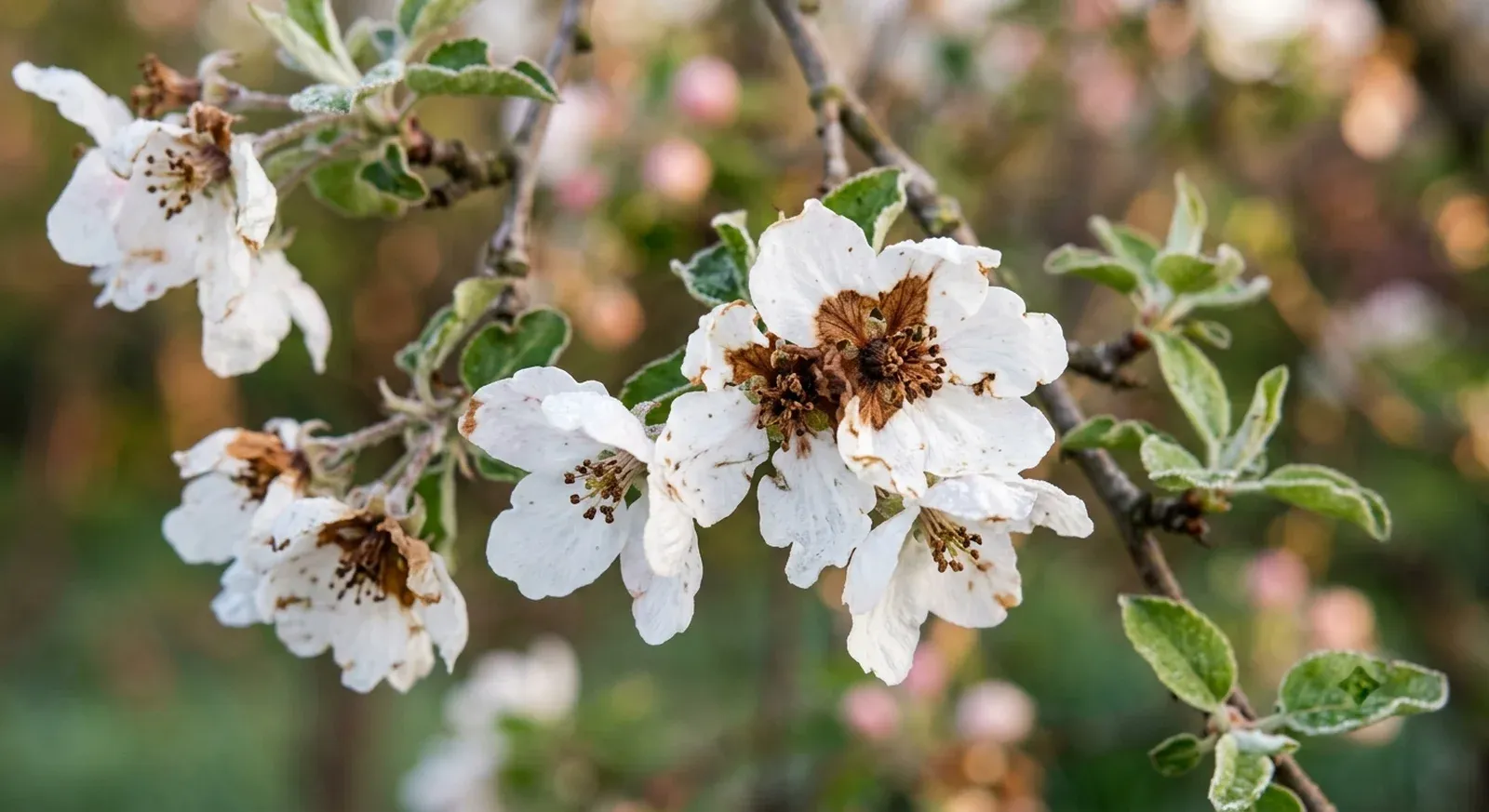
Most frost-tender vegetables are killed by a light frost at 31–33°F (0 to −1°C). Basil is an exception: leaves blacken in the 40s°F (~4–9°C), well above freezing. For fruit trees, frost risk depends entirely on growth stage: early bud stages can survive well below freezing, but open blossoms on the same tree are killed around −2 to −3°C (27–28°F). The T10 and T90 columns below show exactly where 10% and 90% of buds are killed at each stage.
Frost damage is not a single number. It is a curve. Most gardening advice flattens it to something like “cover your tomatoes when frost is forecast,” which is correct but does not tell you much about what you stand to lose, or at what threshold you lose it.
For fruit trees, the research is more precise than most people realise. Washington State University and the FAO have published detailed bud kill temperatures by phenological growth stage: the T10/T90 framework established by Proebsting and Mills in 1978 and used by commercial fruit growers ever since. T10 is the temperature at which 10 percent of buds are killed after 30 minutes of exposure. T90 is where 90 percent are killed. The range between them is your risk window. A forecast just at T10 is a bad night; a forecast at T90 is a lost season.
The vegetable data is different in character. For most vegetables, the research does not produce precise kill curves. Extension services publish categorical thresholds: tender crops are damaged at 31–33°F (0 to −1°C), semi-hardy crops survive repeated light frosts, hardy crops tolerate hard freezes. These categories reflect decades of agronomic observation and are reliable, but they are ranges, not single-temperature thresholds. The tables below preserve that categorical precision rather than inventing fake decimal temperatures that would imply more precision than the data has.
There is also a distinction worth keeping in mind: frost damage and chilling injury are not the same thing. Frost damage requires ice to form in plant tissue. Chilling injury occurs at temperatures above freezing in cold-sensitive crops, through disruption of cell membrane function. Basil is the clearest example: it can be damaged in the 40s°F (4–9°C), temperatures where most gardeners would not even reach for the fleece.
Fruit Tree Critical Temperatures by Bud Stage
Deciduous fruit trees go through distinct phenological stages in spring, from dormant bud swell through to post-bloom. At each stage, the buds and flowers have a different capacity to resist frost. Early in the season, the tissues are still partially dormant and surprisingly hardy. By bloom, that hardiness is mostly gone.
The stage names below come from the WSU/Proebsting and Mills system, which is the standard used in most North American and international extension literature. Some stages have slightly different names between sources: WSU uses “silver tip” for apple, FAO uses “scales separate” for pear. Where WSU and FAO stage names overlap for the same crop, the rows are aligned.
Two separate sources, two separate columns. The WSU °F values and the FAO °C values in the tables below both originate from Proebsting and Mills (1978), but they were captured from different renderings of that dataset. They do not convert perfectly between each other. Do not assume that, for example, Apple full bloom T10 of 28°F converts to −2.9°C (the FAO figure): the FAO and WSU appear to use slightly different cultivar or exposure conditions in their tabulations. Both columns are reproduced here as-is from their respective primary sources.
Key: T10 = 10% bud kill after 30 min exposure. T90 = 90% bud kill after 30 min exposure.
Apple
| Growth Stage | T10 (°F) | T90 (°F) | T10 (°C) | T90 (°C) |
|---|---|---|---|---|
| Silver tip / Scales separate | 15 | 2 | −11.9 | −17.6 |
| Green tip | 18 | 10 | −7.5 | −15.7 |
| Half-inch green | 23 | 15 | −5.6 | −11.7 |
| Tight cluster | 27 | 21 | −3.9 | −7.9 |
| First pink | 28 | 24 | −2.8 | −5.9 |
| Full pink | 28 | 25 | −2.7 | −4.6 |
| First bloom | 28 | 25 | −2.3 | −3.9 |
| Full bloom | 28 | 25 | −2.9 | −4.7 |
| Post bloom | 28 | 25 | −1.9 | −3.0 |
°F source: WSU Crop Protection Guide / EB0913 (Proebsting & Mills 1978). °C source: FAO Table 4.7, Snyder & de Melo-Abreu 2005.
Pear
| Growth Stage | T10 (°F) | T90 (°F) | T10 (°C) | T90 (°C) |
|---|---|---|---|---|
| Buds opening / Scales separate | 15 | 0 | −8.6 | −17.7 |
| Blossom buds exposed | 20 | 6 | −7.3 | −15.4 |
| Tight cluster | 24 | 15 | −5.1 | −12.6 |
| First white | 25 | 19 | −4.3 | −9.4 |
| Full white | 26 | 22 | −3.1 | −6.4 |
| First bloom | 27 | 23 | −3.2 | −6.9 |
| Full bloom | 28 | 24 | −2.7 | −4.9 |
| Post bloom | 28 | 24 | −2.7 | −4.0 |
°F source: WSU Crop Protection Guide / EB0978 (Proebsting & Mills 1978). °C source: FAO Table 4.7, cv. Bartlett, Snyder & de Melo-Abreu 2005.
Sweet Cherry
| Growth Stage | T10 (°F) | T90 (°F) | T10 (°C) | T90 (°C) |
|---|---|---|---|---|
| First swelling / First swell | 17 | 5 | −11.1 | −17.2 |
| Side green | 22 | 9 | −5.8 | −13.4 |
| Green tip | 25 | 14 | −3.7 | −10.3 |
| Tight cluster | 26 | 17 | −3.1 | −7.9 |
| Open cluster | 27 | 21 | −2.7 | −6.2 |
| First white | 27 | 24 | −2.7 | −4.9 |
| First bloom | 28 | 25 | −2.8 | −4.1 |
| Full bloom | 28 | 25 | −2.4 | −3.9 |
| Post bloom | 28 | 25 | −2.2 | −3.6 |
°F source: WSU Crop Protection Guide / EB1128 (Proebsting & Mills 1978). °C source: FAO Table 4.7, cv. Bing, Snyder & de Melo-Abreu 2005.
Sour Cherry (Tart Cherry)
Sour cherry data comes from Michigan State University researchers, confirmed via the Colorado State University Western Colorado Research Center bulletin. FAO Table 4.7 covers sweet cherry only; no FAO °C equivalent exists for sour cherry.
| Growth Stage | T10 (°F) | T90 (°F) |
|---|---|---|
| Bud swell (first swell) | 15 | 0 |
| Side green | 24 | 10 |
| Green tip | 26 | 22 |
| Tight cluster | 26 | 24 |
| Open cluster | 28 | 24 |
| First white | 28 | 24 |
| First bloom | 28 | 24 |
| Full bloom | 28 | 24 |
| Post bloom | 28 | 25 |
°F source: MSU Extension (Longstroth), confirmed via H.J. Larsen / CSU WCRC bulletin.
Peach
| Growth Stage | T10 (°F) | T90 (°F) | T10 (°C) | T90 (°C) |
|---|---|---|---|---|
| First swelling / First swell | 18 | 1 | −7.4 | −17.9 |
| Calyx green | 21 | 5 | −6.1 | −15.7 |
| Calyx red | 23 | 9 | −4.8 | −14.2 |
| First pink | 25 | 15 | −4.1 | −9.2 |
| First bloom | 26 | 21 | −3.3 | −5.9 |
| Full bloom / Late bloom | 27 | 24 | −2.7 | −4.9 |
| Post bloom | 28 | 25 | −2.5 | −3.9 |
°F source: WSU Crop Protection Guide / EB0914 (Proebsting & Mills 1978). °C source: FAO Table 4.7, cv. Elberta, Snyder & de Melo-Abreu 2005.
Apricot
Apricot blooms early, often before the last frost date, which makes it particularly vulnerable. The T90 for the first swelling stage was not reported in the WSU source table.
| Growth Stage | T10 (°F) | T90 (°F) | T10 (°C) | T90 (°C) |
|---|---|---|---|---|
| First swelling | 15 | — | — | — |
| Tip separates | 20 | 0 | −4.3 | −14.1 |
| Red calyx | 22 | 9 | −6.2 | −13.8 |
| First white | 24 | 14 | −4.9 | −10.3 |
| First bloom | 25 | 19 | −4.3 | −10.1 |
| Full bloom | 27 | 22 | −2.9 | −6.4 |
| In the shuck / In shuck | 27 | 24 | −2.6 | −4.7 |
| Green fruit | 28 | 25 | −2.3 | −3.3 |
°F source: WSU Crop Protection Guide / EB1240 (Proebsting & Mills 1978). °C source: FAO Table 4.7, Snyder & de Melo-Abreu 2005.
Plum
Labeled “Plum (Prune)” in WSU source. FAO Table 4.7 labels the equivalent as “Prunes (Italian)”.
| Growth Stage | T10 (°F) | T90 (°F) | T10 (°C) | T90 (°C) |
|---|---|---|---|---|
| First swelling / First swell | 17 | 3 | −11.1 | −17.2 |
| Side white | 20 | 7 | −8.9 | −16.9 |
| Tip green | 24 | 16 | −8.1 | −14.8 |
| Tight cluster | 25 | 20 | −5.4 | −11.7 |
| First white | 26 | 22 | −4.0 | −7.9 |
| First bloom | 27 | 23 | −4.3 | −8.2 |
| Full bloom | 28 | 23 | −3.1 | −6.0 |
| Post bloom | — | — | −2.6 | −4.3 |
°F source: WSU Crop Protection Guide (Proebsting & Mills 1978). °C source: FAO Table 4.7, cv. Italian Prune, Snyder & de Melo-Abreu 2005.
Blueberry
Blueberry data comes from two sources. FAO Table 4.9 (Powel & Himelrick 2000, cited in Snyder & de Melo-Abreu 2005) reports T90 values only in °C. Penn State Extension (Demchak) reports critical temperature ranges in °F, where the lower bound approximates T10 and the upper bound approximates T90. These are not strict T10/T90 values in the Proebsting and Mills sense.
| Growth Stage | Range (°F) | T90 (°C) |
|---|---|---|
| Bud swell / Swelled flower buds | 15–20 | −6.1 |
| Tight cluster (flowers together) | 18–23 | — |
| Individual flowers distinguishable | — | −3.9 |
| Flower buds separated | 22–25 | — |
| Flowers closed, corollas expanded | — | −2.2 |
| Full size closed flowers | 25–26 | — |
| Open blossoms / Fully opened | 27 | −0.6 |
| Petal fall (most tender stage) | 28 | — |
°F source: Penn State Extension, Demchak (referencing MSU blueberry data). °C source: FAO Table 4.9, Snyder & de Melo-Abreu 2005.
Strawberry
Strawberry data comes from Penn State Extension (Demchak, citing NC State). The FAO Table 4.9 records T90-only values in °C from Powel & Himelrick (2000). Penn State reports single critical temperatures per stage rather than T10/T90 ranges.
| Growth Stage | Critical Temp (°F) | T90 (°C) |
|---|---|---|
| Flower buds emerging from crown | 10 | — |
| Tight bud | — | −5.6 |
| Blossoms tightly closed | 22 | — |
| Tight with white petals | — | −2.2 |
| Popcorn stage (closed, petals visible) | 26 | — |
| Open bloom / Full bloom | 30 | −0.6 |
| Young green fruit / Immature fruit | 28 | −2.2 |
°F source: Penn State Extension, Demchak (citing NC State). °C source: FAO Table 4.9, Snyder & de Melo-Abreu 2005.
Raspberry, Gooseberry, Blackcurrant
No formal T10/T90 tables exist in the published literature for these crops. Penn State Extension field observations suggest open raspberry blossoms are damaged when temperatures drop barely below freezing (30–32°F / −0.5 to 0°C). Blackcurrant research (unnamed study, ~1979–1980) reported killing at −3.3, −4.5, and −5.2°C across grape stage to full flower, but not as a T10/T90 table. No kill-percentage data was found for gooseberry in WSU, MSU, FAO, or AHDB sources.
Vegetable Frost Tolerance
Vegetable frost tolerance data is categorical rather than precise. Extension research classifies crops into groups based on the temperature range at which damage occurs, not single-degree thresholds. The table below preserves those categories. Converting “light frost tolerant” into a fake decimal temperature would overstate the precision of the data.
A few things to keep in mind before reading the table:
- Foliage vs. storage organ. Potato foliage is killed by frost at 32°F (0°C), but tubers in the ground survive if the frost is brief. The foliage can regrow. Carrots and parsnips behave similarly: the tops may die but the roots survive.
- Chilling injury vs. frost damage. Basil, tomatoes, peppers, courgettes, and cucumbers are damaged by cold above freezing. The basil finding is the most striking: leaves can blacken in the 40s°F (roughly 4–9°C). This is not frost. It is chilling injury from cold-sensitive cell membranes. The RHS confirms that all tender crops are vulnerable to chilling below about 12°C (54°F).
- Hardy crops improve with frost. Parsnips, Brussels sprouts, and kale develop better flavour after frost. The cold converts starches to sugars. These are not just tolerant; they are improved by the experience.
Tender crops (no frost tolerance)
These crops are killed or severely damaged by any frost at 31–33°F (0 to −1°C). Bring them in or cover them before the first forecast frost.
| Crop | Damage Threshold | Notes | Primary Source |
|---|---|---|---|
| Tomato | 31–33°F (0 to −1°C) | Foliage killed; fruit becomes water-soaked on thawing. Also suffers chilling injury below 12°C (54°F) | NC State Extension; RHS |
| Pepper | 31–33°F (0 to −1°C) | No frost tolerance; pericarp becomes dead and water-soaked after freezing | NC State Extension; SDSU Extension |
| Aubergine / Eggplant | 31–33°F (0 to −1°C) | No frost tolerance; protect or harvest before any light frost | NC State Extension; SDSU Extension |
| French bean / Snap bean | 31–33°F (0 to −1°C) | Severely injured by even a light frost; also chilling-sensitive below 12°C (54°F) | NC State Extension; Purdue Extension |
| Runner bean | 31–33°F (0 to −1°C) | Chilling injury below 12°C (54°F); foliage killed at any frost | RHS; NC State Extension |
| Courgette / Zucchini | 31–33°F (0 to −1°C) | Chilling injury below 12°C (54°F); foliage killed at any frost | NC State Extension; RHS |
| Cucumber | 31–33°F (0 to −1°C) | Chilling injury below 12°C (54°F) | NC State Extension; RHS |
| Sweetcorn | 31–33°F (0 to −1°C) | Frost injures at any growth stage; hard freeze threshold ~28–30°F (−2 to −1°C) | NC State Extension |
| Pumpkin / Winter squash | 31–33°F (0 to −1°C) | May tolerate very light frost if daytime temps reach 70°F (21°C)+; better to protect | SDSU Extension |
| Potato (foliage) | Below 32°F (0°C) | Foliage frost-tender; tubers may survive and regrow. Tubers show grey-blue freeze injury under skin | NC State Extension; Purdue Extension |
| Basil | Chilling injury in 40s°F (~4–9°C) | Leaves blacken above freezing. Most cold-sensitive common herb. Keep above 10°C (50°F) nights | SDSU Extension; RHS |
Half-hardy crops (light frost tolerant)
These crops survive light frosts at 28–32°F (−2 to 0°C) but are damaged or killed by harder freezes.
| Crop | Damage Threshold | Notes | Primary Source |
|---|---|---|---|
| Lettuce | Survives 28–32°F (−2 to 0°C); damaged below 26–28°F (−3 to −2°C) | Outer leaves blister and tan; increased decay risk after hard freeze | SDSU Extension; NC State Extension |
| Beetroot / Beet | Survives repeated light frosts 30–32°F (−1 to 0°C) | External and internal water-soaking at hard freeze; foliage may die, root survives briefly | SDSU Extension; NC State Madison |
| Carrot | Survives 28–32°F (−2 to 0°C) light frost; root hardy below 28°F | Foliage may be damaged; root in soil survives harder frost. Jagged cracks and water-soaking if frozen solid | SDSU Extension; NC State |
| Celery | Tolerates light frost; damaged by moderate frost | Petioles freeze more readily than leaves; wilting and water-soaking on thaw | Cornell CCE; Purdue Extension |
| Coriander / Cilantro | Tolerates light frost; killed as annual by hard frost | RHS rates species H5 for overwintering seeds, but leafy crop behaves as a frost-killed annual | Cornell CCE; RHS |
Hardy crops (moderate frost tolerant)
These crops tolerate hard frosts and freezes. Most survive 25–28°F (−4 to −2°C) and some go below.
| Crop | Damage Threshold | Notes | Primary Source |
|---|---|---|---|
| Spinach | Survives below 26°F (−3°C) hard freeze | Among the most cold-hardy salad crops | NC State Extension; SDSU Extension |
| Broccoli | Tolerates 24–28°F (−4 to −2°C); survives 25–28°F hard freeze | Centre florets most sensitive; brown discolouration and strong odour after thawing | SDSU Extension; Cornell CCE |
| Pea | Survives 28–32°F (−2 to 0°C); tolerates hard frost for limited period | Direct sow several weeks before last frost date | SDSU Extension; NC State Extension |
| Parsley | Survives below 26°F (−3°C); withstands 25–28°F hard freeze | One of the hardiest herbs | NC State Extension; Cornell CCE |
| Broad bean / Fava | RHS H4: survives −10 to −5°C (14 to 23°F) | Autumn-sown hardy varieties overwinter successfully in mild climates | RHS plant database |
Very hardy crops
Kale, Brussels sprouts, parsnips, and leeks are among the hardiest vegetables commonly grown. No formal T10/T90 data exists for these crops, but multiple extension sources confirm they survive well below 26°F (−3°C) and often benefit from frost. Parsnips are typically left in the ground and harvested after frost. Kale flavour improves markedly after the first hard freeze. Brussels sprouts are routinely harvested through winter in temperate climates with repeated frosts.
Methodology Note
What T10 and T90 mean. Both thresholds are based on 30-minute exposure to the stated temperature. A briefer frost may cause less damage; a longer one may cause more. The values represent the temperature at which 10% (T10) or 90% (T90) of buds are expected to be killed in that window. They are population-level probabilities across a cultivar, not individual-bud certainties.
Why WSU °F and FAO °C values do not convert perfectly. Both sets of values trace back to Proebsting and Mills (1978), “Low Temperature Resistance of Developing Flower Buds of Six Deciduous Fruit Species,” JASHS 103(2):192-198. However, the WSU extension bulletins and the FAO manual appear to draw on slightly different representations of that dataset, possibly reflecting different cultivar averages, slightly different rounding, or different table formatting in the original publication. The WSU °F table and FAO °C table are kept as separate columns here rather than merging them via direct unit conversion, which would introduce false precision.
Sour cherry source difference. Sour/tart cherry T10/T90 data comes from MSU researchers (via Longstroth and confirmed by the CSU Western Colorado Research Center bulletin), not from WSU or FAO. FAO Table 4.7 covers sweet cherry only.
Blueberry and strawberry. These crops use different source structures. The FAO Table 4.9 (citing Powel & Himelrick 2000) gives T90-only values in °C. Penn State Extension (Demchak) gives critical temperature ranges in °F for blueberry and single critical temperatures per stage for strawberry. These are consistent with the T10/T90 concept but are not derived from the Proebsting and Mills methodology.
Vegetable categorical data. The vegetable table reflects the classification systems used by NC State Extension, SDSU Extension, Purdue Extension, Cornell CCE, and the RHS. These systems group crops into frost tolerance categories based on agronomic observation, not controlled kill experiments. Converting these categories into false-precision decimal temperatures would misrepresent the underlying data. The categories are: tender (killed at 31–33°F / 0 to −1°C), half-hardy (survives light frost at 28–32°F / −2 to 0°C), hardy (tolerates hard frost to 25–28°F / −4 to −2°C), and very hardy (survives below −3°C / 27°F).
Basil chilling injury. The observation that basil leaves blacken in the 40s°F (~4–9°C) comes from SDSU Extension and is corroborated by RHS guidance that heat-loving crops including basil need nights above 10°C (50°F) to avoid chilling injury. This is genuinely distinct from frost: the damage mechanism is membrane disruption at cold temperatures, not ice crystal formation.
Sources
- WSU Crop Protection Guide, Critical Temperatures: cpg.treefruit.wsu.edu/critical-temperatures/. T10/T90 tables in °F for apple (EB0913), pear (EB0978), sweet cherry (EB1128), peach (EB0914), apricot (EB1240). Reproduces Proebsting & Mills 1978; confirmed by PSU Extension (Oct 2017) and MSU Extension.
- FAO Frost Protection Manual: Snyder, R.L. and de Melo-Abreu, J.P. (2005). Frost Protection: Fundamentals, Practice and Economics, Vol. 1. FAO, Rome. ISBN 92-5-105189-2. Tables 4.7 (deciduous tree fruits, °C) and 4.9 (small fruits, °C). Available at fao.org/4/y7223e/y7223e0a.htm.
- Proebsting, E.L. Jr. and Mills, H.H. (1978): “Low Temperature Resistance of Developing Flower Buds of Six Deciduous Fruit Species.” Journal of the American Society for Horticultural Science 103(2):192–198. Primary dataset underlying both WSU and FAO tables.
- MSU Extension, Mark Longstroth: Critical spring temperatures for tree fruit bud stages, including sour/tart cherry. Referenced in H.J. Larsen, CSU Western Colorado Research Center bulletin: webdoc.agsci.colostate.edu/aes/wcrc/techbulletins/budstagestarcherry.pdf.
- Penn State Extension, Kathy Demchak: “Frost and Freeze Damage on Berry Crops.” Blueberry and strawberry critical temperature ranges. extension.psu.edu/frost-and-freeze-damage-on-berry-crops/.
- NC State Extension: Frost and freeze protection for vegetable crops, tender/semi-hardy/hardy classifications. vegetables.ces.ncsu.edu/news/frost-and-freeze-protection-for-vegetable-crops/ and madison.ces.ncsu.edu/news/how-do-i-protect-my-garden-from-frost/.
- SDSU Extension: Fall frost tolerance of common vegetables, specific °F thresholds per crop. extension.sdstate.edu/fall-frost-tolerance-common-vegetables.
- Purdue Extension HO-203-W: Freeze injury symptoms per vegetable crop. extension.purdue.edu/extmedia/ho/ho-203-w.pdf.
- Cornell CCE Warren County: Hard freeze temperature ranges for vegetables. warren.cce.cornell.edu/gardening-landscape/warren-county-master-gardener-articles/fall-planting-for-the-vegetable-garden.
- Cornell Home Gardening: Celery and coriander frost tolerance. gardening.cornell.edu.
- RHS: Tender crops chilling threshold (12°C), hardiness ratings (H2–H5), planting-out guidance. rhs.org.uk/advice/grow-your-own/features/tender-crops and rhs.org.uk/garden-jobs/when-to-plant-out-tender-plants-avoiding-late-frosts.
Cite This Data
Leaftide’s original compilation, article text, and vegetable reference section are published under Creative Commons Attribution 4.0 (CC BY 4.0). The fruit bud stage T10/T90 values in the tables above are derived from WSU Extension Bulletins and the FAO Frost Protection Manual; those values remain attributed to their respective sources per table and are not relicensed.
How to cite: Leaftide (2026). “Frost Damage Temperatures for Fruit Trees and Vegetables.” Retrieved from https://leaftide.com/learn/frost-damage-temperatures/. Fruit T10/T90 data from WSU Extension Bulletins (Proebsting & Mills 1978) and FAO Frost Protection Manual (Snyder & de Melo-Abreu 2005). Vegetable thresholds from NC State, Cornell CCE, SDSU, Purdue Extension, and RHS.
Last updated: 27 September 2026.
For related reference data, see the chill hours guide and the last frost date guide.