| Apple rootstock | Final height | Spacing | Best for |
|---|---|---|---|
| M27 (very dwarf) | 1.5-2m | 1.5-2m | Pots, tiny gardens |
| M9 (dwarf) | 2-3m | 2.5-3m | Small gardens |
| M26 (semi-dwarf) | 3-4m | 3-4m | Most home orchards |
| MM106 (semi-vigorous) | 4-5m | 4-5m | Larger gardens |
| M25 (vigorous) | 5-8m | 6-8m | Meadow orchards |
When I bought my first apple tree, I picked it because I liked the variety. Cox’s Orange Pippin. I did not think about rootstock at all. The label said “MM106” and I had no idea what that meant. I planted it in a small bed near the house, assuming it would stay manageable.
It did not stay manageable. That tree is now taller than my shed and wider than the bed it lives in. It fruits well, but I have to prune it hard every year just to keep it from swallowing the path. The variety was right. The rootstock was wrong for the space I had.
Rootstock matters more than variety when buying a fruit tree, and it is the decision most people skip entirely. This guide covers what rootstock actually does, what the common options are, and how to pick the right one for your garden.
What rootstock actually is
Every fruit tree you buy from a nursery is two trees joined together. The top part, the scion, is the variety you want to eat: Bramley, Victoria, Conference. The bottom part, the rootstock, is a completely different tree chosen for its root characteristics.
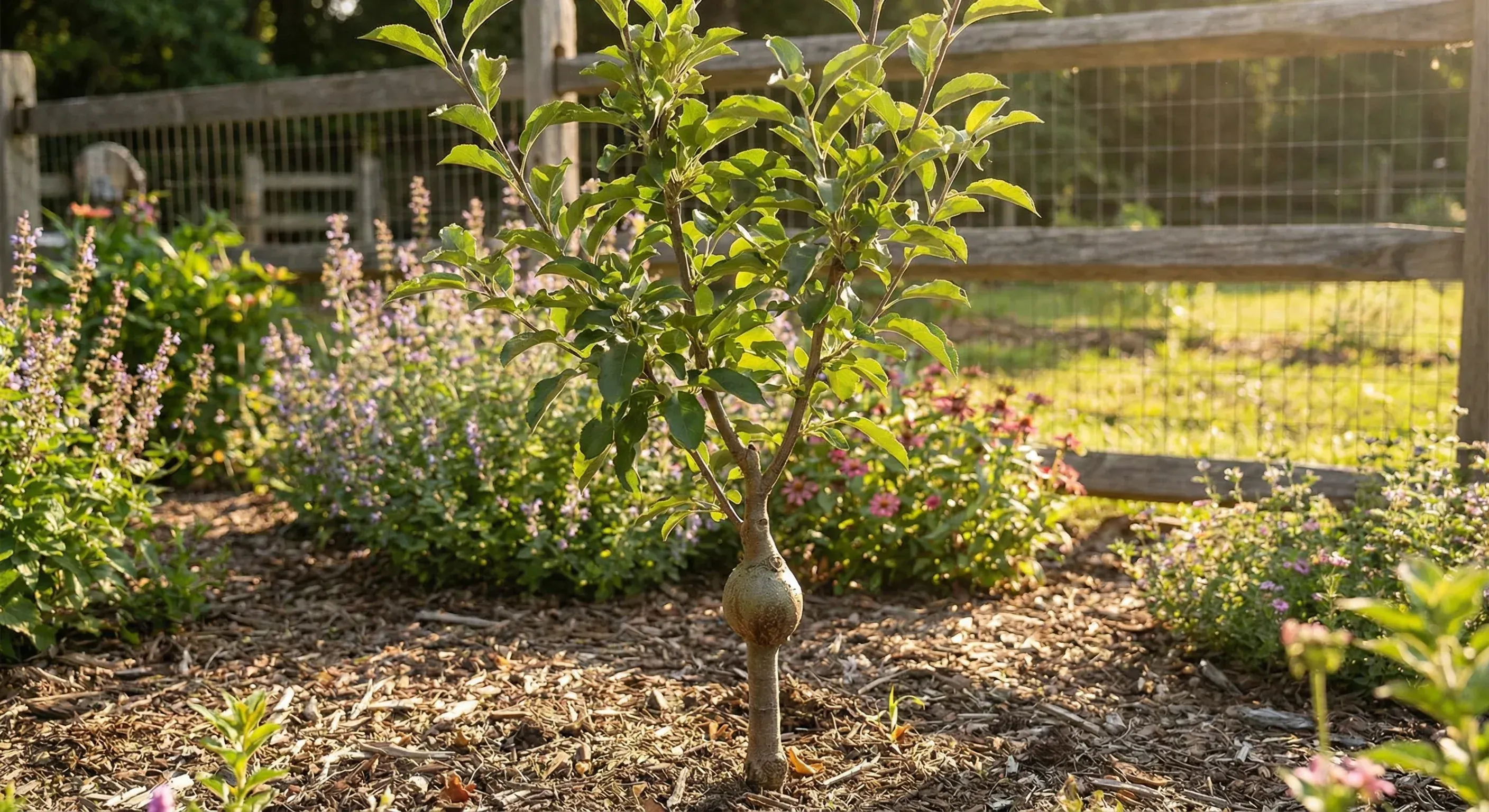
The graft union, a slight bulge near the base of the trunk, is where the two meet. Everything above it is your chosen variety. Everything below it is the rootstock, quietly determining how big the tree gets and how it copes with your soil.
Why not just grow fruit trees on their own roots? Because most fruit varieties on their own roots produce enormous trees that take years to fruit. A Cox apple on its own roots would become a 10-metre tree. The same Cox grafted onto M26 rootstock stays at 3-4 metres. Same fruit, completely different tree.
Nurseries have been doing this for centuries. The rootstock controls the vigour. The scion provides the fruit. Together, they give you a tree suited to your garden rather than a commercial orchard from the 1800s.
Why rootstock choice matters
The rootstock you choose affects almost everything about how your tree behaves:
Final size. This is the most obvious effect. A dwarfing rootstock produces a small tree. A vigorous rootstock produces a large one. The same variety on different rootstocks can range from 1.5 metres to 8 metres tall. If you have a small garden, getting this wrong means years of aggressive pruning or, eventually, removing the tree entirely. The spacing guide covers how to match rootstock to available space.
Time to first fruit. Dwarfing rootstocks generally fruit earlier, sometimes in the second or third year. Vigorous rootstocks can take five to eight years before they produce a meaningful crop. If you want fruit quickly, rootstock choice matters more than variety.
Staking requirements. Dwarf trees have small root systems. They cannot anchor themselves properly and need permanent staking for their entire life. Semi-vigorous and vigorous trees can support themselves after the first few years. This is a practical consideration that affects maintenance and cost.
Soil tolerance. Some rootstocks cope better with heavy clay, poor drainage, or thin soil. If your garden has difficult ground, the right rootstock makes a real difference. The wrong one and you will be fighting the tree for years.
Disease resistance. Certain rootstocks offer resistance to specific problems. Some apple rootstocks tolerate woolly aphid. Some are more resistant to collar rot in wet soils. This matters less in a home garden than a commercial orchard, but it is worth knowing.
Rootstock is a decision you make once and live with for decades.


Apple rootstocks explained
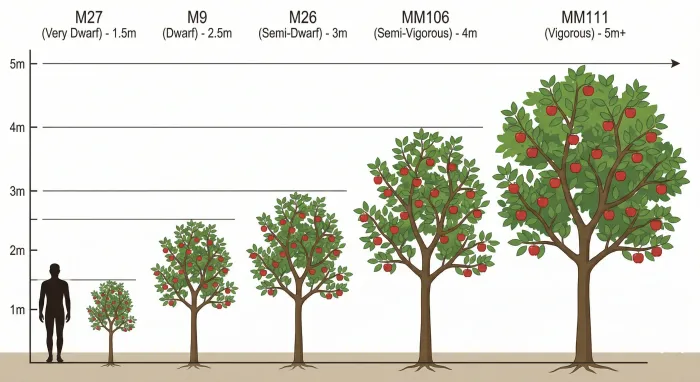
Apples have the widest range of rootstocks, developed over decades at research stations like East Malling in Kent. The “M” and “MM” numbers refer to Malling and Malling-Merton series.
M27 (very dwarf)
Final height: 1.5-2 metres. The smallest apple rootstock commonly available. Trees on M27 are essentially bushes. They fruit quickly, often in the second year, but produce small crops. They need permanent staking, excellent soil, and regular watering. Best for containers or very tight spaces. Not forgiving of neglect.
M9 (dwarf)
Final height: 2-3 metres. The standard commercial rootstock for intensive orchards. Trees fruit early and heavily for their size. They need permanent staking and good soil. M9 does not tolerate poor drainage or competition from grass. In a home garden, this works well if you can give it the attention it needs. Not a plant-and-forget option.
M26 (semi-dwarf)
Final height: 3-4 metres. This is the rootstock I recommend most often for home gardens. It produces a manageable tree that starts fruiting after two or three years, according to the RHS. It needs staking for the first few years but can usually support itself once established. More tolerant of average soil than M9. A solid middle ground for most situations.
MM106 (semi-vigorous)
Final height: 4-5 metres. The classic garden apple rootstock. Trees on MM106 are substantial but not unmanageable with annual pruning. They tolerate a wider range of soils, including heavier clay. They take a little longer to fruit, typically three or four years according to the RHS, but produce good crops once established. This is what my Cox is on, and it would have been perfect if I had given it more space.
MM111 (vigorous)
Final height: 5-8 metres. A large tree for orchards, meadows, or big gardens. Trees on MM111 are robust and long-lived. They tolerate poor soil and drought better than dwarfing stocks. But they take longer to fruit and need significant space. Unless you have room for a proper orchard tree, this is probably more than you need.
Pear rootstocks
Pears have fewer rootstock options than apples. Most are grafted onto quince rootstock, which is a different species entirely.
Quince C (semi-dwarf)
Final height: 3-4 metres. The most dwarfing pear rootstock widely available. Produces compact trees that fruit relatively early. Needs good soil and does not tolerate heavy clay well. A good choice for smaller gardens.
Quince A (semi-vigorous)
Final height: 4-5 metres. The standard pear rootstock. More tolerant of average soil than Quince C. Produces a medium-sized tree that is manageable with pruning. Most pears from garden centres will be on Quince A.
Pyrus communis seedling (vigorous)
Final height: 6-10 metres. A full-sized pear tree. Long-lived and robust, but large. Used for standard trees in orchards or where you want a big specimen tree. Takes longer to fruit.
One complication with pears: some varieties are not compatible with quince rootstock and need an interstock, a short section of a compatible variety grafted between the rootstock and the scion. If you are buying a Williams or a Beurré Hardy, check with the nursery about compatibility.
Plum, cherry, and other stone fruit
Stone fruits have their own rootstock families, less standardised than apples but still important.
Plums
Pixy is the dwarfing option, producing trees of 2-3 metres. Good for small gardens but needs good soil and staking. St Julien A is semi-vigorous at 4-5 metres and tolerates a wider range of conditions. Most garden plums are on St Julien A.
Cherries
Gisela 5 changed home cherry growing completely by producing compact trees of 2.4-3 metres. Before Gisela rootstocks, cherries were enormous trees that needed ladders to pick. Colt is semi-vigorous at 3.5-4.5 metres and still common, but Gisela 5 is the better choice for most gardens.
Peaches and apricots
Usually grafted onto St Julien A (semi-vigorous) or Brompton (vigorous). Dwarfing options are limited. Container growing on St Julien A works for peaches in cooler climates where wall training or greenhouse growing is common.
How to choose the right rootstock
Start with your space. Measure the area where the tree will grow, not just the planting spot but the space it will occupy in ten years. A tree on MM106 needs a circle of about 4-5 metres diameter. A tree on M26 needs 3-4 metres. If you do not have the space, choose a more dwarfing stock. The Spacing Calculator can help you check whether a given rootstock fits your available area.
Soil matters too. Heavy clay, poor drainage, or thin chalky soil all favour more vigorous rootstocks that can cope with difficult conditions. Dwarfing rootstocks need good, well-drained soil to perform well. If your soil is challenging, going one size up from what you think you need is often wise.
Then there is maintenance. Dwarf trees need permanent staking, regular watering, and more attentive care. Semi-vigorous trees are more forgiving. If you want a tree you can largely leave alone after the first few years, avoid the most dwarfing options.
How patient are you? If you want fruit within two to three years, dwarfing rootstocks deliver faster. If you can wait five years for a larger, more productive tree, semi-vigorous stocks are worth the wait.
And talk to the nursery. Good fruit tree nurseries will ask about your garden before recommending a rootstock. If they do not ask, ask them. Tell them your space, soil type, and what you want from the tree. Their advice is usually sound. If space is very tight, consider espalier or cordon training on a dwarfing rootstock, which lets you grow fruit flat against a wall or fence.
Recording rootstock in your plant records
Rootstock is a one-time decision that you need to remember for the life of the tree. That label with “MM106” on it will fade. The receipt will get lost. And in five years, when someone asks why your tree is so vigorous, or when you are trying to figure out why it has not fruited yet, you will wish you had written it down.
I record rootstock for every fruit tree I plant. It goes into the tree’s profile alongside variety, source, and planting date. When I am troubleshooting a problem or planning where to put a new tree, knowing the rootstock tells me what to expect.
This is especially useful when you have multiple trees. If your M26 apple is fruiting well but your MM106 apple has not started yet, the rootstock explains why. If your Quince C pear is struggling in heavy clay while the Quince A pear next to it is thriving, the rootstock is the variable. Knowing the pollination group for each tree alongside the rootstock gives you the full picture when troubleshooting poor fruiting.
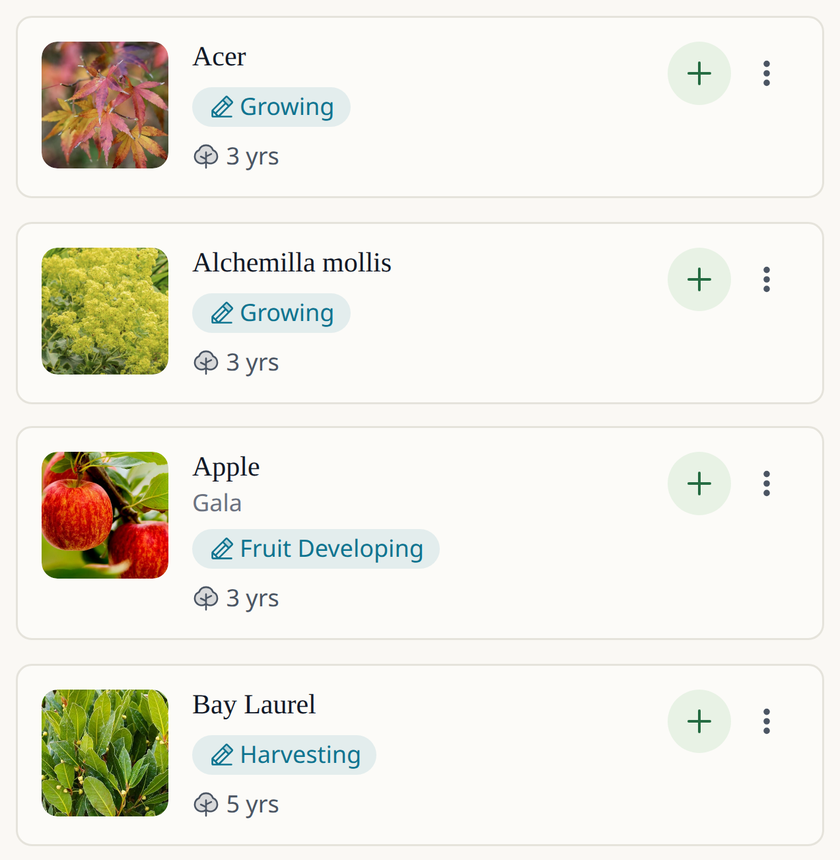
In Leaftide, each fruit tree is a permanent plant with its own profile. I add the rootstock when I create the entry, right from the nursery label. It stays there permanently, alongside the variety, planting date, and full care history. When I need to know what rootstock a tree is on, I do not have to dig through old receipts or squint at faded labels.
Your rootstock choice lasts decades. So should the record.
Quick reference
See the full verified rootstock reference tables below, compiled from RHS, East Malling Research, and PTES.
Rootstock reference tables
Data compiled from RHS, East Malling Research, PTES and Orange Pippin. Heights and spacings are mature tree estimates, actual size depends on soil, pruning, and training method.
Apple rootstocks
| Rootstock | Vigour | Final Height | Recommended Spacing | Needs Stake? | Years to First Crop | Notes |
|---|---|---|---|---|---|---|
| M27 | Dwarfing | 1.2m–1.8m (3.9ft–5.9ft) | 1.2m–1.5m (3.9ft–4.9ft) | Yes | 2 | Extremely dwarfing; needs fertile, weed-free soil and watering in drought. |
| M9 | Dwarfing | 1.8m–2.4m (5.9ft–7.9ft) | 2.4m–3.0m (7.9ft–9.8ft) | Yes | 2–3 | Most widely used commercial apple rootstock; brittle roots require permanent staking. |
| M26 | Semi-dwarfing | 2.4m–3.0m (7.9ft–9.8ft) | 2.4m–3.6m (7.9ft–11.8ft) | Yes | 2–3 | Good all-rounder for home gardens; susceptible to collar rot in wet soils. |
| MM106 | Semi-vigorous | 3.0m–4.0m (9.8ft–13.1ft) | 3.6m–4.0m (11.8ft–13.1ft) | No | 3–4 | Most widely used rootstock in Europe; unsuitable for small gardens. |
| MM111 | Vigorous | 4.0m–4.5m (13.1ft–14.8ft) | 4.5m–5.0m (14.8ft–16.4ft) | No | 4–5 | Robust on difficult sites (wind, drought); stake for 3 years if planting a 2–3-year-old tree. |
| M25 | Vigorous | 4.5m+ (14.8ft+) | 6.0m–7.0m (19.7ft–23.0ft) | No | 5–6 | Too vigorous for most gardens except poor soil; produces traditional large standard trees. |
Sources: RHS (rhs.org.uk/fruit/fruit-trees/rootstocks), PTES Traditional Orchard Project, Orange Pippin Trees, Keepers Nursery.
Pear rootstocks
| Rootstock | Vigour | Final Height | Recommended Spacing | Needs Stake? | Years to First Crop | Notes |
|---|---|---|---|---|---|---|
| Quince C | Semi-dwarfing | 2.5m–3.0m (8.2ft–9.8ft) | 2.5m–3.0m (8.2ft–9.8ft) | Yes | 4 | Best choice for small gardens; many varieties need a stem-builder interstock. |
| Quince A | Semi-vigorous | 3.0m–4.5m (9.8ft–14.8ft) | 3.0m–4.5m (9.8ft–14.8ft) | No | 4 | Most widely planted pear rootstock in the UK; some varieties need a stem-builder interstock. |
| Pyrodwarf | Semi-vigorous | 4.0m–4.5m (13.1ft–14.8ft) | 4.0m (13.1ft) | No | 4–5 | No graft incompatibility issues; tolerates chalk and alkaline soils better than quince rootstocks. |
| Kirchensaller / Kirkensaller† | Vigorous | 5.0m–7.0m (16.4ft–23.0ft) | 6.0m–7.0m (19.7ft–23.0ft) | No | 8–10 | Long-lived traditional orchard tree; spelling varies between German and UK nursery sources. |
Sources: RHS (rhs.org.uk/fruit/fruit-trees/rootstocks), PTES Traditional Orchard Project (Pyrodwarf, Kirchensaller/Kirkensaller), Orange Pippin Trees, Fairplant NL.
Plum rootstocks
| Rootstock | Vigour | Final Height | Recommended Spacing | Needs Stake? | Years to First Crop | Notes |
|---|---|---|---|---|---|---|
| Pixy | Semi-dwarfing | 2.5m–3.0m (8.2ft–9.8ft) | 3.0m (9.8ft) | Yes | 3–4 | Roughly equivalent to apple M26; needs weed-free ground and watering in dry conditions. |
| St Julien A | Semi-vigorous | 3.0m–3.5m (9.8ft–11.5ft) | 3.5m–4.0m (11.5ft–13.1ft) | No | 3–4 | Compatible with almost all plums, gages, damsons, apricots, peaches, and nectarines. |
| Brompton | Vigorous | 4.5m+ (14.8ft+) | 6.0m–7.0m (19.7ft–23.0ft) | No | 4–5 | Standard rootstock for full-sized plum trees; best for traditional orchards. |
| Myrobalan B† | Vigorous | 4.9m–6.0m (16.1ft–19.7ft) | 6.0m–7.0m (19.7ft–23.0ft) | No | 4–5 | Undemanding on soil quality; starts yielding later than St Julien A. |
Sources: RHS (rhs.org.uk/fruit/fruit-trees/rootstocks, rhs.org.uk/advice/beginners-guide/fruit-basics/rootstocks), Orange Pippin Trees (orangepippintrees.com/articles/fruit-tree-advice/rootstocks-for-plum-trees), PTES Traditional Orchard Project.
Cherry rootstocks
| Rootstock | Vigour | Final Height | Recommended Spacing | Needs Stake? | Years to First Crop | Notes |
|---|---|---|---|---|---|---|
| Gisela 5 | Semi-dwarfing | 2.4m–3.0m (7.9ft–9.8ft) | 2.7m–3.0m (8.9ft–9.8ft) | Yes | 3–4 | Most widely planted dwarfing cherry rootstock in Europe; best choice for garden cherry trees. |
| Gisela 6† | Semi-vigorous | 3.0m–4.0m (9.8ft–13.1ft) | 3.0m (9.8ft) | Unknown | 3–4 | Less fussy about soil conditions than Gisela 5; staking requirement not confirmed in primary sources. |
| Colt | Semi-vigorous | 3.5m–4.5m (11.5ft–14.8ft) | 4.0m–6.0m (13.1ft–19.7ft) | Yes | 3–4 | Tolerates poorer soils than Gisela 5; good compatibility with nearly all varieties. |
| F12/1 | Vigorous | 6.0m+ (19.7ft+) | 6.0m–7.5m (19.7ft–24.6ft) | No | 5–7 | Natural resistance to bacterial canker; traditional orchards only. |
Sources: RHS (rhs.org.uk/fruit/fruit-trees/rootstocks), PTES Traditional Orchard Project (F12/1), Orange Pippin Trees (orangepippintrees.com/articles/fruit-tree-advice/rootstocks-for-cherry-trees), Keepers Nursery.
† Medium confidence: height and spacing data extrapolated from secondary sources where no direct RHS or Keepers Nursery primary entry was found. Kirchensaller / Kirkensaller from PTES and Fairplant NL; Myrobalan B from Orange Pippin generic entry and Hrotkó (1999); Gisela 6 staking from Orange Pippin and PTES only.
Last updated: September 2026
How to cite: Leaftide (2026). Fruit Tree Rootstock Guide. leaftide.com/learn/fruit-tree-rootstock-guide/. Leaftide’s original compilation is licensed CC BY 4.0. Rootstock data compiled from RHS, East Malling Research, PTES, and Orange Pippin; those values are attributed to their respective sources and not relicensed.
Sources and further reading
For detailed rootstock information, these resources are authoritative:
Royal Horticultural Society:
- RHS: Growing Apples - Comprehensive guide to apple rootstock options
- RHS: Growing Pears - Pear rootstock guidance
- RHS: Growing Plums - Stone fruit rootstock options
Specialist Nurseries:
- Frank P Matthews - UK fruit tree nursery with rootstock guidance
- Orange Pippin Trees - Detailed rootstock descriptions and recommendations
Related articles:
- First Year Fruit Tree Care - What to do after planting
- How Long Until Fruit Trees Bear Fruit - Years to first fruit, full crop and productive life by species and rootstock
- Home Orchard Record Keeping - Building a complete orchard record
- Fruit Tree Pruning Logs - Recording your pruning history