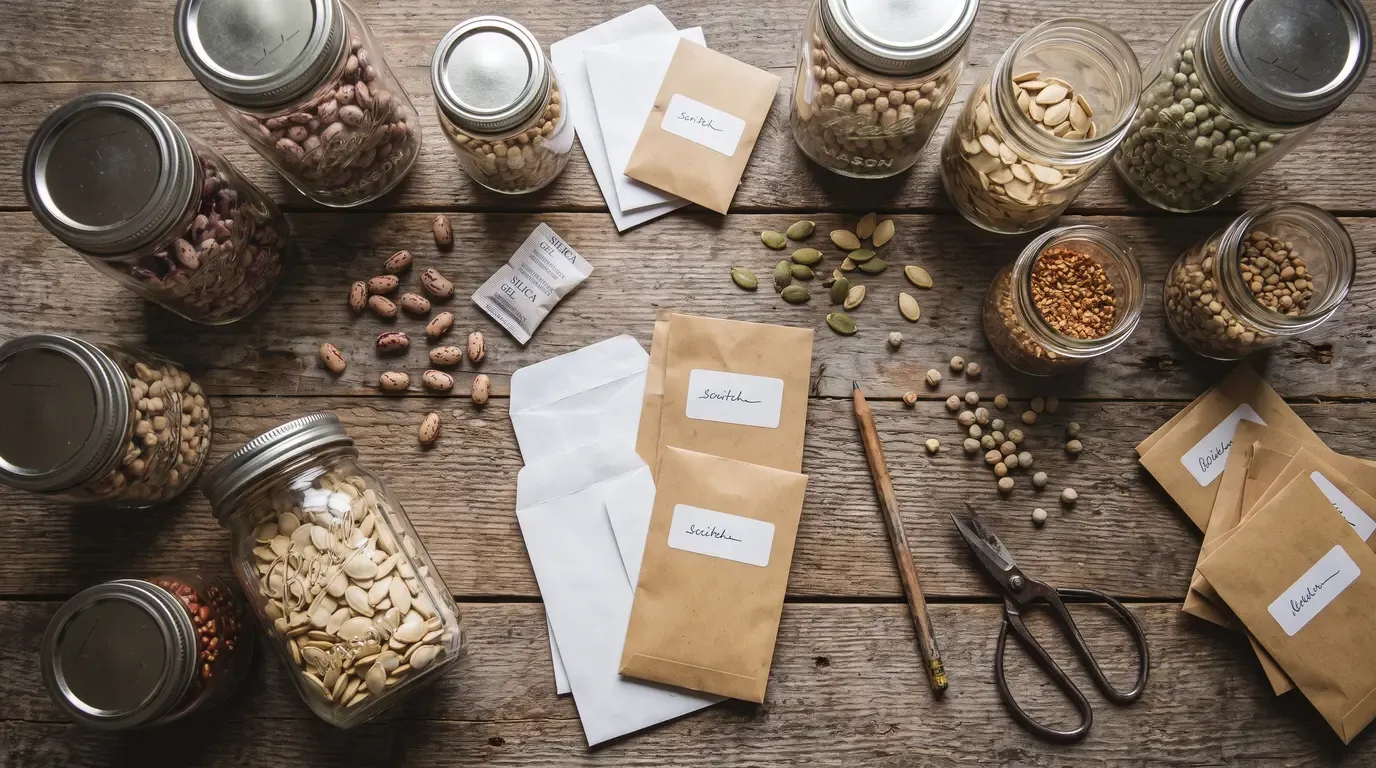
Most vegetable seeds stay usable for 1 to 6 years under favourable storage. Onion, parsley and parsnip seed is short-lived (about 1 year), while tomato, squash and cabbage seed keeps for about 4 years and cucumber seed for about 5 (Harrington and Minges, 1954). Germination drops gradually: in room storage at about 68 °F (20 °C) and 50% relative humidity, half the seeds had lost the ability to germinate after 4.6 years for lettuce and 13.9 years for pea (Nagel and Börner, 2010). Seed life roughly halves for each 9 °F (5 °C) rise in storage temperature and for each 1% rise in seed moisture content (Harrington, in Justice and Bass, 1978). Cool, dry, airtight storage keeps seed alive for longer.
Last updated: 21 October 2026.
Seed packets carry a “packed for” year, but seeds do not die on a date. Each seed lot loses germination along a curve, and the shape of that curve depends on the species and on how warm and how damp the seeds are kept.
This page brings together the numbers that sit behind the charts gardeners pass around. It covers 44 vegetables, 16 herbs and 45 flowers. Each figure names its source and year, and the full reference list is at the bottom.
If you are saving your own seed, the seed saving guide covers harvesting, cleaning and drying. If you are deciding when to sow, the seed starting indoors schedule covers timing.
Vegetable seed viability chart
The table gives four measures for each crop.
The first column is a widely reproduced chart. Knott’s Handbook for Vegetable Growers (6th edition, 2023, Table 2.6) prints it as “adapted from” a 1954 University of California leaflet by J. F. Harrington and P. A. Minges. It gives the approximate number of years seed keeps under favourable storage.
The second column comes from Colorado State University Extension fact sheet 7.221 (Ells, Bass and Whiting; first published 1992, reviewed 2025). It mostly matches the 1954 chart, but it differs for lettuce and radish.
The third column is the USDA relative storability index from Justice and Bass (1978), Principles and Practices of Seed Storage, Agriculture Handbook 506. The classes are relative ratings for seed of high viability and vigour, and the authors say they do not refer to specific years of storage. Class 1 means 50% or more of the seeds germinate after 1 to 2 years. Class 2 means 50% or more germinate after 3 to 5 years. Class 3 means 50% or more germinate after 5 or more years. The classes assume favourable ambient storage at latitudes of about 35° to 48° N.
The fourth column is the federal germination standard for vegetable seed in interstate commerce (7 CFR 201.31). Packets of 1 pound or less that germinate below it must be labelled “Below Standard” and show their germination percentage (7 CFR 201.29). The standard gives a benchmark for judging an old packet after a germination test.
| Vegetable | Years, Harrington and Minges (1954), as adapted in Knott’s (2023) | Years, Colorado State Univ. Ext. 7.221 | USDA storability class, Justice and Bass (1978) | US germination standard (7 CFR 201.31) |
|---|---|---|---|---|
| Asparagus | 3 | 3 | 1 | 70% |
| Bean (garden) | 3 | 3 | 1 | 70% |
| Beet (beetroot) | 4 | 4 | 3 | 65% |
| Broccoli | 3 | 3 | 2 | 75% |
| Brussels sprouts | 4 | 4 | 2 | 70% |
| Cabbage | 4 | 4 | 2 | 75% |
| Cardoon | 5 | not listed | 1 | 60% |
| Carrot | 3 | 3 | 2 | 55% |
| Cauliflower | 4 | 4 | 2 | 75% |
| Celeriac | 3 | 3 | 2 | 55% |
| Celery | 3 | 3 | 2 | 55% |
| Chard, Swiss | 4 | 4 | not listed | 65% |
| Chicory | 4 | 4 | 2 | 65% |
| Chinese cabbage | 3 | 3 | 2 | 75% |
| Collards | 5 | not listed | 2 | 80% |
| Corn salad (mâche) | 5 | not listed | not listed | 70% |
| Cress, garden | 5 | not listed | 2 | 75% |
| Cucumber | 5 | 5 | 2 | 80% |
| Dandelion | 2 | not listed | 1 | 60% |
| Eggplant (aubergine) | 4 | 4 | 2 | 60% |
| Endive | 5 | 5 | 2 | 70% |
| Kale | 4 | 4 | 2 | 75% |
| Kohlrabi | 3 | 3 | 2 | 75% |
| Leek | 2 | 2 | 1 | 60% |
| Lettuce | 6 | 1 | 1 | 80% |
| Muskmelon (cantaloupe) | 5 | 5 | 2 | 75% |
| Mustard (India) | 4 | not listed | 2 | 75% |
| New Zealand spinach | 3 | 3 | 2 | 40% |
| Okra | 2 | 2 | 2 | 50% |
| Onion | 1 | 1 | 1 | 70% |
| Parsley | 1 | 1 | 1 | 60% |
| Parsnip | 1 | 1 | 1 | 60% |
| Pea | 3 | 3 | 2 | 80% |
| Pepper | 2 | 2 | 1 | 55% |
| Pumpkin | 4 | 4 | 2 | 75% |
| Radish | 5 | 4 | 2 | 75% |
| Rutabaga (swede) | 4 | 4 | 2 | 75% |
| Salsify | 1 | 1 | 1 | 75% |
| Spinach | 3 | 3 | 2 | 60% |
| Squash | 4 | 4 | 2 | 75% |
| Sweet corn | 2 | 2 | 2 | 75% |
| Tomato | 4 | 4 | 3 | 75% |
| Turnip | 4 | 4 | 2 | 80% |
| Watermelon | 4 | 4 | 2 | 70% |
“Not listed” means that source does not include the crop. The Harrington and Minges numbers are as adapted in Knott’s Handbook (2023); the 1954 leaflet itself is not available online.
The first three measures agree on the short-lived crops. Onion, parsley, parsnip and salsify score 1 year or class 1 in every source. Leek and pepper score 2 years or class 1 in every source.
Lettuce is the largest disagreement. Harrington and Minges (1954) give lettuce 6 years. Colorado State University Extension gives lettuce 1 year, and Justice and Bass (1978) put lettuce in class 1 (50% or more germinate after 1 to 2 years). A seed bank study using a different measure, the time to 50% germination, found 4.6 years for lettuce in room storage (Nagel and Börner, 2010).
How fast seed germination declines with age
The “years” in the chart above are a single cut-off. Seed bank research measures the whole decline instead, usually as the half-viability period (P50): the time until only 50% of the seeds germinate.
The table below compares four studies. They used very different storage conditions, which is why the numbers differ so much.
- Room storage, Germany (Nagel and Börner, 2010): seeds were kept in paper bags at 20.3 ± 2.3 °C (about 68 °F) and 50.5 ± 6.3% relative humidity for up to 26 years at the IPK genebank in Gatersleben. This is the closest match to a seed box kept indoors.
- Open storage, 13 temperate sites (Priestley, Cullinan and Wolfe, 1985): the authors re-analysed published storage records from 13 stations in Europe, North America, Australia and Russia, using only seed lots that started at 90% germination or more. The figure is the paper’s estimate of what the average P50 would be across all 13 sites; for many crops it rests on 1 to 3 sites, and values from a single site are marked †.
- Laboratory storage, Cheyenne, Wyoming (James et al., 1964): these are documented long survivals, reported in Justice and Bass (1978, Table 29) as germination after a stated number of years.
- USDA genebank (Walters, Wheeler and Grotenhuis, 2005): these seeds were stored cold, at 5 °C (41 °F) until 1978 and at -18 °C (0 °F) after that. This shows what cold storage can achieve. Where germination was still above 50% at the last test (marked ‡), the P50 is a fitted estimate that runs past the observed storage period.
| Vegetable | P50 in room storage, years (Nagel and Börner, 2010) | P50 in open storage, years (Priestley et al., 1985) | Germination after long laboratory storage (James et al., 1964) | P50 in cold genebank storage, years (Walters et al., 2005) |
|---|---|---|---|---|
| Bean (Phaseolus vulgaris) | 9.8 | 16.0 | n/a | 31 |
| Beet (Beta vulgaris, species level) | n/a | 16.5 | n/a | 42 |
| Broad bean (Vicia faba) | n/a | 15.6 | n/a | n/a |
| Cabbage family (Brassica oleracea) | 7.3 (collards) | 7.2 | n/a | 23 |
| Carrot | 6.1 | 6.6 | 7% after 31 years | 30 |
| Celery | n/a | 4.1† | n/a | 27 |
| Chives | 2.0 | n/a | n/a | 24‡ (1 accession) |
| Corn (maize, Zea mays) | 12.3 | 9.6 | n/a | 49 |
| Cucumber | 14.9 | 4.9† | 77% after 30 years | 87‡ |
| Eggplant | n/a | n/a | n/a | 46 |
| Leek | n/a | 5.3† | n/a | 32‡ |
| Lettuce | 4.6 | 6.4 | n/a | 23 |
| Muskmelon | n/a | n/a | 96% after 30 years | 66‡ |
| Okra | n/a | n/a | n/a | 87‡ |
| Onion | n/a | 5.4 | 33% after 22 years | 23 |
| Parsley | n/a | 3.4† | n/a | 21 |
| Parsnip | n/a | 4.0 | 30% after 28 years | 30 |
| Pea | 13.9 | 15.9 | n/a | 97‡ |
| Pepper (Capsicum annuum, species level) | n/a | n/a | 69% after 28 years | 29 |
| Radish | n/a | 13.8 | n/a | 120‡ |
| Spinach | n/a | 12.8† | n/a | 73‡ |
| Squash, summer (Cucurbita pepo) | n/a | n/a | n/a | 76‡ |
| Tomato | n/a | 24.5 | n/a | 73 |
| Turnip (Brassica rapa, species level) | n/a | 8.7 | n/a | n/a |
| Watermelon | n/a | n/a | 92% after 30 years | 68‡ |
“n/a” means the study did not include that crop. † marks a Priestley value from a single storage site. ‡ marks a Walters value fitted beyond the last germination test, where germination was still above 50%. Priestley values are rounded to one decimal from the paper’s two-decimal estimates. Rows labelled “species level” cover the whole species: Beta vulgaris includes sugar beet, Brassica rapa is not only turnip, and Capsicum annuum covers all annual peppers. The corn data are for maize germplasm in general, mostly field corn, not sweet corn specifically.
In room storage, germination stayed high for at least the first 2 years after harvest for most of the 18 crops tested, then fell to zero within 5 to 23 years (Nagel and Börner, 2010). The average P50 across those 18 crops was 8.6 ± 3.6 years.
Cold genebank storage stretched the same species much further. Lettuce reached 50% germination after 4.6 years at room temperature (Nagel and Börner, 2010) and after 23 years in the USDA genebank (Walters et al., 2005). Pea reached 50% after 13.9 years at room temperature; in the genebank it still germinated at 70% after about 64 years, and the fitted curve puts 50% at about 97 years.
The ranking of crops is fairly stable across studies, even when the years are not. Walters et al. (2005, Table 3) combined five storage surveys and classed onion, celery, the cabbage family, pepper, lettuce, parsnip and parsley as short-lived. The same analysis classed okra, beet, muskmelon, tomato, pea, radish, spinach and maize as long-lived.
How long seeds last, crop by crop
How long do tomato seeds last?
Harrington and Minges (1954) give tomato seed 4 years under favourable storage. Justice and Bass (1978) put tomato in USDA storability class 3, meaning 50% or more of the seeds germinate after 5 or more years. In the open-storage analysis by Priestley et al. (1985), tomato had an estimated half-viability period of 24.5 years, the second-longest of the 92 species analysed after white sweet clover (Melilotus alba, 33.4 years). In the USDA genebank, tomato seed took 73 years to fall to 50% germination (Walters et al., 2005). Walters et al. (2005) class tomato seed as long-lived.
How long do pepper seeds last?
Harrington and Minges (1954) give pepper seed 2 years. Colorado State University Extension also gives 2 years, and Justice and Bass (1978) put pepper in class 1 (50% or more germinate after 1 to 2 years). A lot of red pepper seed stored in a laboratory in Cheyenne, Wyoming, still germinated at 69% after 28 years (James et al., 1964, in Justice and Bass, 1978). In the USDA genebank, Capsicum annuum seed took 29 years to fall to 50% germination (Walters et al., 2005). Walters et al. (2005) class pepper seed as short-lived.
How long do onion seeds last?
Onion seed is rated 1 year by Harrington and Minges (1954), by Colorado State University Extension and by Justice and Bass (1978). Priestley et al. (1985) estimated a half-viability period of 5.4 years for onion in open storage, with individual sites ranging from 2.5 years (Yonkers, New York) to 5.1 years (Brno, Czechoslovakia). Onion seed kept in a laboratory in Cheyenne, Wyoming, still germinated at 33% after 22 years (James et al., 1964). Buy or save fresh onion seed each year unless you can keep it dry and cold.
How long do lettuce seeds last?
Sources disagree on lettuce more than on any other crop. Harrington and Minges (1954) give 6 years, while Colorado State University Extension gives 1 year. In room storage at about 68 °F (20 °C), lettuce germination fell from 98% at 2 years to 26% at 5 years and 0% at 8 years (Nagel and Börner, 2010). Lettuce had a half-viability period of 4.6 years in that study and 6.4 years in the open-storage analysis by Priestley et al. (1985).
How long do carrot seeds last?
Harrington and Minges (1954) and Colorado State University Extension both give carrot seed 3 years. In room storage, carrot germination fell from 75.2% at 2 years to 15.5% at 9 years, with a half-viability period of 6.1 years (Nagel and Börner, 2010). Priestley et al. (1985) estimated a similar 6.6 years in open storage.
How long do bean and pea seeds last?
Harrington and Minges (1954) give both bean and pea seed 3 years. In room storage, pea seed kept above 80% germination for 11 years and reached 50% at 13.9 years (Nagel and Börner, 2010). Common bean seed held 70% to 90% germination for 9 years and reached 50% at 9.8 years in the same study. Priestley et al. (1985) estimated about 16 years for both bean and pea in open storage.
How long do cucumber, squash and melon seeds last?
Harrington and Minges (1954) give cucumber and muskmelon 5 years, and squash, pumpkin and watermelon 4 years. In room storage, cucumber seed held 70% to 100% germination for 12 years and had a half-viability period of 14.9 years (Nagel and Börner, 2010). Seed stored in a laboratory in Cheyenne, Wyoming, germinated at 96% for muskmelon and 92% for watermelon after 30 years (James et al., 1964). Walters et al. (2005) class muskmelon seed as long-lived and cucumber and watermelon seed as medium-long-lived.
How long do parsnip and parsley seeds last?
Parsnip and parsley seed is rated 1 year by Harrington and Minges (1954), by Colorado State University Extension and by Justice and Bass (1978). Priestley et al. (1985) estimated half-viability periods of 4.0 years for parsnip and 3.4 years for parsley, among the shortest of the vegetables they analysed. Parsnip seed stored in a laboratory in Cheyenne, Wyoming, still germinated at 30% after 28 years (James et al., 1964). Walters et al. (2005) class both parsnip and parsley seed as short-lived.
Herb and flower seed viability chart
Herb and flower seeds have far less published data than vegetables. The most complete source is the relative storability index in Justice and Bass (1978), which uses the same three classes as the vegetable chart: class 1 means 50% or more germinate after 1 to 2 years, class 2 after 3 to 5 years, and class 3 after 5 or more years. Justice and Bass compiled the list from 12 earlier sources, including Goss (1937), Harrington (1972) and James et al. (1964).
Where a seed bank study measured the same species, its half-viability period (P50) is added. Treat genebank P50 values based on one accession as a single data point.
Herb seeds
| Herb | USDA storability class (Justice and Bass, 1978) | Other measurements |
|---|---|---|
| Anise | 1 | n/a |
| Balm (lemon balm) | 1 | n/a |
| Basil, sweet | 2 | P50 104 years in the USDA genebank, 2 accessions (fitted estimate; germination was still above 50% at the last test) (Walters et al., 2005) |
| Borage | 1 | n/a |
| Caraway | 1 | P50 4.2 years in open storage, single site (Priestley et al., 1985) |
| Chervil | 1 | P50 3.4 years in open storage, single site (Priestley et al., 1985); 3 years under favourable storage (Harrington and Minges, 1954) |
| Chives | not listed | P50 2.0 years in room storage (Nagel and Börner, 2010); 24 years in the USDA genebank, 1 accession (fitted estimate; germination was still above 50% at the last test) (Walters et al., 2005) |
| Coriander (cilantro) | 1 | n/a |
| Dill | 1 | n/a |
| Fennel | 1 | 4 years under favourable storage (Harrington and Minges, 1954) |
| Hyssop | 1 | n/a |
| Marjoram | 1 | n/a |
| Rosemary | 1 | n/a |
| Sage | 1 | P50 57 years in the USDA genebank, 1 accession (fitted estimate; germination was still above 50% at the last test) (Walters et al., 2005) |
| Savory | 1 | n/a |
| Thyme | 1 | n/a |
Chives were the shortest-lived of all 18 crops in the room-storage study: germination started at 62% after 1 year and reached zero by year 6 (Nagel and Börner, 2010). Parsley is in the vegetable chart above.
Flower seeds
| Flower | USDA storability class (Justice and Bass, 1978) | Other measurements |
|---|---|---|
| Ageratum | 2 | n/a |
| Alyssum | 2 | n/a |
| Amaranthus | 3 | n/a |
| Aster, China | 1 | n/a |
| Bachelor’s button (cornflower) | 2 | n/a |
| Balsam | 2 | n/a |
| Calendula | 2 | n/a |
| Candytuft, annual | 1 | n/a |
| Cleome (spider flower) | 1 | n/a |
| Cockscomb (celosia) | 2 | n/a |
| Columbine | 1 | n/a |
| Coneflower | 1 | n/a |
| Cosmos | 2 | P50 45 years in the USDA genebank, 1 accession (fitted estimate; germination was still above 50% at the last test) (Walters et al., 2005) |
| Dahlia | 2 | n/a |
| Foxglove | 1 | n/a |
| Gaillardia | 2 | n/a |
| Hollyhock | 3 | n/a |
| Larkspur, annual | 1 | n/a |
| Lobelia | 2 | n/a |
| Lupine, annual | 2 | n/a |
| Marigold, African (Tagetes erecta) | 2 | P50 64 years in the USDA genebank, 5 accessions (fitted estimate; germination was still above 50% at the last test) (Walters et al., 2005) |
| Marigold, French (Tagetes patula) | 2 | P50 22 years in the USDA genebank, 11 accessions (Walters et al., 2005) |
| Morning glory | 3 | n/a |
| Nasturtium | 2 | n/a |
| Nicotiana | 2 | n/a |
| Pansy | 1 | n/a |
| Petunia | 2 | P50 26 years at 5 °C (41 °F) and 5.6% seed moisture (fitted estimate; germination was still above 50% at the last test) (Walters et al., 2005, Table 2) |
| Phlox | 1 | n/a |
| Poppy, California | 2 | n/a |
| Poppy, corn (Shirley) | 3 | n/a |
| Poppy, breadseed (Papaver somniferum) | not listed | P50 8.2 years in room storage, with a wide 95% confidence range of 6.6 to 25.8 years (Nagel and Börner, 2010); 7.3 years in open storage, single site (Priestley et al., 1985); 62 years in the USDA genebank (fitted estimate; germination was still above 50% at the last test) (Walters et al., 2005) |
| Portulaca | 2 | n/a |
| Sage, scarlet (Salvia splendens) | 1 | P50 61 years in the USDA genebank, 1 accession (fitted estimate; germination was still above 50% at the last test) (Walters et al., 2005) |
| Scabiosa | 2 | n/a |
| Snapdragon | 2 | n/a |
| Statice | 1 | n/a |
| Stocks | 3 | n/a |
| Sunflower | 2 | P50 4.3 years in room storage (Nagel and Börner, 2010); 5.4 years in open storage (Priestley et al., 1985); 50 years in the USDA genebank (Walters et al., 2005) |
| Sweet pea, annual | 3 | P50 40 years in the USDA genebank, 23 accessions (fitted estimate; germination was still above 50% at the last test) (Walters et al., 2005) |
| Sweet William | 2 | n/a |
| Verbena | 2 | n/a |
| Vinca (periwinkle) | 1 | n/a |
| Viola | 1 | n/a |
| Achillea (“the pearl”) | 2 | P50 5.8 years in open storage, single site, for common yarrow, A. millefolium (Priestley et al., 1985) |
| Zinnia | 3 | P50 46 years in the USDA genebank for Zinnia violacea, 12 accessions (Walters et al., 2005) |
Sunflower seed lost viability quickly in room storage: germination fell from 90% after 1 year to 32% after 6 years and reached zero by year 10 (Nagel and Börner, 2010).
How storage temperature and moisture change seed life
Two things control how fast a dry seed ages: its temperature and its moisture content. The seed’s moisture content follows the humidity of the air around it unless the seed is sealed.
Harrington’s rules of thumb
J. F. Harrington, of the Department of Vegetable Crops at the University of California, Davis (Knott’s Handbook, 2023), proposed three rules of thumb. Justice and Bass (1978) summarise them as follows.
- Temperature rule: seed life is halved for each 5 °C (9 °F) increase in storage temperature. Harrington cautioned against using it below 0 °C (32 °F) or above 50 °C (122 °F).
- Moisture rule: seed life is halved for each 1% increase in seed moisture content. Harrington (1972) said it applies between 5% and 14% seed moisture.
- Sum rule: the storage temperature in °F plus the relative humidity in percent should not exceed 100. Justice and Bass describe it as a useful guide for commercial seed storage for up to 5 years.
Harrington treated the temperature and moisture rules as independent, with additive effects. Justice and Bass (1978) stress that the rules give only rough estimates.
As an example of the sum rule, 50 °F (10 °C) at 50% relative humidity adds up to 100. Various kinds of seed stored at those conditions showed no loss of viability over 5 years (James et al., 1967, cited in Justice and Bass, 1978).
Knott’s Handbook (2023) gives the same sum rule. It adds that storage near 32 °F (0 °C) is not necessary, that 40 to 50 °F (4 to 10 °C) is quite satisfactory when seed moisture is low, and that seed dried to 4 to 5% moisture and sealed will keep at 70 °F (21 °C) for more than 1 year.
The Ellis and Roberts seed viability equation
Ellis and Roberts (1980) turned the same ideas into an equation. It predicts the germination of a seed lot across a wide range of storage times, temperatures and moisture contents (for barley, the authors give -20 to 90 °C and 5 to 25% moisture):
v = Ki - p / σ, where log10 σ = KE - CW × log10(m) - CH × t - CQ × t²
vis the germination afterpdays of storage, expressed as a probit (a statistical unit where 0 means 50%).Kiis the starting germination of the seed lot, also as a probit.σis the spread of seed deaths over time, in days. A largerσmeans slower ageing.mis seed moisture content (% of fresh weight) andtis storage temperature in °C.KEandCWare constants for each species.CHandCQdescribe the response to temperature.
Dickie et al. (1990) tested eight very different species, from barley and lettuce to tropical trees, and found that the temperature constants did not differ significantly between them. They gave common values of CH = 0.0329 and CQ = 0.000478. Their conclusion was that “the quantitative relation between seed longevity and temperature does not vary among diverse species”. Species still differ in the moisture constant CW and the baseline constant KE.
The table below applies the equation to lettuce. It uses the lettuce constants from Dickie et al. (1990, Table 1), KE = 6.985 and CW = 4.200, with the common temperature constants above. Leaftide ran the calculation; the inputs are the published constants.
Lettuce seed: predicted years to fall from 95% germination to 85% and to 50%
| Seed moisture content | 86 °F (30 °C) | 68 °F (20 °C) | 50 °F (10 °C) | 41 °F (5 °C) |
|---|---|---|---|---|
| 5% | 0.7 / 1.9 | 2.6 / 7.1 | 7.8 / 21.2 | 12.4 / 33.6 |
| 6% | 0.3 / 0.9 | 1.2 / 3.3 | 3.6 / 9.9 | 5.8 / 15.6 |
| 8% | 0.1 / 0.3 | 0.4 / 1.0 | 1.1 / 2.9 | 1.7 / 4.7 |
| 10% | 0.04 / 0.1 | 0.1 / 0.4 | 0.4 / 1.2 | 0.7 / 1.8 |
Each cell shows years to 85% germination / years to 50% germination, starting from 95%. The constants were fitted to lettuce data from storage of up to 5.5 years (Kraak and Vos, 1987), so the longer predictions are extrapolations. Under ambient storage, Nagel and Börner (2010) found that the equations underestimated seed life for almost every species they compared, pea being the exception.
The prediction for lettuce at 6% moisture and 68 °F (20 °C) is 3.3 years to 50% germination. Lettuce seed in equilibrium with 45% to 60% relative humidity holds 5.9% to 7.1% moisture (Justice and Bass, 1978, Table 5). The room-storage study measured 4.6 years at similar conditions, 68 °F (20 °C) and about 50% relative humidity (Nagel and Börner, 2010).
The equation broadly agrees with Harrington’s rules. For lettuce at 68 °F (20 °C), drying from 6% to 5% moisture multiplies predicted seed life by about 2.2. At 5% moisture, cooling from 77 °F (25 °C) to 68 °F (20 °C) multiplies it by about 1.9.
Drying stops helping below a certain point. Ellis et al. (1990) tested eight crops in hermetic storage at 65 °C. Seven showed a low-moisture limit at a moisture content in equilibrium with about 10.5% relative humidity, ranging from 9.9% for onion and sugar beet to 11.5% for wheat. Below that limit, further drying made no significant difference in six of them; wheat kept improving, and soya bean showed no limit down to the driest level tested. Above the limit, seed longevity doubled for each 8.7% reduction in equilibrium relative humidity, with no significant difference among the eight crops.
Seed moisture content at different humidities
Open containers let seeds reach equilibrium with the room’s humidity. The table shows the moisture content vegetable seeds reach at about 77 °F (25 °C). The data are from Harrington (1960), as tabulated in Justice and Bass (1978, Table 5).
| Vegetable | 30% RH | 45% RH | 60% RH | 75% RH |
|---|---|---|---|---|
| Bean, snap | 6.8% | 9.4% | 12.0% | 15.0% |
| Beet | 5.8% | 7.6% | 9.4% | 11.2% |
| Cabbage | 5.4% | 6.4% | 7.6% | 9.6% |
| Carrot | 6.8% | 7.9% | 9.2% | 11.6% |
| Cucumber | 5.6% | 7.1% | 8.4% | 10.1% |
| Lettuce | 5.1% | 5.9% | 7.1% | 9.6% |
| Onion | 8.0% | 9.5% | 11.2% | 13.4% |
| Pea | 8.6% | 10.1% | 11.9% | 15.0% |
| Pepper | 6.0% | 7.8% | 9.2% | 11.0% |
| Spinach | 7.8% | 9.5% | 11.1% | 13.2% |
| Sweet corn | 7.0% | 9.0% | 10.6% | 12.8% |
| Tomato | 6.3% | 7.8% | 9.2% | 11.1% |
Colorado State University Extension gives the same pattern at the extremes: seed dries to about 6% moisture at 15% relative humidity, and only to about 19% at 90% relative humidity, where germination will be poor after one year.
How seed banks store seeds
Seed banks dry seeds first and then freeze them in airtight containers.
The FAO Genebank Standards (2014) specify drying seeds to equilibrium at 5 to 20 °C (41 to 68 °F) and 10 to 25% relative humidity. Long-term collections are then held at -18 ± 3 °C (about 0 °F) and 15 ± 3% relative humidity. Medium-term working collections are held at 5 to 10 °C (41 to 50 °F).
The Millennium Seed Bank at the Royal Botanic Gardens, Kew, dries seeds to about 15% equilibrium relative humidity before long-term storage (Kew Technical Information Sheet 08, 2022). Kew notes that this lets the seeds tolerate freezing.
FAO (2014) says the initial germination of most cultivated crop seed should exceed 85%. It sets the threshold for growing out a fresh batch at 85% of initial viability or lower, depending on the species.
How to store seeds at home so they last longer
These steps follow from the sources above.
- Dry the seed before you seal it. Colorado State University Extension recommends drying to below 8% moisture, for example at 100 °F (38 °C) for six hours, and says this can give many seeds a 10-year storage life. Never use a microwave, and do not heat seed above 100 °F.
- Seal it in an airtight container. Colorado State University Extension recommends sealed cans or jars rather than plastic bags. A sealed container stops dry seed from taking up moisture again.
- Keep it cool. Colorado State University Extension gives below 40 °F (4 °C) as good storage. A refrigerator meets that, and a freezer works for well-dried seed in a sealed jar.
- Keep the sum under 100. If you store seed at room conditions, the temperature in °F plus the relative humidity in percent should stay under 100 (Harrington, in Justice and Bass, 1978). At 70 °F (21 °C), that means less than 30% relative humidity around the seed.
- Let cold jars warm before opening. University of Illinois Extension (2021) advises letting seeds from the refrigerator or another cool store come to room temperature before you open the container.
- Do not overdry beans and peas. Colorado State University Extension warns that beans and peas dried below 8% moisture can become hard seed that is slow to absorb water. It recommends leaving overdried beans and peas in a humid atmosphere for two weeks before planting.
- Use primed seed in its first season. Knott’s Handbook (2023) notes that primed seed usually has a shorter shelf life than unprimed seed, and that seed should only be primed for the season it will be planted in.
How to test whether old seeds will still germinate
A germination test measures your own seed lot directly. University of Illinois Extension (2021) gives a simple method:
- Place 10 seeds on a damp paper towel.
- Fold the towel and put it in a plastic bag or reusable container so it stays moist.
- Label it with the crop, the date and the expected days to germination from the packet.
- Keep it somewhere warm; light is not needed.
- Count the sprouted seeds after the expected number of days.
If all 10 seeds sprout, sow as normal. If 7 to 9 sprout, sow more thickly. If 6 or fewer sprout, Illinois Extension recommends buying new seed.
Compare your result with the US germination standard in the vegetable chart. The federal standard is 80% for lettuce, pea, cucumber, collards and turnip, and 55% for carrot, celery and pepper (7 CFR 201.31).
Your seed passed the test. Now sow it at the right time.


Why seed viability charts disagree
Three things explain most of the differences between charts.
The charts measure different end points. Gardening charts give the years a seed lot keeps a useful germination rate. Seed bank studies give the half-viability period (P50), the time until germination falls to 50%. A crop can be past its chart date and still have a P50 several years away.
Storage climate changes the numbers a great deal. Justice and Bass (1978) note that many kinds of seed store for 5 years or more at ambient conditions in arid areas, but may keep only 2 or 3 years in temperate regions. In humid subtropical and tropical regions, viability may be lost in a few months or weeks. The 3 open-storage sites that stored tomato in Priestley et al. (1985) gave half-viability periods from 7.5 years (Yonkers, New York) to 29.9 years (Leningrad).
Charts also copy each other. The widely reproduced vegetable chart traces back to the 1954 Harrington and Minges leaflet. Knott’s Handbook (2023), University of Maine Extension Bulletin 2410 and the University of Illinois Extension infosheet (2021) all show the same numbers, and the first two credit that leaflet. Colorado State University Extension differs on lettuce (1 year instead of 6) and radish (4 years instead of 5). Charts that give no source at all were left out of this page.
Seed lots also differ within a species. Nagel and Börner (2010) found that the spread between accessions of the same crop grew with age, from an average standard deviation of 9.9% in year 2 to 21.6% around each crop’s P50. Chive and bean seed lots varied especially widely, with standard deviations above 20% around their P50.
Frequently asked questions
How long do vegetable seeds last?
Most vegetable seeds stay usable for 1 to 6 years under favourable storage, depending on the crop. The widely copied chart from Harrington and Minges (1954) gives 1 year for onion, parsley, parsnip and salsify, 2 years for sweet corn, leek, okra and pepper, 4 years for tomato, squash and cabbage, and 5 years for cucumber. Seed bank studies show the decline is gradual: in room storage at about 68 °F (20 °C) and 50% relative humidity, lettuce seed fell to 50% germination after 4.6 years and pea seed after 13.9 years (Nagel and Börner, 2010).
How long do tomato seeds last?
Harrington and Minges (1954) list tomato seed as lasting 4 years under favourable storage. Justice and Bass (1978, USDA) put tomato in their longest-lived storage class, meaning 50% or more of the seeds germinate after 5 or more years. In open storage in temperate climates, Priestley et al. (1985) estimated that tomato seed takes 24.5 years to fall to 50% germination; that estimate rests on 3 storage sites.
Can you plant expired seeds?
Yes, if enough of them still germinate. Seed does not expire on a fixed date; germination falls gradually, and the speed depends on the crop and on storage temperature and moisture. A 10-seed paper towel test tells you what fraction is still alive: University of Illinois Extension advises sowing normally if all 10 sprout, sowing more thickly if 7 to 9 sprout, and buying new seed if 6 or fewer sprout.
What is the best way to store seeds?
Keep seeds dry and cool, in an airtight container. Colorado State University Extension (fact sheet 7.221) states that drying seed to below 8% moisture can give many seeds a 10-year storage life, and that good storage means seed below 8% moisture kept below 40 °F (4 °C). The Harrington rule of thumb says the storage temperature in °F plus the relative humidity in percent should not exceed 100 (Justice and Bass, 1978).
Should you store seeds in the freezer?
Yes, if the seed is dry and sealed. Colorado State University Extension (fact sheet 7.221) recommends packaging dried seed in a moisture-proof container and storing it in a refrigerator or deep freezer. Seed banks work the same way: the FAO Genebank Standards (2014) specify drying seeds to equilibrium at 10-25% relative humidity and then storing them at -18 ± 3 °C (about 0 °F) for the long term. Moisture matters in the freezer: lettuce seed stored at -20 °C was damaged when its moisture content exceeded 12%, but showed no decline after 18 months or more at 9.5% moisture or less (Kraak and Vos, 1987).
What are Harrington's rules for seed storage?
J. F. Harrington's rules of thumb say seed life roughly halves for each 5 °C (9 °F) rise in storage temperature and for each 1% rise in seed moisture content. The moisture rule applies between 5% and 14% seed moisture, and the temperature rule between 0 °C and 50 °C. A third rule says the storage temperature in °F plus the relative humidity in percent should not exceed 100. All three are summarised in Justice and Bass (1978), USDA Agriculture Handbook 506.
Why do seed viability charts disagree?
They measure different things under different conditions. Gardening charts give the years a seed lot keeps a useful germination rate in typical storage. Seed bank studies give the half-viability period (P50), the time until only 50% of the seeds germinate, which is usually much longer. Charts also copy each other: the common vegetable chart traces back to a 1954 University of California leaflet by Harrington and Minges, while Colorado State University Extension gives lettuce 1 year where that leaflet gives 6.
Methodology
Every number on this page comes from a source Leaftide opened and checked, with a page or table reference in our research notes. The sources are seed science papers, USDA and FAO publications, a vegetable growers’ handbook and university extension services.
Popular seed life charts were traced to their origin. A chart was used only when its original source could be identified. Where sources disagree, both values are shown.
Cells marked “not listed” or “n/a” are gaps in the sources, not zeros. Leaftide did not fill gaps from general knowledge. Herbs such as oregano and mint, and year-by-year decline curves for flowers, are left out because no primary source we opened covers them.
The lettuce predictions in the viability equation table are Leaftide’s calculation from the published constants in Dickie et al. (1990). All other values are reported as published, with Priestley et al. (1985) P50 values rounded to one decimal place.
Sources
- Harrington, J.F. and Minges, P.A. (1954). Vegetable Seed Germination. University of California Agricultural Extension leaflet, unnumbered. As adapted in Hochmuth, G.J. and Sideman, R.G. (2023), Knott’s Handbook for Vegetable Growers, 6th edition, Wiley, Table 2.6, p. 77.
- Hochmuth, G.J. and Sideman, R.G. (2023). Knott’s Handbook for Vegetable Growers, 6th edition. Wiley. Seed storage, p. 76; seed priming, pp. 78-80; soil temperature table, p. 161.
- Ells, J.E., Bass, L.N. and Whiting, D. Storing Vegetable and Flower Seeds. Fact sheet 7.221, Colorado State University Extension (published 1992, reviewed 2025). extension.colostate.edu
- Justice, O.L. and Bass, L.N. (1978). Principles and Practices of Seed Storage. USDA Agriculture Handbook 506. Harrington’s rules pp. 27, 37 and 183; Table 5 p. 40; relative storability index pp. 175-182; Table 29 pp. 203-205. govinfo.gov
- Priestley, D.A., Cullinan, V.I. and Wolfe, J. (1985). Differences in seed longevity at the species level. Plant, Cell and Environment 8: 557-562. doi.org/10.1111/j.1365-3040.1985.tb01693.x
- Walters, C., Wheeler, L.M. and Grotenhuis, J.M. (2005). Longevity of seeds stored in a genebank: species characteristics. Seed Science Research 15: 1-20. doi.org/10.1079/SSR2004195
- Nagel, M. and Börner, A. (2010). The longevity of crop seeds stored under ambient conditions. Seed Science Research 20: 1-12. doi.org/10.1017/S0960258509990213
- Ellis, R.H. and Roberts, E.H. (1980). Improved equations for the prediction of seed longevity. Annals of Botany 45: 13-30. doi.org/10.1093/oxfordjournals.aob.a085797
- Dickie, J.B., Ellis, R.H., Kraak, H.L., Ryder, K. and Tompsett, P.B. (1990). Temperature and seed storage longevity. Annals of Botany 65: 197-204. doi.org/10.1093/oxfordjournals.aob.a087924
- Ellis, R.H., Hong, T.D., Roberts, E.H. and Tao, K.-L. (1990). Low moisture content limits to relations between seed longevity and moisture. Annals of Botany 65: 493-504. doi.org/10.1093/oxfordjournals.aob.a087961
- FAO (2014). Genebank Standards for Plant Genetic Resources for Food and Agriculture, revised edition. Rome. Standards 4.2.1-4.2.4 (p. 24) and 4.3.2-4.3.4 (p. 30). fao.org
- Royal Botanic Gardens, Kew, Millennium Seed Bank Partnership (2022). Technical Information Sheet 08: Small-scale seed drying methods. brahmsonline.kew.org
- Kraak, H.L. and Vos, J. (1987). Seed viability constants for lettuce. Annals of Botany 59: 343-349. doi.org/10.1093/oxfordjournals.aob.a087323
- US Code of Federal Regulations, 7 CFR 201.29 and 201.31. Germination labelling of vegetable seed in containers of 1 pound or less; minimum germination standards for vegetable seeds in interstate commerce. ecfr.gov
- University of Illinois Extension (2021). Will My Seeds Still Grow? Seed Viability and Germination. extension.illinois.edu
Cite this data
Leaftide’s compilation on this page is released under CC BY 4.0. You are free to share and adapt it for any purpose, including commercial use, as long as you credit Leaftide.
How to cite: Leaftide (2026). How Long Do Seeds Last? Seed Viability Chart for Vegetables, Herbs and Flowers. Retrieved from https://leaftide.com/learn/how-long-do-seeds-last/
The underlying values belong to the original authors and are not relicensed by Leaftide. To quote a single figure in academic or commercial work, cite the original source named next to it.
Last updated: 21 October 2026.
For saving, cleaning and drying your own seed, read the seed saving guide. For when to sow what, use the seed starting indoors schedule and the vegetable germination temperatures chart.