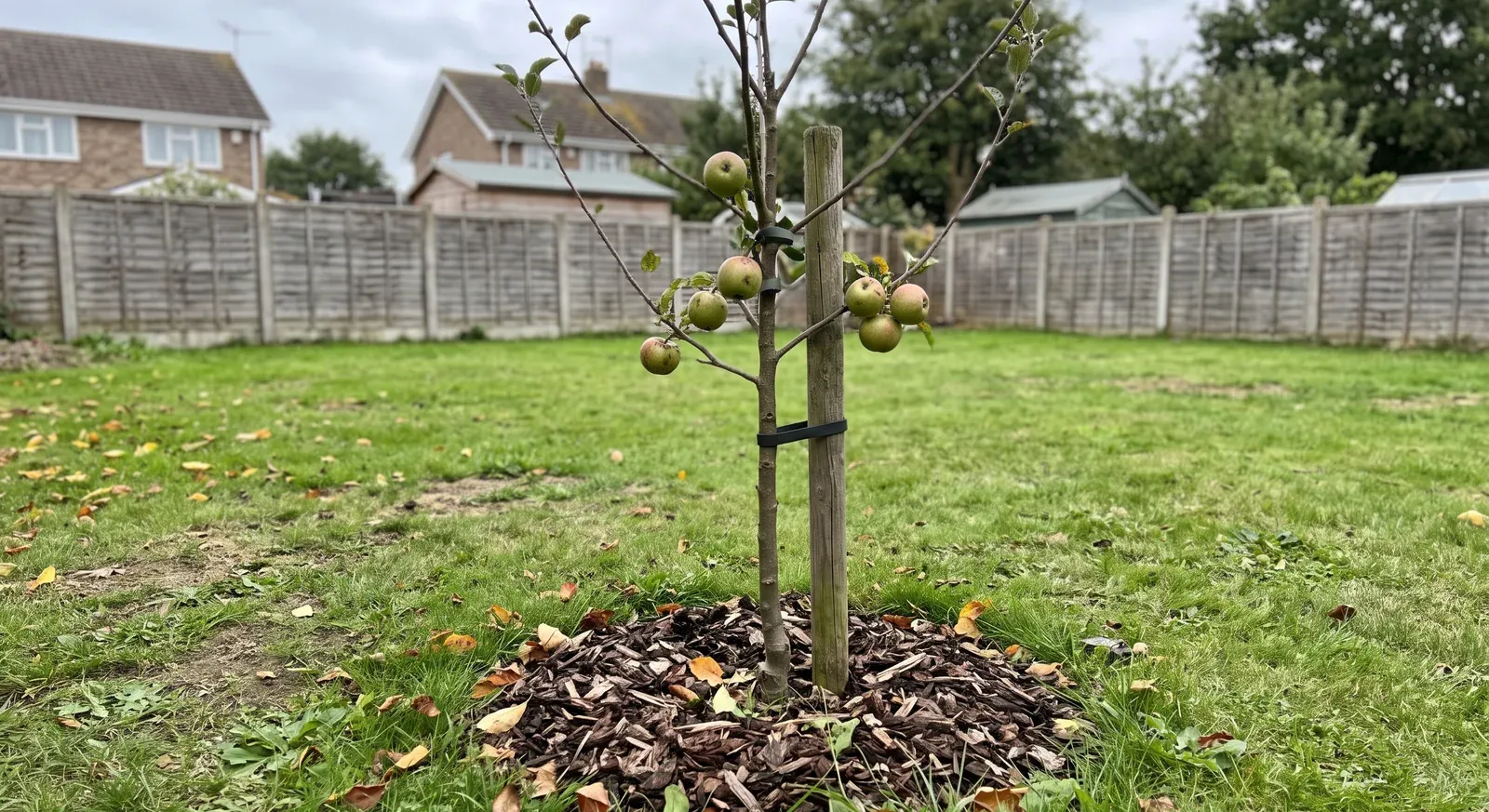
Fruit and nut trees normally begin to bear 2 to 5 years after planting, according to UC ANR’s The Home Orchard (2007). Apple trees on dwarfing rootstocks such as M9 start fruiting after two or three years (RHS), while apple trees on seedling rootstock take 6 to 10 years (NC State Extension, 2022). Most extension tables put peaches at 2 to 4 years (Oregon State gives 4 to 5). Sweet cherries take 4 to 7 years in most extension tables, but trees on Gisela 6 can give a harvestable crop by the third leaf (Oregon State University, 2021). Full cropping comes later: by year 5 or 6 in high-density apple orchards on dwarfing rootstocks, and at year 10 to 15 in traditional orchards on vigorous rootstocks (Robinson, 2003 and 2011).
Last updated: 21 October 2026.
The honest answer to “how long until it fruits?” is a range. The range depends on the species, the rootstock, and whether the tree was grafted in a nursery or grown from seed. I copied every figure below from a named source and put the year next to it where the source gives one, so you can see where each number comes from and where the sources disagree.
This page adds numbers to two existing guides. The fruit tree rootstock guide covers tree height, spacing and staking by rootstock. The first-year fruit tree care guide explains why fruit should be removed in the first year after planting.
UConn (2012), NMSU (2014), University of Missouri Extension, Iowa State (2025) and UMaine count the years from planting a nursery tree. The other tables do not say where their clock starts. UConn (2012) and NMSU (2014) both note that nursery trees are usually one to two years old when they are planted. The “range across sources” column runs from the lowest to the highest figure given by the sources in that row. It summarises the sources and does not predict the behaviour of any one tree.
How long until a fruit tree bears fruit? Years by species
Apple, pear, plum, cherry and other temperate fruit trees
| Tree | Years to first fruit (range across sources) | What each source says |
|---|---|---|
| Apple, dwarf | 2–5 | Virginia Cooperative Extension (VCE) 2020: 2–3. University of Vermont (UVM): 2–3. Lockwood, UT/UGA 2017: 2–3. University of Missouri Extension (MU): 3. Purdue HO-190: 3–4. Oregon State University (OSU) EC 819, 2025: 3–5. UC ANR (Krueger) 2018 (dwarfing): 3–5. UMaine: 2–3. |
| Apple, semi-dwarf | 3–7 | VCE 2020: 4–6. UVM: 4–6. Lockwood 2017: 4–6 (3–4 at 250–550 trees per acre). MU: 5. Purdue: 4–5. University of Maine (UMaine): 4–5. OSU 2025: 5–7. |
| Apple, standard or seedling rootstock | 4–10 | VCE 2020: 6–10. UVM: 6–10. NC State 2022: 6–10. MU: 5–7. Lockwood 2017: 6–8. UC ANR The Home Orchard 2007: 7–10. OSU 2025: 7–10. UMaine: “as much as seven to ten”. Krueger 2018 (standard): 4–8. |
| Pear (mostly European; most sources say “pear”) | 4–8 | VCE 2020 (standard): 5–8. UVM (standard): 5–8. MU: 5–8. University of Arizona 2015: 4–8. OSU 2025: 5–7. NC State 2022: 4–6. UConn 2012: 4–6. NMSU 2014: 4–6. Iowa State 2025: 4–6. Purdue (standard): 4–5. Krueger 2018 (standard): 4–8. UMaine (“most pear trees”): 4–5. |
| Pear, dwarf or semi-dwarf | 3–6 | VCE 2020 (dwarf): 3–4. Purdue (dwarf): 3–4. UVM (semi-dwarf): 4–6. RHS (pear on Quince C, dwarfing): after 4. Krueger 2018 (dwarfing): 3–5. |
| Asian pear | 2–3 | NC State 2022: 2–3. Only one source found. |
| Plum (type not stated) | 3–7 | VCE 2020: 4–5. UVM: 4–5. NC State 2022: 4–6. UConn 2012: 4–6. NMSU 2014: 4–6. MU: 4–6. OSU 2025 (plums and prunes): 3–5. Iowa State 2025: 3–5. Purdue: 3–5 (dwarf 3–4). UMaine Bulletin 2034: “the third year after planting”. UMaine rootstock page (any rootstock): 3–4. Krueger 2018 (apricots, plums): 4–7 (standard), 3–6 (dwarfing). |
| European plum | 4–5 (one numeric source) | University of Arizona 2015: 4–5. Childers 1983: “about two years later” than Japanese plums, which he puts at 3–5 years of age. |
| Japanese plum | 3–5 | University of Arizona 2015: 3. Childers 1983: 3–5 years of age. |
| Sweet cherry | 3–8 | VCE 2020: 5–7. UConn 2012: 5–7. NMSU 2014: 5–7. OSU 2025: 6–7. Purdue: 4–7. The Home Orchard 2007 (cherries): “up to 4”. Krueger 2018 (cherries): 4–8 (standard), 3–5 (dwarfing). UMaine rootstock page (cherry, any rootstock): 3–4. |
| Sour (tart) cherry | 3–6 | VCE 2020: 4–5. OSU 2025: 3–5. UConn 2012: 3–5. NMSU 2014: 3–5. Iowa State 2025: 3–5. MU: 3–5. Purdue: 3–5 (dwarf 3–4). Childers 1983 (Michigan commercial orchards): 5–6. |
| Peach | 2–5 | NC State 2022: 2–4. NMSU 2014: 2–4. MU: 2–4. VCE 2020: 3–4. UConn 2012: 3–4. UVM: 3–4. University of Arizona 2015: 3. Purdue: 3. Lockwood 2017: 3. Westwood 1993: “the 3rd or 4th year”. Krueger 2018: 3. UMaine rootstock page (any rootstock): 3–4. OSU 2025: 4–5. |
| Nectarine | 2–5 | NC State 2022: 2–4. University of Arizona 2015: 3. Purdue: 3. OSU 2025 (with peaches): 4–5. |
| Apricot | 2–7 | UConn 2012: 2–5. NMSU 2014: 3–5. University of Arizona 2015: 3–4. Purdue: 3–4. Westwood 1993: “the 3rd or 4th year”. Krueger 2018 (apricots, plums): 4–7 (standard), 3–6 (dwarfing). OSU 2025: 6–7. |
| Quince | 3–7 | Childers 1983: 3–4. VCE 2020: 5–6. UConn 2012: 5–6. NMSU 2014: 5–7. |
| Fig | 2–6 | University of Arizona 2015: 2–3. UC ANR (Krueger) 2018: 3. NC State 2022: 3–4. Childers 1983: “as early as the fourth season”. OSU 2025: 5–6. |
| Persimmon | 3–10 | UF/IFAS 2020 (Japanese persimmon): “by the third year”. NC State 2022 (American and Asian): 3–7. Purdue: 4–6. OSU 2025: 8–10. |
| Pawpaw | 3–14 | Kentucky State University (KYSU) 2018 and 2026 (grafted): 3–4. NC State 2022: 5–7. KYSU (seedlings): 7–8 (2018), 5–7 (2026). OSU 2025: 12–14. |
| Mulberry | 8–10 | RHS (black mulberry): “around eight years”, adding that “its varieties often fruit more quickly”. NC State 2022 (red mulberry): 8–10. |
Sources: VCE Publication 426-841, Table 1 (Yuan 2020); UVM Master Gardener slides (Garcia, undated); Lockwood, UT/UGA New Farmer Academy slides (2017); MU Extension MG6, Table 1 (Warmund, reviewed 2017); Purdue HO-190, Table 1 (Dana, undated); OSU EC 819, Tables 1 and 2 (Olsen 2025); NC State Extension Gardener Handbook, Tables 15-3 and 15-6 (Parker 2022); UConn IPM (2012); NMSU Guide H-308 (2014); Iowa State Yard and Garden (Jauron 2025); University of Arizona AZ1162 (2015); UMaine Bulletin 2034 and “Rootstocks and Dwarf Fruit Trees” (undated); UC ANR The Home Orchard (Ingels et al. 2007), p. 179; UC ANR Master Gardener slides (Krueger 2018); UF/IFAS HS1389 (Sarkhosh et al. 2020); KYSU fact sheets (Crabtree and Pomper 2018; Pomper and Crabtree 2026); RHS grow-your-own guides and rootstock guide (accessed October 2026); Childers, Modern Fruit Science, 9th ed. (1983), pp. 200, 254, 279, 309; Westwood, Temperate-Zone Pomology, 3rd ed. (1993), p. 175.
Citrus, avocado, mango and olive
| Tree | Years to first fruit (range across sources) | What each source says |
|---|---|---|
| Orange, grapefruit and mandarin (grafted or budded) | 2–3 after planting; 5 as tree age (Clemson) | Texas A&M AgriLife (Sauls): “most budded citrus trees can produce a few fruit in the second year after planting, but usually do not produce until the third year”. Samson 1986: a budded tree “will generally start flowering in the second or third year after planting”. Clemson HGIC 1364, 2024: young grafted oranges, grapefruits and mandarins “must grow for 5 years before they will flower and produce fruit” (tree age, not years after planting). |
| Lemon | 1–3 (tree age) | Clemson HGIC 1364, 2024: lemons “require 1 to 3 years to overcome juvenility” (tree age, not years after planting). This is the only lemon-specific source; the budded-citrus figures in the row above also cover lemons. |
| Key lime | 1–3 | UF/IFAS FC47 (Crane, revised 2016): trees from cuttings or air-layers “may produce some fruit within a year of planting”; budded and grafted trees “usually produce fruit within three years”. |
| Avocado (grafted) | 2–4 | Texas A&M EHT-018, 2013: “a few fruit 2 or 3 years after establishment”. UF/IFAS CIR1034 (revised 2016): “after 3 to 4 years”. |
| Mango (grafted) | 3–5 | UF/IFAS HS2 (revised 2023): “3 to 5 years after planting”. University of Hawaii CTAHR HC-2, 1997: “three to five years in dry areas”. Litz (ed.) 2009, p. 375: grafted trees “usually flower after 3 or 4 years”. Nakasone and Paull 1998, p. 34 (commercial crop): “commercial-size crops in 4–5 years”. |
| Olive | 4–5 | UC Marin Master Gardeners (UC ANR): “by the fourth or fifth year”. Only one source found. |
Nut trees
| Tree | Years to first nuts (range across sources) | What each source says |
|---|---|---|
| Almond | 2–6 | The Home Orchard 2007 (stone fruit and almond): “2 or 3 years”. Childers 1983: “the third or fourth year in the orchard”. OSU 2025: 3–5. Utah State 2017: “Don’t expect to harvest nuts for 4 to 6 years after planting.” |
| Hazelnut (filbert) | 2–6 | OSU EM 9072, 2013 (tree age): “a few nuts when they are 2 or 3 years old”. Purdue: 3. Westwood 1993: “the 3rd or 4th year”. OSU 2025: 5–6. |
| Chestnut | 2–7 | University of Missouri Center for Agroforestry (UMCA) AF1007, 2022 (grafted Chinese chestnut): “two or three years following establishment”. UT Extension Knox County, undated (‘Crane’, ‘Orrin’, ‘Nanking’): 2–3. NC State 2022 (chestnut, chinquapin): 3–5. OSU 2025: 5–7. Purdue (Chinese chestnut): 7. |
| English (Persian) walnut | 5–12 | The Home Orchard 2007 (walnuts and pecans): “up to 5 years”. UC ANR (Krueger) 2018: 5–8. Purdue: 6–10. Utah State 2011 (“most walnut species”): “7 to 8 years old”. OSU 2025: 10–12. |
| Black walnut | 4–12 | NC State 2022: 4–7 (small crop). UMCA AF1022, 2022 (grafted): “within four to six years after transplanting” (p. 9) and “within five to seven years of tree establishment” (p. 1). Purdue: 8–12. OSU 2025: 10–12. |
| Pecan | 4–10 | NC State 2022: 4–8 (grafted), 8–10 (seedling). NC State 2016, by cultivar: from 5–6 (‘Caddo’, ‘Kiowa’) to 8–10 (‘Stuart’). Childers 1983: 4–7. Rutgers FS1225, 2014 (named cultivars): 8–10. UMCA 2004: 7–10 after grafting. |
| Hickory | 8–20 | Rutgers FS1225, 2014: 8–10. OSU 2025: 10–14. Purdue: 10–20. |
| Pistachio | 5–6 | UC ANR Publication 8147, 2004: “5 to 6 years to produce the first crop”. UC ANR California Pistachio Research: “a small crop at 5 - 6 years”. |
Sources: Clemson HGIC 1364 (Snipes and Melgar 2024); Texas A&M AgriLife citrus fact sheet (Sauls, undated) and EHT-018 (Nesbitt et al. 2013); UF/IFAS EDIS FC47, CIR1034 and HS2 (Crane et al.); CTAHR HC-2 (Chia et al. 1997); Samson, Tropical Fruits, 2nd ed. (1986), p. 82; Nakasone and Paull, Tropical Fruits (1998); Litz (ed.), The Mango, 2nd ed. (2009); UC Marin Master Gardeners, Olive; Utah State University Extension (Roper and Heflebower 2017; Beddes et al. 2011); OSU EM 9072 (Olsen 2013); UMCA AF1007 and AF1022 (2022) and Green Horizons 8(1) (Coggeshall 2004); NC State, Growing Pecans in North Carolina (Parker 2016); Rutgers NJAES FS1225 (Fogerty 2014); UT Extension Knox County, Nut Crops for Tennessee (undated); UC ANR Publication 8147 (Geisel and Beede 2004).
Years to first fruit by rootstock
Webster (1995) lists “how soon after planting the tree begins to flower and fruit” among the traits a rootstock can influence. The RHS says fruit trees not grown on dwarfing rootstock “will not produce a good crop until their fourth year”, while cropping on dwarfing rootstock “can begin within two years”. Some invigorating rootstocks, such as M.25, still induce early flowering and cropping (Webster 1995, New Zealand Journal of Crop and Horticultural Science 23: 377).
How long until an apple tree bears fruit, by rootstock
| Rootstock | RHS vigour class | RHS: start fruiting | NC State 2022: fruit-bearing age (years) | Other sources |
|---|---|---|---|---|
| M27 | Extremely dwarfing | After 2 years | – | OSU EC 819, 2025 (“more dwarf”, M-27): 3–5 years to first bearing. |
| M9 | Dwarfing | After 2 or 3 years | 2–3 | VCE 2020: trees on M.9 “will often produce crops in two to three years”. Penn State 2017 (dwarf rootstocks M.9, B.9, G.41, G.11, G.935): fruit “in the second or third season after planting”. OSU 2025 (dwarf class: M-9, M-26, Bud 9): 3–5. |
| B.9, G.11, G.41 | – | – | – | VCE Gardener Handbook (undated): trees on M.9, G.11, G.41 or Bud.9 “will often produce crops in 2-3 years”. In the 2010 NC-140 trial with ‘Honeycrisp’, “very few sites harvested any fruit” in the second leaf, across all the trial’s rootstocks (Autio et al. 2020). |
| Mark | – | – | 2–3 | – |
| M26 | Dwarfing | After 2 or 3 years | 2–4 | OSU 2025 (dwarf class): 3–5. |
| M7 (M.7a) | – | – | 3–4 | OSU 2025 (semi-dwarf class: MM-106, MM-111, M-7): 5–7. Ontario OMAFA 2025: “Fruit production is relatively light for the first 10 years.” |
| MM106 | Semi-dwarfing | After 3 or 4 years | 3–4 | OSU 2025 (semi-dwarf class): 5–7. |
| MM111 | Vigorous | After 4 or 5 years | 4–6 | OSU 2025 (semi-dwarf class): 5–7. |
| M25 | Very vigorous | After 5 or 6 years | – | – |
| Seedling | – | – | 6–10 | The Home Orchard 2007: “come into bearing late (in 7 to 10 years)”. OSU 2025 (vigorous): 7–10. VCE 2020: trees on seedling rootstocks “usually do not begin fruiting until they are 7 to 8 years old”. |
Sources: RHS, “Rootstocks for fruit” (accessed October 2026); NC State Extension Gardener Handbook, Table 15-3 (Parker 2022); OSU EC 819, Table 2 (Olsen 2025); VCE 426-841, p. 2 (Yuan 2020) and VCE Gardener Handbook, Chapter 10; Penn State Extension, “Apple Production” (Crassweller et al. 2017); Autio et al. (2020), Journal of the American Pomological Society 74: 182–195; OMAFA, “Apple rootstocks” (updated 2025).
The sources split on MM106. Webster and Wertheim (2003, Apples: Botany, Production and Uses, p. 111) say MM.106 “induces excellent yield precocity”, and NIAB East Malling lists it among semi-vigorous rootstocks that “induce much better precocity” than others of similar vigour. Robinson (2003, p. 385) lists MM.106 with M.7 and MM.111 as rootstocks whose “lack of precocity is a serious limitation” in high-density orchards.
Apple trees by size class
Many extension tables group apple rootstocks into dwarf, semi-dwarf and standard trees instead of naming them. The figures below come from those tables.
| Size class | First fruit (years) | Full crop (years) | Life expectancy (years) | Source |
|---|---|---|---|---|
| Dwarf | 2–3 | – | 30–35 | VCE 426-841, Table 1 (2020) |
| Dwarf | 2–3 | 5–6 | 14+ | Lockwood, UT/UGA (2017), p. 59 |
| Dwarf | 3 | – | 15–20 | MU Extension MG6, Table 1 (reviewed 2017) |
| Dwarf | 3–4 | – | 10–15 | Purdue HO-190, Table 1 (undated) |
| Semi-dwarf | 4–6 | – | 30–35 | VCE 426-841, Table 1 (2020) |
| Semi-dwarf | 4–6 | 9–11 | 20+ | Lockwood, UT/UGA (2017), p. 59 |
| Semi-dwarf | 5 | – | 20–30 | MU Extension MG6, Table 1 (reviewed 2017) |
| Semi-dwarf | 4–5 | – | 15–20 | Purdue HO-190, Table 1 (undated) |
| Standard | 6–10 | – | 35–45 | VCE 426-841, Table 1 (2020) |
| Seedling | 6–8 | 12–14 | 30+ | Lockwood, UT/UGA (2017), p. 59 |
| Standard | 5–7 | – | 35–45 | MU Extension MG6, Table 1 (reviewed 2017) |
Pear rootstocks
| Rootstock | Years to fruit | Source |
|---|---|---|
| Quince C | Start fruiting after 4 years | RHS (accessed October 2026) |
| Quince A | Start fruiting after 4 years | RHS (accessed October 2026) |
| OHxF 87 (Pyro 2-33 for ‘Bartlett’) | “Significant yields as early as the 5th or 6th season after planting” in semi-intensive plantings | Smith and Einhorn, WTFRC final report (after the 2010 season) |
| ‘Bosc’ on six rootstocks in the 2005 trellised planting at Tonasket, Washington | “Commercially significant yields in the 4th, and especially in 2009, their 5th season” | Smith and Einhorn, WTFRC final report |
| OHxF 87 with ‘d’Anjou’ | Crop “in the 6th leaf may have been worth picking, but barely”; no other rootstock in that trial set a crop worth picking | Smith and Einhorn, WTFRC final report |
Sweet cherry rootstocks
Cherry research gives tree ages in “leaves” (growing seasons). Some authors count the nursery season too: Lang (2000) equates the 3rd leaf with the “2nd year in the orchard”, so his leaf numbers run about one higher than orchard years.
| Rootstock | First fruit | Full production | Source |
|---|---|---|---|
| Gisela 5 | 3–4 years (RHS); 3rd leaf with ‘Bing’ at western sites (NC-140, preliminary results) | – | RHS; NC-140 cherry rootstock trial page (1987 trials, preliminary results after 7 seasons) |
| Gisela 6 | Harvestable crops by the 3rd leaf | Possible by the 5th leaf | OSU PNW 619 (Long, Kaiser and Thompson 2021) |
| Gisela 12 | 3rd leaf with ‘Bing’ (NC-140, preliminary results); first yield in year 3 in the WSU ‘Bing’ budget | 5th leaf (OSU PNW 619); 6th year assumed in the WSU budget | OSU PNW 619 (2021); WSU Extension TB22 (2015) |
| Krymsk 5 and MaxMa 14 | “Small yields by the third or fourth leaf” | – | OSU PNW 619 (2021) |
| Colt | 3–4 years (RHS) | – | RHS. OSU PNW 619 (2021) describes Colt, in the irrigated orchards of the Pacific Northwest, as having “similarly low precocity” to Mazzard. |
| Mazzard (F12/1) | 5th or 6th leaf (OSU PNW 619); 5 or 6 years (OSU PNW 642, 2013); often no significant flowering until the 6th or 7th leaf (Lang 2000, who counts the nursery year) | 12th leaf | OSU PNW 619 (2021); OSU PNW 642 (Long and Kaiser 2013); Lang (2000), HortTechnology 10: 719–725 |
| Mahaleb | Often no significant flowering until the 6th or 7th leaf (nursery year counted) | – | Lang (2000) |
Colt is the clearest disagreement in this table. The RHS gives three or four years, while Oregon State, writing about irrigated Pacific Northwest orchards, groups it with Mazzard as a low-precocity rootstock.
Plum, peach and apricot rootstocks
| Rootstock | Used for | Years to fruit | Source |
|---|---|---|---|
| Pixy | Plum, gage, damson | 3 or 4 years | RHS (accessed October 2026) |
| St Julien A | Peach, nectarine, apricot, plum, gage, damson | After 3 or 4 years | RHS (accessed October 2026) |
| Torinel | Peach, nectarine, apricot, plum, gage, damson | After 3 or 4 years | RHS (accessed October 2026) |
| 19 peach rootstocks, including Lovell, Nemaguard and Guardian | Peach (‘Redhaven’) | No years to first fruit given; the authors remark in passing that trees “come into full production at approximately years 4 or 5” | Reighard et al. (2004), Journal of the American Pomological Society 58: 174–202 |
| Any rootstock | Peach, plum, cherry | “Regardless of the rootstock, peach, plum and cherry trees begin to bear fruit at an age of three to four years.” | UMaine, “Rootstocks and Dwarf Fruit Trees” (undated) |
In a Dutch trial, plum trees on Krymsk 1 (VVA-1) were “by far the least vigorous, most precocious, and most production efficient” of the rootstocks tested (Maas et al. 2011, Acta Horticulturae 903: 547–554). I found no authoritative years-to-fruit figure for the Brompton, Myrobalan B or Wavit plum rootstocks.
How long until a fruit tree reaches full cropping?
The first crop is small. Full or “mature” cropping comes several years later, and the gap is widest on vigorous rootstocks (Robinson 2003; Lockwood 2017; OSU PNW 619, 2021).
| Tree or system | Years to full or mature crop | Source |
|---|---|---|
| Apple, high-density orchard on dwarfing rootstocks | Mature yields “by year 5 or 6” | Robinson (2003), in Apples: Botany, Production and Uses, p. 346 |
| Apple, modern high-density orchard | Mature yields “by year 5” | Robinson (2011), Revista Brasileira de Fruticultura 33: 40 |
| Apple, high-density orchard | Full yield “within 4 or 5 years from planting or even less” | Jackson (2003), The Biology of Apples and Pears, p. 46 |
| Apple and pear, semi- and full-dwarf | Full bearing in 4–5 years | Childers (1983), p. 541 |
| Apple on dwarf “9-series” rootstock, Washington (‘Fuji’, 1,089 trees per acre) | Full production in the 6th year | WSU Extension TB73E (2019) |
| Apple on G.41, Washington (‘Cosmic Crisp’) | Full production in the 6th year of operation | WSU Extension TB104E (2024) |
| Apple, dwarf (600+ trees per acre) | 5–6 years | Lockwood, UT/UGA (2017), p. 8 |
| Apple, semi-dwarf | 6–8 years (250–550 trees per acre, p. 8); 9–11 years (p. 59) | Lockwood, UT/UGA (2017) |
| Apple, seedling rootstock | 12–14 years | Lockwood, UT/UGA (2017), p. 59 |
| Apple, traditional low-density orchard on vigorous rootstocks | Mature yields at year 15 (Robinson 2003); year 10–12 (Robinson 2011) | Robinson (2003), p. 346; Robinson (2011), p. 40 |
| Pear, best rootstocks in semi-intensive plantings | Full production “in less than eight years, rather than the traditional 14 to 16” | Smith and Einhorn, WTFRC final report |
| Peach | 6 years | Lockwood, UT/UGA (2017), p. 69 |
| Peach | Top production between 6 and 8 years of age | Childers (1983), p. 541 |
| Peach ‘Redhaven’, NC-140 rootstock trial (authors’ general remark, not a per-rootstock result) | Full production “at approximately years 4 or 5” | Reighard et al. (2004), p. 180 |
| Plum | “About eight years after planting” | UMaine Bulletin 2034 (Moran) |
| Sweet cherry on Mazzard | 12th leaf | OSU PNW 619 (2021) |
| Sweet cherry on Gisela 6 or Gisela 12 | Full production possible by the 5th leaf | OSU PNW 619 (2021) |
| Sweet cherry ‘Bing’ on Gisela 12, Washington | 6th year | WSU Extension TB22 (2015) |
| Tart cherry, Michigan commercial orchards | 8th or 9th year | Childers (1983), p. 279 |
| Quince | Maximum production at 10 years | Childers (1983), p. 200 |
| Fig | Commercial bearing at about 7 years of age | Childers (1983), p. 309 |
| Japanese persimmon | 8–10 years | UF/IFAS HS1389 (2020) |
| Olive, super-high-density hedgerow (over 600 trees per acre) | Full production “within four or five years” | UC Davis / UC ANR, Olive Production in California (Lazicki and Geisseler) |
| Hazelnut | “Commercially productive” at 4 years of age | OSU EM 9072 (2013) |
| Chinese chestnut, grafted | Commercial production between the 6th and 9th year; 2,000+ lb per acre by age 12–15 | UMCA AF1007 (2022) |
| Walnut (“most walnut species”) | Full production at about 15 years old | Utah State University Extension (2011) |
| Black walnut, grafted | First significant commercial harvest around age 10 | UMCA AF1022 (2022) |
| Black walnut | Large crop at 20–30 years | NC State Extension Gardener Handbook, Table 15-6 (2022) |
| Pecan | Commercial crops at 7–12 years | Childers (1983), p. 285 |
| Pistachio | Full bearing at 10–12 years of age | UC ANR California Pistachio Research |
How long do fruit trees stay productive?
Life expectancy figures vary widely between sources: Purdue gives dwarf apple trees 10 to 15 years, and Virginia (VCE 2020) gives them 30 to 35. Commercial figures are economic lifespans, meaning how long an orchard is worth keeping.
| Tree | Productive life or life expectancy (years) | Source |
|---|---|---|
| Apple, standard | 35–45 (VCE 2020; MU); 35+ (UVM); 30+ (Lockwood 2017, seedling); 30-year bearing life in a 1982 California cost budget for standard trees | VCE 426-841; MU MG6; UVM; Lockwood (2017); Childers (1983), p. 566, from Tyler (1982) |
| Apple, size not stated | 20–30 | University of Arizona AZ1162 (2015) |
| Apple, semi-dwarf | 30–35 (VCE 2020); 20–30 (MU); 20–25 (UVM); 20+ (Lockwood 2017); 15–20 (Purdue) | As listed |
| Apple, dwarf | 30–35 (VCE 2020); 15–20 (MU; UVM); 14+ (Lockwood 2017); 10–15 (Purdue) | As listed |
| Apple, commercial orchards | At least 20 (Penn State 2017); 20 (WSU cost studies on dwarf “9-series” rootstock and G.41, 2014–2024, although the 2019 ‘Fuji’ study also gives 15 in its text); about 15 for an intensively managed orchard (Tromp et al. 2005, p. 372); about 20 at medium density and possibly 40 at low density (OMAFA 2025); “as short as 7 years, but generally not longer than 12–15 years” for super-spindle orchards (Robinson 2003, p. 363) | As listed |
| Pear, standard | 35–45 (VCE 2020; UVM; MU, type not stated); 25–45 (University of Arizona 2015, type not stated); 15–20 (Purdue) | As listed |
| Pear, dwarf or semi-dwarf | 15–20 (VCE 2020, dwarf); 20–25 (UVM, semi-dwarf); 10–15 (Purdue, dwarf) | As listed |
| Peach | 15–20 (VCE 2020; University of Arizona 2015; UVM; The Home Orchard 2007); 17 (Lockwood 2017); 10–15 (MU; Purdue) | As listed |
| Nectarine | 15–20 (University of Arizona 2015); 10–15 (Purdue) | As listed |
| Plum | 15–20 (VCE 2020; MU; UVM; Purdue, standard); 10–15 (Purdue, dwarf); 20 (University of Arizona 2015, European and Japanese); 18 assumed for a Dutch orchard on St Julien A in an economic model (Maas et al. 2011) | As listed |
| Sweet cherry | 20–30 (VCE 2020); 25 (WSU TB22, 2015, ‘Bing’ on Gisela 12; UC Davis cost study, 2005); 15–20 (Purdue) | As listed |
| Sour cherry | 15–20 (VCE 2020; MU; Purdue, standard); 10–15 (Purdue, dwarf); Michigan orchards hold full production “until about 20 to 22 years” (Childers 1983, p. 279) | As listed |
| Apricot | 30 (University of Arizona 2015); 10–15 (Purdue) | As listed |
| Quince | 30–40 | VCE 426-841 (2020) |
| Fig | 30–40 | University of Arizona AZ1162 (2015) |
| Persimmon | 50+ | Purdue HO-190 |
| Citrus orchards | 40 in California and 33 in Florida, from first to last harvest | Samson (1986), p. 9 |
| Mango | “40 years or more” in production (CTAHR 1997); 25-year orchard life in a Florida cost study (Litz 2009, p. 614) | As listed |
| Avocado, ultra-high-density orchards in California | Expected 10–12 (personal communication cited by the book) | Schaffer, Wolstenholme and Whiley (eds), The Avocado, 2nd ed. (2013), p. 354 |
| Hazelnut | 40–50 for a well-managed orchard (OSU EM 9072, 2013); 30–50 (Purdue) | As listed |
| Chinese chestnut | 40–50 | Purdue HO-190 |
| Persian walnut | 40–50 | Purdue HO-190 |
| Black walnut | 80+ | Purdue HO-190 |
Westwood (1993, p. 68), explaining why long-lived crops such as apple and pear are rarely replanted with new varieties, refers to plantings that remain productive “for 50 or more years”. Penn State Extension (2017) expects a commercial apple orchard to be productive “for at least 20 years”.
How long does a fruit tree grown from seed take to fruit?
A seedling tree must pass through a juvenile phase before it can flower. Westwood (1993, p. 217) defines juvenility as the state of a seedling “during which it cannot be induced to flower”. NC State Extension (2022) notes that “grafted trees bear fruit more quickly than seed-grown trees”.
| Tree | Years from seed to first flowering or fruit | Source |
|---|---|---|
| Apple | 4–8 (Malus) | Hackett (1985), Horticultural Reviews 7, Table 3.1, from Clark (1983); the same figures are repeated in Tromp, Webster and Wertheim (2005), p. 90 |
| Apple | 6–12 (apple and pear) | van Nocker and Gardiner (2014), Table 1, citing Visser (1964) |
| Apple | Fell from 7.4 to 4.3 years in comparable seedling groups over 20 years | Jackson (2003), p. 89, citing Visser et al. (1976) |
| Pear | 6–10 (Pyrus) | Hackett (1985), Table 3.1 |
| Pear | Fell from 9.2 to 6 years in comparable seedling groups over 20 years | Jackson (2003), p. 89, citing Visser et al. (1976) |
| Plum, cherry, peach, apricot (Prunus) | 2–8 | Hackett (1985), Table 3.1 |
| Cherry | 3–5 | van Nocker and Gardiner (2014), Table 1, citing Besford et al. (1996) |
| Peach | 3 or more | van Nocker and Gardiner (2014), Table 1, citing Hansche (1986) |
| Almond | 3–4 | van Nocker and Gardiner (2014), Table 1 |
| Citrus | 5–8 | Hackett (1985), Table 3.1 |
| Orange, lemon, mandarin | 5–10 | van Nocker and Gardiner (2014), Table 1, citing Furr et al. (1947) |
| Mandarin, sweet orange, grapefruit | 5 to as long as 13 | Davies and Albrigo (1994), Citrus, p. 59 |
| Lemon and lime | Less than 2 under subtropical conditions | Davies and Albrigo (1994), p. 59 |
| Orange | 8–15 | UF/IFAS HS884 (Ferguson 2002) |
| Avocado | 15 or more | van Nocker and Gardiner (2014), Table 1, citing Lavi et al. (1992) |
| Avocado | 5–15 | Nakasone and Paull (1998), p. 81 |
| Avocado | 4–10 | UF/IFAS Gardening Solutions, Avocado |
| Mango | 3–7 | Litz (ed.) (2009), The Mango, 2nd ed., p. 2 |
| Mango | 5–10 for seedling trees, compared with 3 or 4 for grafted trees | Litz (ed.) (2009), p. 375 |
| Walnut | 5–9 | van Nocker and Gardiner (2014), Table 1 |
| Pecan | 5 or more | van Nocker and Gardiner (2014), Table 1, citing Romberg (1944) |
| Pistachio | 4–10 | van Nocker and Gardiner (2014), Table 1 |
| Pawpaw | 7–8 (2018); 5–7 (2026), for seedling trees counted from planting | Kentucky State University fact sheets |
| Nut trees in general | 8–12 for planted seedlings (counted from planting), compared with 2–4 for named cultivars | Rutgers FS1225 (2014) |
Lemon and avocado show wide spreads. Davies and Albrigo (1994) give less than 2 years for lemons from seed, while van Nocker and Gardiner (2014) give 5 to 10 years for citrus as a group (orange, lemon, mandarin and tangerine, from Furr et al. 1947). For avocado, the range runs from 4 to 10 years (UF/IFAS) up to 15 or more (van Nocker and Gardiner 2014).
Why the sources give different numbers
The same tree can appear with a different number in each table for four reasons.
The clock starts in different places. UConn, NMSU, MU, Iowa State and UMaine count from planting; the other tables do not say. UConn (2012) titles its table “The age trees can be expected to bear fruit after planting”. Some textbooks count the age of the tree instead: Childers (1983) says Japanese plums “bear at from three to five years of age”. Cherry and apple trials count “leaves” (growing seasons), and some authors, such as Lang (2000), include the nursery season in that count.
Sources also count different events. The RHS distinguishes between cropping that “can begin within two years” on dwarfing rootstock and “a good crop” that non-dwarfing trees will not produce “until their fourth year”. Some tables record the first handful of fruit, and others record the first crop worth picking.
Region and climate may explain some of the spread, although the sources do not say why their figures differ. Oregon State (2025) gives 6–7 years for apricots and 12–14 years for pawpaws. The University of Arizona (2015) gives 3–4 years for apricots, and Kentucky State University gives 3–4 years for grafted pawpaws.
Some tables share a lineage and may not be independent. The Virginia Tech (2020) and University of Vermont tables have almost the same title and the same columns, and most of their bearing ages match. UConn (2012) and NMSU (2014) both publish “Why Fruit Trees Fail to Bear” with identical figures for pear, plum and both cherries.
Where two sources disagree, the page shows both figures. A dash marks a cell for which I found no authoritative figure.
Frequently asked questions
How long does an apple tree take to bear fruit?
It depends mostly on the rootstock. The RHS says apple trees start fruiting after two years on M27, after two or three years on M9 or M26, after three or four years on MM106, after four or five years on MM111 and after five or six years on M25. NC State Extension (2022) gives a fruit-bearing age of 2 to 3 years on M.9, 2 to 4 years on M.26, 3 to 4 years on MM.106, 4 to 6 years on MM.111 and 6 to 10 years on seedling rootstock. Virginia Cooperative Extension (2020) gives 2 to 3 years for dwarf apple trees, 4 to 6 years for semi-dwarf trees and 6 to 10 years for standard trees.
Which fruit trees bear fruit the fastest?
The quickest temperate trees are peaches, nectarines, Asian pears and apples on very dwarfing rootstocks. NC State Extension (2022) gives 2 to 4 years to harvest for peaches and nectarines and 2 to 3 years for Asian pears. The RHS says apples on M27 start fruiting after two years. Texas A&M AgriLife Extension says most budded citrus trees can produce a few fruit in the second year after planting, but usually do not produce until the third year.
Which fruit and nut trees take the longest to bear?
Some nut trees are among the slowest. Oregon State University Extension (EC 819, 2025) gives 10 to 12 years to bearing for English and black walnuts and 10 to 14 years for hickory. Seedling pecans take 8 to 10 years in the NC State Extension table (2022). Among fruit trees, black mulberry takes around eight years to start fruiting, although its varieties often fruit sooner (RHS), and Oregon State gives 8 to 10 years for persimmon and 12 to 14 years for pawpaw.
How long does a fruit tree grown from seed take to fruit?
Much longer than a grafted tree. Hackett (1985, Horticultural Reviews 7, Table 3.1, from Clark 1983) lists the juvenile period from seed as 4 to 8 years for apple (Malus), 6 to 10 years for pear (Pyrus), 2 to 8 years for Prunus species and 5 to 8 years for citrus. van Nocker and Gardiner (2014, Horticulture Research) give 6 to 12 years for apple and pear seedlings and 15 or more years for avocado.
When does a fruit tree reach full cropping?
Full cropping comes several years after the first fruit. Robinson (2003, in Apples: Botany, Production and Uses) says high-density apple orchards on dwarfing rootstocks reach mature yields by year 5 or 6, while traditional low-density orchards on vigorous rootstocks did not reach mature yields until year 15. Oregon State University Extension (PNW 619, 2021) says sweet cherries on Mazzard rootstock often reach full production only in the 12th leaf, while full production is possible by the 5th leaf on Gisela 6 or Gisela 12.
How many years does a fruit tree stay productive?
Virginia Cooperative Extension (2020) gives a life expectancy of 35 to 45 years for standard apple and pear trees, 20 to 30 years for sweet cherry, and 15 to 20 years for peach, plum and sour cherry. Smaller trees live shorter lives in most other tables: University of Missouri Extension gives 15 to 20 years for dwarf apple trees, while Virginia gives dwarf and semi-dwarf apples the same 30 to 35 years. Penn State Extension (2017) expects a commercial apple orchard to be productive for at least 20 years.
Sources
University extension and government
- Yuan, R. (2020). Tree Fruit in the Home Garden. Virginia Cooperative Extension 426-841 (SPES-259P). Table 1. pubs.ext.vt.edu
- Virginia Cooperative Extension Gardener Handbook, Chapter 10, “Fruits in the Home Garden”. pressbooks.lib.vt.edu
- Parker, M. (2022). “Tree Fruits and Nuts”, Chapter 15, North Carolina Extension Gardener Handbook, 2nd ed. NC State Extension. Tables 15-3 and 15-6. content.ces.ncsu.edu
- Parker, M.L. (2016). Growing Pecans in North Carolina. NC State Extension. Table 1. content.ces.ncsu.edu
- Olsen, J.L. (2025). Growing tree fruits and nuts at home. Oregon State University Extension EC 819. Tables 1 and 2. extension.oregonstate.edu
- Olsen, J. (2013). Growing Hazelnuts in the Pacific Northwest: Introduction. OSU Extension EM 9072. extension.oregonstate.edu
- Long, L., Kaiser, C. and Thompson, A. (2021). Sweet cherry rootstocks for the Pacific Northwest. PNW 619. extension.oregonstate.edu
- Long, L.E. and Kaiser, C. (2013). Sweet Cherry Orchard Establishment in the Pacific Northwest. PNW 642. extension.oregonstate.edu
- Dana, M.N. Fruits and Nuts for Edible Landscaping. Purdue Extension HO-190. Table 1. ag.purdue.edu
- Warmund, M. Fruit Production. University of Missouri Extension MG6. Table 1. extension.missouri.edu
- Garcia, M.E. Master Gardener: Fruit Trees in the Home Garden. University of Vermont. uvm.edu
- Lockwood, D.W. (2017). Challenges & Opportunities in the Production & Marketing of Fruit & Nut Crops. University of Tennessee Center for Profitable Agriculture. utia.tennessee.edu
- UConn IPM (2012). “Why Fruit Trees Fail to Bear”. ipm.cahnr.uconn.edu
- Herrera, E. and Sullivan, D., revised by Yao, S. (2014). Why Fruit Trees Fail To Bear. NMSU Guide H-308. pubs.nmsu.edu
- Jauron, R. (2025). “How soon will a newly planted fruit tree begin to bear fruit?” Iowa State University Extension. yardandgarden.extension.iastate.edu
- Young, D., Call, R.E., Kilby, M. and DeGomez, T. (2015). Backyard Fruit Production at Elevations 3500 to 6000 Feet. University of Arizona AZ1162. extension.arizona.edu
- Moran, R. Plum Production in Maine. University of Maine Cooperative Extension Bulletin 2034. extension.umaine.edu
- University of Maine Cooperative Extension. “Rootstocks and Dwarf Fruit Trees”. extension.umaine.edu
- Crassweller, R.M. et al. (2017). “Apple Production”. Penn State Extension. extension.psu.edu
- Ontario Ministry of Agriculture, Food and Agribusiness (2025). “Apple rootstocks”. ontario.ca
- Gallardo, R.K. and Galinato, S. 2019 Cost Estimates of Establishing, Producing, and Packing Fuji Apples in Washington State. WSU Extension TB73E. Listed at ses.wsu.edu.
- Gallardo, R.K., Galinato, S.P. and Sallato C., B. (2024). 2024 Cost and Return Estimates of Establishing, Producing, and Packing Cosmic Crisp Apples in Washington. WSU Extension TB104E. Listed at ses.wsu.edu.
- Galinato, S.P., Gallardo, R.K. and Hong, Y.A. 2014 Cost Estimates of Establishing, Producing, and Packing Gala Apples in Washington State. WSU Extension TB18. Listed at ses.wsu.edu.
- Galinato, S.P. and Gallardo, R.K. 2015 Cost Estimates of Establishing, Producing, and Packing Bing Sweet Cherries in Washington State. WSU Extension TB22. Listed at ses.wsu.edu.
- Grant, J. et al. (2005). Costs to Establish and Produce Cherries, San Joaquin Valley. UC Cooperative Extension. ucanr.edu
- Ingels, C.A., Geisel, P.M. and Norton, M.V. (eds) (2007). The Home Orchard: Growing Your Own Deciduous Fruit and Nut Trees. UC ANR Publication 3485.
- Krueger, B. (2018). Home Orchards: Fruit and Nut Trees. UC ANR Master Gardener training. ucanr.edu
- Geisel, P.M. and Beede, R.H. (2004). Pistachio: Calendar of Operations for Home Gardeners. UC ANR Publication 8147. ucanr.edu
- UC ANR California Pistachio Research. “Climate & Cultivars”. ucanr.edu
- Lazicki, P. and Geisseler, D. Olive Production in California. UC Davis / UC ANR. ucanr.edu
- UC Marin Master Gardeners. “Olive”. ucanr.edu
- Roper, T.R. and Heflebower, R. (2017). Almonds in the Home Garden. Utah State University Extension. extension.usu.edu
- Beddes, T., Murray, M., Kuhns, M. and Goodspeed, J. (2011). Walnuts in the Home Orchard. Utah State University Extension. extension.usu.edu
- Crane, J.H. et al. Mango Growing in the Florida Home Landscape (HS2, revised 2023); Avocado Growing in the Florida Home Landscape (CIR1034, revised 2016); Key Lime Growing in the Florida Home Landscape (FC47, revised 2016). UF/IFAS EDIS.
- Sarkhosh, A., Huff, D.M. and Andersen, P.C. (2020). Japanese Persimmon Cultural Practices in Florida. UF/IFAS EDIS HS1389.
- Ferguson, J.J. (2002). Your Florida Dooryard Citrus Guide: Introduction. UF/IFAS EDIS HS884.
- UF/IFAS Gardening Solutions. “Avocado”. gardeningsolutions.ifas.ufl.edu
- Snipes, Z. and Melgar, J.C. (2024). In-Ground Citrus Production. Clemson HGIC 1364. hgic.clemson.edu
- Sauls, J.W. “Citrus”. Texas A&M AgriLife Extension. aggie-horticulture.tamu.edu
- Nesbitt, M., Stein, L. and Kamas, J. (2013). Texas Fruit and Nut Production: Avocados. Texas A&M AgriLife Extension EHT-018.
- Chia, C.L., Hamilton, R.A. and Evans, D.O. (1997). Mango. University of Hawaii CTAHR HC-2. ctahr.hawaii.edu
- Crabtree, S. and Pomper, K. (2018). All About Pawpaws; Pomper, K. and Crabtree, S. (2026). Planting Pawpaw Trees. Kentucky State University Cooperative Extension.
- Revord, R. et al. (2022). Growing and Marketing Chinese Chestnuts. UMCA AF1007; Webber, J.B. et al. (2022). Growing Black Walnut for Nut Production. UMCA AF1022; Coggeshall, M. (2004). “Grafting Nut Trees: How Do I Get Started?” Green Horizons 8(1). University of Missouri Center for Agroforestry. agebb.missouri.edu
- Fogerty, E. (2014). Nut Trees for New Jersey. Rutgers NJAES FS1225. njaes.rutgers.edu
- UT Extension Knox County (undated). Nut Crops for Tennessee. knox.tennessee.edu
- Smith, T.J. and Einhorn, T. PNW Pear Rootstock Trial. Washington Tree Fruit Research Commission, Project PR-099-903A, final report. treefruitresearch.org
- NC-140. “NC-140 Cherry Rootstock Trial” (preliminary results, 7 seasons, 1987 trials). Archived copy: web.archive.org
RHS and NIAB East Malling
- RHS. “Rootstocks for fruit”. rhs.org.uk
- RHS. “Fruit: unproductive trees”. rhs.org.uk
- RHS. “How to grow mulberries”. rhs.org.uk
- NIAB. “The influence of rootstock or interstock (interstem)”. niab.com
Peer-reviewed papers
- Autio, W. et al. (2020). Budagovsky, Geneva, Pillnitz, and Malling apple rootstocks affect ‘Honeycrisp’ performance over eight years in the 2010 NC-140 ‘Honeycrisp’ Apple Rootstock Trial. Journal of the American Pomological Society 74(4): 182–195.
- Hackett, W.P. (1985). Juvenility, maturation, and rejuvenation in woody plants. Horticultural Reviews 7: 109–155. doi.org/10.1002/9781118060735.ch3
- Lang, G.A. (2000). Precocious, dwarfing, and productive: how will new cherry rootstocks impact the sweet cherry industry? HortTechnology 10(4): 719–725. doi.org/10.21273/HORTTECH.10.4.719
- Maas, F.M. et al. (2011). Krymsk 1 (VVA-1), a dwarfing rootstock suitable for high density plum orchards in the Netherlands. Acta Horticulturae 903: 547–554. doi.org/10.17660/ActaHortic.2011.903.76
- Reighard, G. et al. (2004). Eight-year performance of 19 peach rootstocks at 20 locations in North America. Journal of the American Pomological Society 58(4): 174–202.
- Robinson, T. (2011). Advances in apple culture worldwide. Revista Brasileira de Fruticultura 33: 37–47. doi.org/10.1590/S0100-29452011000500006
- van Nocker, S. and Gardiner, S.E. (2014). Breeding better cultivars, faster: applications of new technologies for the rapid deployment of superior horticultural tree crops. Horticulture Research 1: 14022. doi.org/10.1038/hortres.2014.22
- Webster, A.D. (1995). Rootstock and interstock effects on deciduous fruit tree vigour, precocity, and yield productivity. New Zealand Journal of Crop and Horticultural Science 23(4): 373–382. doi.org/10.1080/01140671.1995.9513913
Textbooks
- Childers, N.F. (1983). Modern Fruit Science, 9th ed. Horticultural Publications, Gainesville, Florida.
- Davies, F.S. and Albrigo, L.G. (1994). Citrus. CAB International, Wallingford.
- Ferree, D.C. and Warrington, I.J. (eds) (2003). Apples: Botany, Production and Uses. CABI, Wallingford. Chapters by Webster and Wertheim (Ch. 5) and Robinson (Ch. 15, doi.org/10.1079/9780851995922.0345).
- Jackson, J.E. (2003). The Biology of Apples and Pears. Cambridge University Press.
- Litz, R.E. (ed.) (2009). The Mango: Botany, Production and Uses, 2nd ed. CAB International, Wallingford.
- Nakasone, H.Y. and Paull, R.E. (1998). Tropical Fruits. CAB International, Wallingford.
- Samson, J.A. (1986). Tropical Fruits, 2nd ed. Longman, Harlow.
- Schaffer, B., Wolstenholme, B.N. and Whiley, A.W. (eds) (2013). The Avocado: Botany, Production and Uses, 2nd ed. CAB International, Wallingford.
- Tromp, J., Webster, A.D. and Wertheim, S.J. (eds) (2005). Fundamentals of Temperate Zone Tree Fruit Production. Backhuys Publishers, Leiden.
- Westwood, M.N. (1993). Temperate-Zone Pomology: Physiology and Culture, 3rd ed. Timber Press, Portland, Oregon.
Cite this data
Leaftide’s compilation and article text are published under Creative Commons Attribution 4.0 (CC BY 4.0). The individual values remain attributed to the sources named next to them and are not relicensed.
How to cite: Leaftide (2026). “How Long Until Fruit Trees Bear Fruit? Years by Species and Rootstock.” Retrieved from https://leaftide.com/learn/how-long-fruit-trees-take-to-fruit/. Values compiled from university extension services, the RHS, NC-140 rootstock trials, peer-reviewed reviews and horticulture textbooks, as cited per row.
For height, spacing and staking by rootstock, see the fruit tree rootstock guide. For what to do while you wait for the first crop, see first-year fruit tree care.