How to Grow Davidson's Plum
Davidsonia pruriens
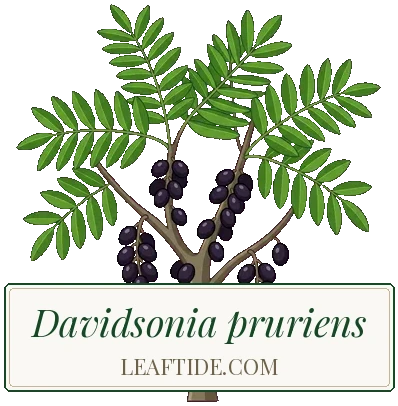
Davidson's plum (Davidsonia pruriens) is a stunning Australian rainforest tree with clusters of intensely tart dark purple fruit borne directly on the trunk, a spectacular cauliflorous effect. The fruit is prized for jams, sauces, and desserts. It is a shade-tolerant understory tree needing rich, moist, well-drained soil and a sheltered frost-free position. Subtropical in origin so needs frost protection, especially when young. Mulch heavily and feed with native plant fertiliser. Not for cold gardens.
 In your Leaftide garden


- Height
- 7 m (23 ft)
- Spread
- 4 m (13 ft)
- Spacing
- 4 m (13 ft)
- Harvest
- August - September
- Light
- Part shade
- Water
- Moderate
Yearly Lifecycle
Care Essentials
Feed in spring and early summer with a slow-release fertiliser formulated for rainforest or native plants. Mulch heavily with organic material to maintain soil moisture and fertility. Avoid high-phosphorus feeds.
Watch For
- Frost damage: protect below 5C
- Leaf scorch in full sun
- Root rot in waterlogged soil
- Fruit fly in warm climates
Companions
Ginger, Lemon Myrtle, Finger Lime, Tree Fern
Care Requirements
Light
Dappled shade, sheltered position
One of the few fruiting trees that prefers shade. Full sun causes leaf scorch and fruit drop. Plant under or beside larger trees for best results.
Watering
Consistent moisture year-round
Keep soil evenly moist, especially in the first few years. Mulch heavily to retain moisture. Avoid waterlogging which causes root rot.
Fertilizing
Native plant fertiliser in spring
Feed in spring and early summer with a slow-release fertiliser formulated for rainforest or native plants. Avoid high-phosphorus feeds.
Pruning
Minimal, remove dead wood only
Remove dead or crossing branches in late winter. Avoid heavy pruning as the tree fruits on older wood and the trunk itself (cauliflory).
Growing Tips
Shade is an asset, not a problem
Davidson plum is one of the few fruiting trees that actively prefers shade. Plant it under or beside larger trees. Full sun causes leaf scorch and fruit drop.
Fruit grows on the trunk
The dark purple fruits emerge directly from the trunk and older branches: this is called cauliflory. Do not prune the main trunk, as this is where the fruit forms.
Fruit is extremely tart, not for fresh eating
Davidson plum is not eaten raw. It is used in cooking: jams, sauces, chutneys, wine, and desserts. The intense flavour and high antioxidant content make it a superfood ingredient.
Pests & Diseases
Pest Queensland Fruit Fly
Identification: Small sting marks on colouring fruit, then soft, rotting patches with white maggots inside. It is a pest of eastern Australia. Davidsonia jerseyana, which ripens in summer, is hit harder than D. pruriens, which ripens in autumn and winter when there are fewer flies.
- Hang fruit fly traps in the tree before the fruit starts to colour and check them weekly.
- Pick up fallen fruit, seal it in a plastic bag and leave it in the sun for 3 to 7 days before binning it.
- Harvest fruit as it ripens instead of leaving it on the tree, or cover the crop with fine exclusion netting or fruit bags.
Pest Birds, Possums and Flying Foxes
Identification: Fruit pecked, bitten or stripped from the trunk and branches, often overnight; parrots take both ripe and half-ripe fruit.
- Net the tree as the fruit starts to colour.
- Use wildlife-safe netting with holes no bigger than 5 mm (required by law in Victoria), so birds, bats and possums cannot get tangled in it.
- Pick up fallen fruit promptly, as it also draws rats.
Pest Caterpillars and Leaf Beetles
Identification: Chewed flowers, young fruit and soft new leaves. The red-shouldered leaf beetle (Monolepta australis), about 6 mm long and yellow with red patches on the shoulders, can arrive in swarms and strip new growth within hours.
- Pick caterpillars off by hand, and shake beetles into a bucket of soapy water.
- Swarms tend to appear after the first good rain following a dry spell, so check flowers and new growth then, and cover young trees with fine netting while beetles are about.
Spacing & Planting
| Plant spacing | 4 m (13 ft) |
| Row spacing | 4 m (13 ft) |
| Mature height | 7 m (23 ft) |
| Mature spread | 4 m (13 ft) |
Allow 3-5m (10-16 ft) spread. Davidson plum is a shade-tolerant understory tree: ideal planted under or near larger trees. Suitable for subtropical and warm temperate gardens with rich, moist, sheltered positions.