| Where | What grows well there | Pot size |
|---|---|---|
| Floor | Tomatoes, courgettes, potatoes, beans, peppers | 20 to 50 litres |
| Railing | Salad leaves, herbs, strawberries, radishes | Window box 15 to 20 cm (6 to 8 in) deep |
| Hanging | Trailing tomatoes, strawberries, nasturtiums, thyme | 25 to 35 cm (10 to 14 in) across |
| Up the railing | Mangetout, climbing beans, passion flower | One deep pot at the foot |
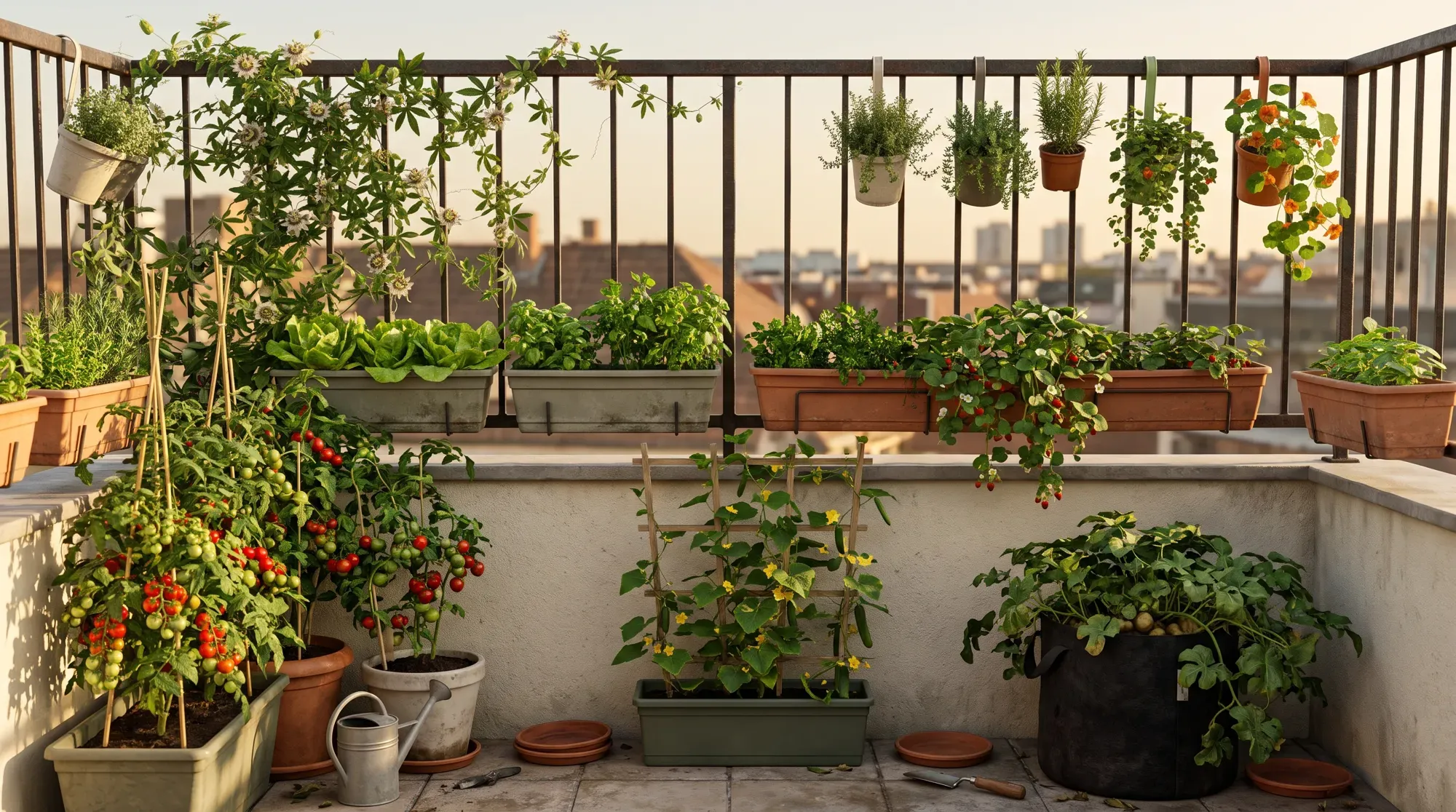
A balcony is a garden you plan upwards. The floor is only a metre or two deep, but above it there is a wall, a railing and the air in front of both, and a well-used balcony grows food on all of them. A tomato stands in a big pot on the floor, salad fills a window box on the rail, and strawberries hang from a hook at eye height.
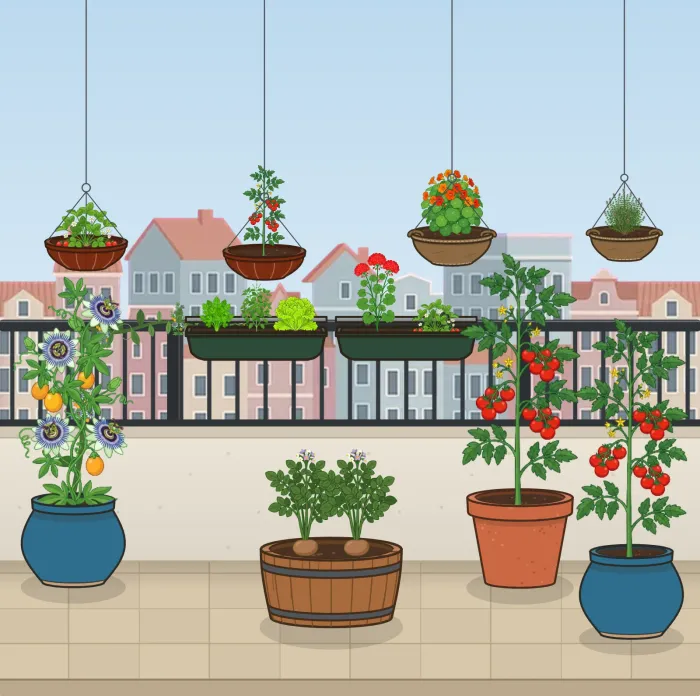
That is also why balcony planning trips people up. A plan drawn from above, the way garden beds are planned, shows the window box on the railing and the pot on the floor below it in the same spot. What you need is a picture from the front: what stands where, at what height, and what shades what.
This guide covers the decisions that make the most difference on a small balcony: what grows on each level, how big each pot needs to be, and how sun, wind and watering differ from a garden.
Start with the three levels
Most balconies have three places to grow, and each suits different crops.
The floor takes the heavy pots. Tomatoes, courgettes, potatoes, peppers and beans need deep, roomy containers, and a 40 litre pot of wet compost weighs around 40 kg. The floor is the only place that weight belongs. It is also the shadiest level if your balcony has a solid wall at the front, because the wall blocks the low sun for anything shorter than it.
The wall and the railing are where light is best. Window boxes hung on the railing or along the top of the wall sit in full sun and catch the breeze. They suit shallow-rooted crops: salad leaves, rocket, radishes, spring onions, herbs and strawberries.
Hanging pots use the space above both. A pot on a hook or bracket holds one plant: a trailing cherry tomato, a strawberry, thyme or a nasturtium that spills over the edge. They dry out fastest of anything on the balcony, so put them where you can reach them with a watering can every day.
A fourth option is to grow up the railing itself. Mangetout, climbing beans and a passion flower will all climb the bars from a deep pot standing at their foot, and because they grow flat against the rail, they shade very little.
Pot sizes for balcony vegetables
The most common balcony mistake is pots that are too small. A small pot dries out within hours on a hot day, starves the plant of nutrients by midsummer, and gives the roots no room. Most vegetables crop far better in a pot one size up from the one you first picked.
| Crop | Minimum pot | Better | Notes |
|---|---|---|---|
| Tomato (cordon) | 20 litres | 30 to 40 litres | One plant per pot, staked or tied to the railing |
| Cucumber | 20 litres | 30 litres | Give it a small trellis or the railing to climb |
| Courgette | 40 litres | 60 litres | One plant fills a 1 m (3 ft) square, so only on a big balcony |
| Potato | 40 litre bag | 50 litres | 3 to 4 seed potatoes per bag |
| Chilli and peppers | 10 litres | 15 to 20 litres | Love the heat of a sunny wall |
| French bean (dwarf) | 15 litres | 20 litres | About 5 plants per 20 litre pot |
| Mangetout | 20 cm (8 in) deep trough | 25 cm (10 in) deep | Sow along the railing and let them climb |
| Lettuce and salad leaves | 15 cm (6 in) deep box | 20 cm (8 in) deep | 4 to 6 plants per 60 cm (24 in) window box |
| Strawberry | 2 litres each | 3 litres each | 3 to 4 plants per 60 cm (24 in) box, or one per hanging pot |
| Basil and other herbs | 1 to 2 litres | 3 to 5 litres | Mediterranean herbs like the hottest spot |
If you are not sure how many plants fit in a box or trough, the Spacing Calculator works it out from the container’s size.
Sun: watch it for a day
Sun decides more on a balcony than anywhere else, because the building blocks half the sky. A balcony in full sun from late morning suits tomatoes, peppers and chillies. One with three or four hours of sun is better for salad, beans, peas, herbs and strawberries. A balcony with no direct sun at all can still grow leafy greens and mint, but fruiting crops will struggle.
Spend one sunny day noting where the light falls at 9am, noon and 4pm. Note it per level, not just for the balcony as a whole. The railing often gets two or three hours more sun than the floor behind a solid wall, which is why the railing boxes are the best place for anything that ripens.
Tall plants on the floor shade what stands behind them. Keep the tomatoes and climbers where their shadow falls on the wall or on the next balcony, not on your salad.
Wind
Balconies are windier than gardens, and the higher up, the windier. Wind dries pots out, knocks over tall plants and tears soft leaves.
Big floor pots rarely blow over; tall plants in small pots do. Tie tomatoes and beans to a stake or the railing, and they survive gusts that would otherwise snap them. Keep hanging pots small and hook them on firmly, because a pot swinging in the wind dries out fast and can unhook itself. A solid lower wall shelters the floor, which is one more reason to put the heavy, tall crops there.
On a very exposed balcony, a strip of windbreak netting tied to the inside of the railing slows the wind without blocking much light.
Plan your balcony the way it really looks.
Free for up to 30 permanent plants and 15 seasonal crops a season. No card needed.


Watering a balcony garden
Containers can only hold so much water, and on a warm, windy day a small pot can run dry by mid-afternoon. A few habits keep the crop going:
- Water in the morning, deeply, until water runs out of the drainage holes. A splash on the surface does not reach the roots.
- Check pots by weight or with a finger, not by the calendar. Lift a pot or push a finger into the compost: if it is dry 2 to 3 cm (1 in) down, water.
- Use saucers or self-watering boxes for window boxes and small pots, but empty saucers after heavy rain so roots don’t sit in water.
- Group pots that need the same amount of water. Tomatoes and cucumbers together, Mediterranean herbs together, so you are not drowning one to keep the other alive.
Rain may not reach your pots at all. A balcony with a roof, or the one above yours, stays dry even in a downpour, and so does a glazed one. Pots near the open front may catch rain while the ones against the house wall stay dry. Know which of your pots get rain, or you will skip watering after a wet night and find the sheltered ones wilting.
Frost and the season
Pots freeze faster than garden soil, because the cold gets in from every side. On the other hand, a balcony against a heated building often stays a degree or two warmer than the open garden. Neither is reliable, so plan around your local frost dates rather than how sheltered the balcony feels.
Sow tender crops like tomatoes, peppers and basil indoors and move them out after your last frost date. The last frost date guide explains how to find yours. In autumn, bring tender perennials such as chillies and lemon verbena indoors before the first frost, and wrap the pots of anything that stays out over winter.
A glazed balcony is warmer than an open one but not frost-free unless it is heated. Unheated glass can drop below freezing on a clear night just like the air outside.
A small balcony plan that works
Here is one way to use a 1 m x 3 m (3 x 10 ft) balcony with a solid wall and a railing on top, in a spot that gets sun from late morning:
- Floor, back corner: two cherry tomatoes in 30 litre pots, tied to the railing.
- Floor, middle: a cucumber in a 30 litre pot with a small trellis, and a potato bag beside it.
- Railing: three 60 cm (24 in) window boxes, one of cut-and-come-again salad, one of herbs, one of strawberries.
- Hanging: two pots of trailing strawberries or thyme where they get the afternoon sun.
- Up the railing: mangetout sown in a deep trough at one end, climbing the bars in spring. When it finishes, sow dwarf beans in the same trough for summer.
That is ten containers, and it keeps salad, herbs and something to pick coming from May to October.
Keep track of what stands where
Once a balcony fills up, it gets hard to remember what you sowed in which box, when, and what worked last year. A plan helps more on a small balcony than in a big garden, because every pot counts.
You can sketch it on paper from the front, as the balcony really looks. Or use Leaftide’s balcony planner: add your pots, window boxes and hanging pots at their real sizes, arrange them in a front view on the floor, the wall and the railing, and get sowing and harvest dates worked out for where you live. If rain doesn’t reach your balcony, you say so once and the watering reminders take it into account.
Every pot in its place.
Free for up to 30 permanent plants and 15 seasonal crops a season. No card needed.
Frequently asked questions
What vegetables grow best on a balcony?
Cherry tomatoes, salad leaves, dwarf French beans, mangetout, chillies, strawberries and most herbs all do well in pots. They crop heavily for the space they take and cope with a container's limited root room. Larger crops like courgettes and potatoes work too, but each needs a big pot or grow bag of its own.
How big should pots be for balcony vegetables?
Bigger than most people buy. A tomato wants at least 20 litres and does better in 30 to 40. Courgettes need 40 litres or more, potatoes a 40 to 50 litre bag, and peppers, chillies and dwarf beans 10 to 20 litres. Salad leaves, radishes and herbs grow happily in a window box 15 to 20 cm (6 to 8 in) deep.
Can I put window boxes on a balcony railing?
Usually, yes, with brackets made for your railing's shape. Hang them on the inside where you can, since a box falling off the outside can hurt someone below. A full, freshly watered 60 cm (24 in) box weighs 15 to 20 kg, so check your building's rules and the railing's strength first.
How often should I water vegetables on a balcony?
In a warm summer spell, small pots and window boxes may need water every day, and hanging pots sometimes twice. Wind dries balconies faster than gardens. Large pots hold more water and need it less often, which is one more reason to go big. On a roofed or glazed balcony rain never reaches the pots, so they depend on you all year.
Do balcony plants need protection from frost?
Roots in a pot freeze faster than roots in the ground, because the cold reaches them from every side. A balcony against a heated building is often a degree or two milder than an open garden, but not frost-free. Move tender plants indoors or under cover before your first frost date, and wrap large pots of perennials.