| Method | When to plant |
|---|---|
| Sets (spring) | Mid-March to mid-April (UK); February-April (US by region) |
| Seeds indoors | January to February (10-12 weeks before last frost) |
| Overwintering sets | October to November |
Choose long-day varieties for northern regions (14-16 hrs daylight to bulb) and short-day varieties for southern regions (10-12 hrs).
I spent my first two years growing onions without thinking about day length at all. I planted sets in spring, watered them, and waited. Some years the bulbs were decent. Other years they barely sized up, and I blamed the weather or the soil or the variety. It was not until I started reading about photoperiod that the pattern made sense. The onions that failed were not getting enough daylight hours to trigger proper bulbing. I had been planting the right crop at roughly the right time, but without understanding the mechanism that actually makes an onion form a bulb.
That realisation changed how I approach onion timing entirely. When to plant onions is not just a calendar question. It depends on what you are planting, where you are growing, and which day length group your variety belongs to.
The quick answer: it depends on type
There are three ways to start onions, and each has its own planting window.
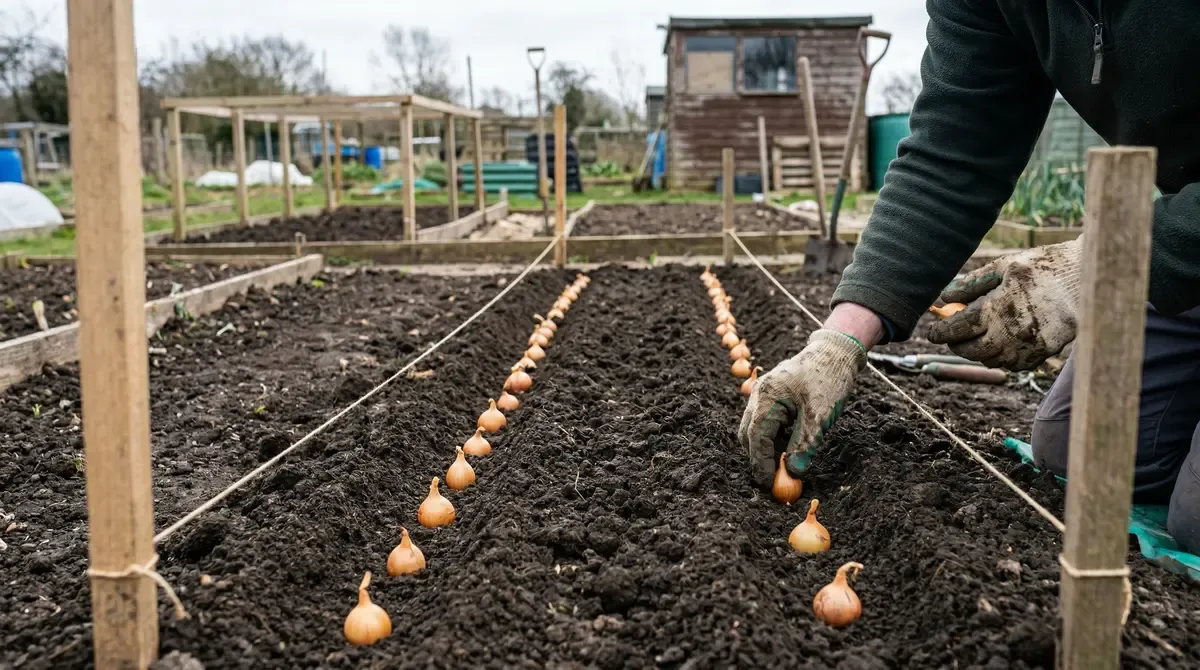
Sets (small dormant bulbs) go in the ground in early spring once the soil is workable. In the UK, that means mid-March to mid-April. In the US, it ranges from February in the south to April in the north. Sets are the easiest route because they skip the slow seedling stage entirely.
Seeds started indoors need a much earlier start. Sow them in January or February, about 10 to 12 weeks before your last frost date. Onion seedlings are slow growers, and they need that full lead time to reach a size worth transplanting. If you wait until March to start seeds indoors, the seedlings will be too small to make the most of the growing season.
Overwintering sets flip the calendar entirely. These go in during October or November, establish roots before winter, and resume growing in early spring. They produce an earlier harvest than spring-planted onions, often by four to six weeks.
If you already know your planting method and just need to sort out spacing, the onion spacing guide covers distances for sets, seeds, and transplants.
Why day length matters more than you think
Onions are photoperiod-sensitive. They do not start forming a bulb until the day length reaches a specific threshold, and that threshold varies by variety group.
Long-day onions need 14 to 16 hours of daylight to trigger bulbing. These are the standard choice for the UK, northern Europe, and the northern half of the US (roughly zones 6 and above). In these regions, the long summer days provide the signal the plant needs. Varieties like Sturon, Centurion, and Ailsa Craig are all long-day types.
Short-day onions begin bulbing when day length hits just 10 to 12 hours. They are designed for southern regions (zones 7 and below in the US) where summer days are not as long. Varieties like Texas 1015 and Vidalia fall into this group. Plant them in the wrong latitude and they will bulb prematurely, producing tiny onions before the plant has grown enough foliage to support a decent bulb.
Intermediate-day onions sit between the two, bulbing at 12 to 14 hours. They work in a wider band of latitudes and are a reasonable choice if you are not sure which group suits your area.
The practical takeaway is simple. Check which day length group your variety belongs to before you buy it. A long-day onion planted in Texas will not perform, and a short-day onion planted in Scotland will bulb far too early. Getting this right matters as much as getting the planting date right.
How frost dates shape your onion timing
Your last frost date is the anchor for spring onion planting. Sets and transplants go in two to four weeks before the last frost, because onions are hardy enough to tolerate light frosts once they are in the ground. They are not as frost-tender as tomatoes or peppers. A few degrees below zero will not kill established onion plants.
That said, planting into frozen or waterlogged soil is a different problem. The sets sit in cold, wet ground and rot before they can root. The soil needs to be workable, which means dry enough to crumble when you squeeze a handful rather than forming a sticky ball.
If you do not know your last frost date, the frost date finder will give you a location-specific estimate. From there, count backwards to find your indoor seed starting window (10 to 12 weeks before last frost) and forwards to find your outdoor planting window (2 to 4 weeks before last frost for sets).
For a visual timeline of when each stage falls for your location, the crop timeline calculator maps it out so you are not doing the arithmetic in your head.
Onion timing depends on your frost date, your latitude, and your variety.


Overwintering onions: the autumn option
Overwintering is the approach I wish someone had told me about sooner. You plant specially bred sets in October or November, they put down roots before the ground gets too cold, and then they sit through winter in a semi-dormant state. When temperatures rise in February and March, they are already established and start growing immediately. The result is a harvest in June or July, weeks ahead of spring-planted onions.
Not every variety survives overwintering. You need types bred for it. In the UK, Radar, Shakespeare, and Senshyu Yellow are reliable choices. These varieties tolerate the cold and resist bolting when temperatures fluctuate in late winter. Standard spring-planting sets will often rot or bolt if you try to overwinter them.
The timing window is narrower than spring planting. Too early (September) and the sets grow too much top growth before winter, which makes them vulnerable to frost damage. Too late (December) and they do not establish enough root to survive. The sweet spot is mid-October to mid-November in most of the UK, and a similar window in USDA zones 5 to 7.
Overwintering onions also fill a gap in the harvest calendar. Spring-planted onions are not ready until late summer. Overwintered ones bridge the period between using up stored onions from the previous year and harvesting the new spring-planted crop.
Regional timing guide
Onion planting dates vary significantly by region. Here is a practical breakdown.
UK and northern Europe. Plant sets from mid-March to mid-April. Start seeds indoors in January or February. Overwintering sets go in from mid-October to mid-November. Long-day varieties are the standard choice. The long summer days (16+ hours in June) provide plenty of signal for bulbing.
Northern US and Canada (zones 3 to 5). Spring is later here. Plant sets in April or early May, once the ground thaws and dries out. Start seeds indoors in February, as the short outdoor season means you need every week of lead time. Long-day varieties are essential at these latitudes.
Mid-Atlantic and Midwest US (zones 6 to 7). Sets go in from March to early April. Both long-day and intermediate-day varieties work well. This is the transition zone where variety choice becomes more flexible, but long-day types are still the safer bet for most gardeners.
Southern US (zones 8 to 10). Short-day onions are the standard here. Plant sets or transplants from October to January, depending on how far south you are. In the deep south, onions grow through the mild winter and are harvested in late spring. The timing is essentially reversed compared to northern regions.
Spring onions and scallions: more flexible timing
Spring onions (also called scallions or salad onions) play by different rules. Because you harvest them young, before they form a bulb, day length is largely irrelevant. They do not need to reach the bulbing stage, so the photoperiod constraints that govern bulb onions do not apply.
You can sow spring onions from March through to August in the UK, and from early spring through late summer in most US zones. They germinate quickly, grow fast, and are ready to pull in 8 to 12 weeks. Successive sowings every two to three weeks give you a continuous supply rather than a single glut.
Spring onions also tolerate cooler conditions than you might expect. Early sowings under a cloche or fleece can go in from late February in milder areas. They will not grow fast in the cold, but they will not die either, and they will be ready earlier than unprotected sowings.
If you are new to onions and the day length business feels overwhelming, spring onions are a good place to start. They are forgiving, fast, and almost impossible to get wrong on timing.
Signs you have planted too late
The most common timing mistake with onions is planting too late in spring. The consequences are predictable and frustrating.
Bolting. When onions experience a cold spell followed by warming temperatures, they can interpret this as a signal to flower. Late-planted onions that go into the ground during an unsettled spring are more prone to this. Once an onion bolts, the bulb stops developing and becomes woody around the central flower stalk. You can still eat it, but it will not store.
Small bulbs. Onions need to grow a full canopy of leaves before the longest day triggers bulbing. Each leaf corresponds to a ring in the bulb. Late planting shortens the window for leaf production, which means fewer rings and a smaller final bulb. There is no way to compensate for this once bulbing starts.
Poor storage. Late-harvested onions from late plantings often have thicker necks that do not dry down properly. Thick-necked onions are the first to rot in storage. If you grow onions partly for winter keeping, timely planting is not optional.
The general rule is that onions should be in the ground and growing well before the summer solstice. Every week you lose before that point is a week less foliage growth, and that translates directly into smaller bulbs at harvest.
Not sure if your onion timing is right for this season?