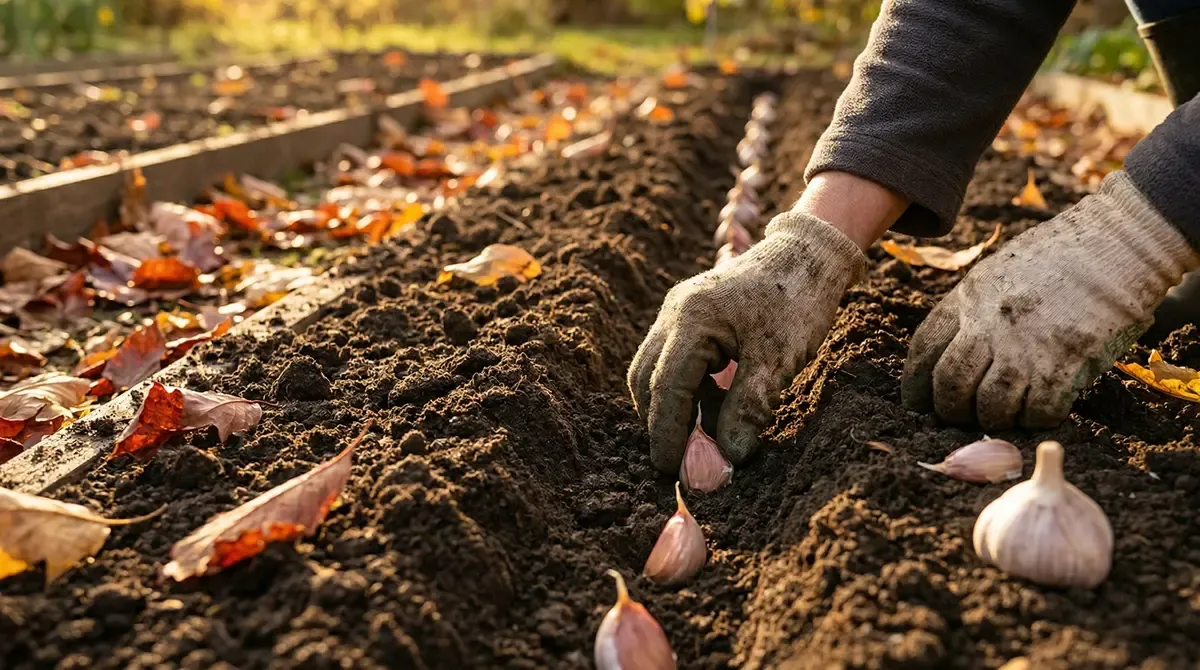
Plant garlic in autumn, 4-6 weeks before the ground freezes. In the UK: October to November. In northern US/Canada: late September to mid-October. In mild climates (zones 8-10): November to early December. Hardneck varieties need cold winters; softneck tolerates milder climates. Spring planting is possible but produces smaller bulbs.
My first year growing garlic, I planted it in March. I had read somewhere that garlic goes in the ground in spring, same as onions. The cloves sprouted, grew into decent-looking plants, and by July I pulled up a row of bulbs the size of walnuts. Technically garlic. Practically useless.
The following autumn, a neighbour at the allotment handed me a bag of cloves and said, “Put these in now, before the frost.” I did, mostly out of politeness. The next July, those same beds produced bulbs three times the size of my spring attempt. That was the year I learned that garlic is, fundamentally, an autumn crop.
The quick answer: plant garlic in autumn
For most gardeners, the right time to plant garlic is autumn. Specifically, four to six weeks before the ground freezes in your area. In the UK, that typically means October to November. In the northern United States and Canada, late September to mid-October. In milder climates like the southern US or Mediterranean regions, November or even early December.
The reason is simple. Garlic cloves need a period of cold to trigger the hormonal process that causes a single clove to divide into a full bulb. Without that cold period, you get a single round lump instead of the segmented head you are after. Planting in autumn gives the cloves time to establish roots before winter, then the cold months provide the vernalisation they need, and spring growth starts from an already-rooted plant with a head start.
There are exceptions, and I will cover spring planting further down. But if you have the choice, autumn is the answer.
Hardneck vs softneck: timing differences
Not all garlic is the same, and the type you grow affects when you plant it.
Hardneck garlic produces a stiff central stalk (the scape) and needs a solid cold period to form bulbs properly. It is the better choice for cold climates, USDA zones 3 through 7, and most of the UK. Hardneck varieties are less forgiving about timing. Plant them too late and they do not root in before the freeze. Plant them too early and they push up green growth that gets damaged by hard frost. The four-to-six-week window before ground freeze is important for hardneck types.
Softneck garlic is more flexible. It tolerates milder winters, stores longer, and does not absolutely require the same intensity of cold. It is the standard supermarket garlic and the better choice for zones 8 through 10 and warmer parts of Europe. Softneck varieties can be planted a bit later in autumn because they are less dependent on deep vernalisation. They are also the better option if you are attempting a spring planting.
If you are not sure which type to grow, start with hardneck if your winters regularly drop below minus 5 Celsius, and softneck if they do not.
Why autumn planting produces bigger bulbs
The science behind this is vernalisation, the process by which prolonged cold exposure triggers developmental changes in a plant. In garlic, vernalisation is what tells the clove to stop being a single unit and start dividing into multiple cloves around a central stem.
Garlic needs roughly four to eight weeks of soil temperatures below 10 Celsius (50 Fahrenheit) for this process to complete. The exact requirement varies by variety, but the principle is consistent. Without enough cold, the bulb either does not divide at all or produces fewer, smaller cloves.
Autumn-planted garlic gets this cold exposure naturally over winter. By the time spring arrives and the soil warms, the plant has already rooted, already vernalised, and is ready to put all its energy into bulb development. Spring-planted garlic, by contrast, is trying to root, grow, and bulb all in the same compressed window. The result is almost always smaller.
There is also a root development advantage. Cloves planted in autumn spend weeks growing roots in cool, moist soil before the ground freezes. When spring arrives, they already have an established root system ready to absorb water and nutrients. Spring-planted cloves start from zero and never quite catch up.
How to time it using frost dates
The four-to-six-week rule is the most reliable way to time garlic planting. Take your first autumn frost date and count backwards by four to six weeks. That is your planting window.
If your first frost date is 15 October, plant garlic in early to mid-September. If your first frost date is 20 November, plant in mid-October. The goal is to give cloves enough time to grow roots (but not significant top growth) before the ground freezes solid.
A few centimetres of green shoot poking through the soil before winter is fine. Garlic is hardy and a light frost will not damage young growth. What you want to avoid is a full canopy of leaves going into a hard freeze, because that foliage can be killed back and the plant wastes energy regrowing it in spring.
If you do not know your frost dates, the frost date finder will show you both your spring and autumn dates based on your location. From there, the crop timeline calculator can help you work backwards to find your ideal planting window.
Garlic timing depends on where you are, not a generic calendar.


Spring planting: when and why
Spring planting is not ideal, but it is not pointless either. There are two situations where it makes sense.
First, if you live in a climate where the ground freezes before October and stays frozen until April or May. Parts of northern Canada, Scandinavia, and high-altitude regions fall into this category. In these areas, autumn planting is risky because cloves may not root before the deep freeze, and spring planting with pre-chilled cloves is the safer option. To simulate vernalisation, store seed garlic in the refrigerator for six to eight weeks before planting.
Second, if you simply missed the autumn window. It happens. Life gets in the way, the cloves arrive late, or you did not think about garlic until January. Spring planting will still give you a harvest. It will just be smaller.
For spring planting, get cloves in the ground as early as the soil can be worked, ideally four to six weeks before your last frost date. Choose softneck varieties. They handle the compressed timeline better than hardneck types. Expect bulbs that are roughly half to two-thirds the size of autumn-planted garlic, with fewer cloves per head.
Regional timing guide
Garlic planting dates vary significantly by region. Here is a general guide, though your specific microclimate may shift these by a week or two in either direction.
United Kingdom. Most of the UK plants garlic from mid-October to late November. Southern England and coastal areas can push into early December in mild years. Northern England and Scotland should aim for October to avoid planting into waterlogged or frozen soil. The UK climate is well suited to softneck varieties, though hardneck types perform well in the north.
Northern United States and Canada (zones 3-6). Plant from mid-September to mid-October, depending on how early your ground freezes. Hardneck varieties are the standard here. Mulch heavily after planting, 10 to 15 centimetres of straw, to insulate cloves through harsh winters. In the coldest areas (zone 3), some growers plant as early as late August.
Southern United States (zones 7-10). Plant from late October to December. The challenge in warm climates is not cold damage but insufficient vernalisation. Choose softneck varieties bred for mild winters, such as Creole or Artichoke types. In zones 9 and 10, refrigerate seed garlic for six to eight weeks before planting to ensure adequate chilling.
Elephant garlic: different timing
Elephant garlic is not actually garlic. It is a close relative of the leek, which explains its mild flavour and enormous clove size. But it is planted and grown in a similar way, with a few differences worth noting.
Elephant garlic benefits from a longer growing season than true garlic. Plant it in early to mid-autumn, at the same time as or slightly before your regular garlic. It is less cold-hardy, so in zones 5 and below, mulch it heavily or consider spring planting instead.
Give elephant garlic wider spacing, 20 to 25 centimetres between cloves, because the bulbs grow significantly larger. Plant cloves about 10 centimetres deep. In mild climates, elephant garlic can be left in the ground as a perennial, producing larger bulbs each successive year.
Signs garlic is ready to harvest
Planting at the right time is half the equation. The other half is knowing when to pull it up. Harvest too early and the bulbs have not finished sizing up. Harvest too late and the wrappers deteriorate, reducing storage life.
The signal to watch is the leaves. Garlic is ready to harvest when the lower third to half of the leaves have turned brown and dried, but the upper leaves are still green. Each green leaf corresponds to one wrapper layer around the bulb. More green leaves at harvest means more protective wrappers and better storage.
For most autumn-planted garlic, harvest falls between late June and early August, depending on your climate and variety. Hardneck types are generally ready a few weeks before softneck types.
Stop watering one to two weeks before you plan to harvest. This helps the outer wrappers dry down and begin curing while still in the ground. To check readiness, dig up one test bulb. The cloves should fill out the wrappers tightly, and the skins between cloves should be papery and dry. If the cloves are still loose inside the wrapper, give it another week.
After harvest, cure garlic in a warm, dry, well-ventilated spot out of direct sunlight for two to three weeks. Once cured, trim the roots and either braid softneck varieties or cut the stalks to a few centimetres above the bulb for hardneck types. Properly cured garlic stores for six to ten months depending on the variety.
Track your garlic from planting to harvest.
The patience crop
Garlic is one of the few vegetables that asks you to think almost a full year ahead. You plant in autumn for a harvest the following summer. That long timeline can feel strange if you are used to the quick gratification of lettuce or radishes. But it is also what makes garlic satisfying. You put cloves in the ground when the rest of the garden is winding down, forget about them through winter, and then watch them emerge in spring already strong and growing.
Get the timing right, and garlic is one of the easiest crops in the garden. Get it wrong, and you end up with walnut-sized bulbs and a lesson you only need to learn once.