| Variety | Chill hours | Flesh | Zones |
|---|---|---|---|
| Eva’s Pride | 100-200 | Yellow/white | 8-10 |
| Florida Prince | 150 | Yellow | 8-10 |
| Tropic Beauty | 150 | Yellow | 8-10 |
| Desert Gold | 200 | Yellow | 8-10 |
| Red Baron | 250-300 | Yellow | 7-10 |
| Saturn (donut) | 300 | White | 7-10 |
When I moved from a cold-winter region to a milder climate, I assumed peaches were off the table. Every variety I knew needed 700 or 800 chill hours, and my new garden barely accumulated 300 in a typical winter. I planted a standard Elberta anyway, because I am stubborn and I love peaches.
Two years of patchy bud break and zero fruit later, I pulled it out. That was the push I needed to learn about low chill peach varieties. Varieties bred specifically for climates like mine, where winter is more of a suggestion than a season.
It turns out that warm-climate peach breeding has been going on for decades, mostly in Florida and Southern California. The varieties that have come out of those programmes are not compromises. Some of them are flat-out excellent peaches that happen to need very little winter cold. I have been growing three of them for several years now, and they fruit reliably every season.
What “low chill” actually means for peaches
Every peach tree needs a certain number of cold hours during winter dormancy before it can flower and fruit properly the following spring. This is measured in chill hours, typically counted as hours between 0°C and 7°C (32°F and 45°F). A traditional peach like Elberta needs around 800 of these hours. If it does not get them, bud break is delayed and uneven, flowering is sparse, and fruit set is poor or nonexistent.
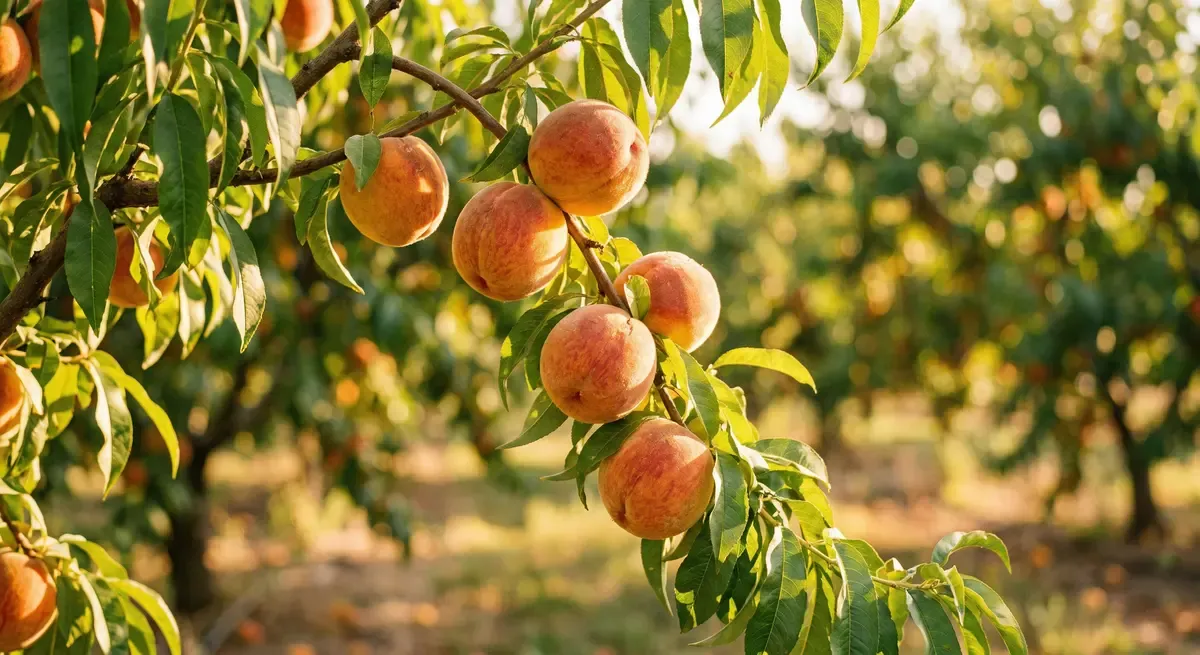
Low chill peach varieties are cultivars bred to complete their dormancy cycle with far less winter cold. Most need between 100 and 400 chill hours. Some, like Eva’s Pride, can get by with as few as 100. This makes them viable in USDA zones 8 through 10, across the southern United States, coastal California, parts of the UK and southern Europe, and anywhere else where winters are mild.
There is a lot of history behind these varieties. The University of Florida has been developing low chill stone fruit since the 1950s. Their programme has produced dozens of commercial and home-garden varieties adapted to Florida’s 100 to 300 chill hour range. California breeders, particularly Floyd Zaiger of Zaiger Genetics, have contributed varieties like Eva’s Pride and Saturn that combine low chill needs with exceptional flavour.
The best low chill peach varieties
Not all low chill peaches are equal. Some are bred for commercial shipping and sacrifice flavour for firmness. Others are outstanding eating peaches that bruise if you look at them sideways. Here is what I have learned from growing them, talking to other warm-climate growers, and reading trial data from university extension programmes.
| Variety | Chill hours | Flesh | Stone | Flavour | Harvest | Zones |
|---|---|---|---|---|---|---|
| Florida Prince | 150 | Yellow | Semi-cling | Sweet, mild acidity | Early (May) | 8-10 |
| Tropic Beauty | 150 | Yellow | Semi-free | Rich, balanced | Early-mid (May-June) | 8-10 |
| Desert Gold | 200 | Yellow | Freestone | Classic peach, sweet-tart | Early (May) | 8-10 |
| Eva’s Pride | 100-200 | Yellow/white | Freestone | Rich, complex | Mid (June-July) | 8-10 |
| Red Baron | 250-300 | Yellow | Freestone | Rich, full flavour | Mid (June-July) | 7-10 |
| Bonanza (dwarf) | 250 | Yellow | Freestone | Good, sweet | Mid (July) | 7-10 |
| Flordaprince | 150 | Yellow | Semi-cling | Sweet, low acid | Very early (April-May) | 8-10 |
| Saturn / Donut | 300 | White | Freestone | Sweet, aromatic, floral | Mid-late (July) | 7-10 |
A few notes on the standouts.
Florida Prince is the workhorse of warm-climate peach growing. At 150 chill hours, it fruits reliably in places where almost nothing else will. The flavour is good, not extraordinary, but the consistency is what matters. It produces year after year without drama. If you are new to low chill peaches, this is a safe first choice.
Eva’s Pride is the one that changed my mind about low chill peaches. I had assumed that breeding for low chill meant sacrificing flavour. Eva’s Pride proved me wrong. It is a rich, complex peach that holds its own against any high-chill variety I have tasted. The chill requirement is low, just 100 to 200 hours. If your climate can support it, plant this one.
Tropic Beauty comes from the University of Florida programme and is one of the most widely planted low chill peaches commercially. It has better bacterial spot resistance than many alternatives, which matters in humid climates. The flavour is solid, the tree is vigorous, and it is self-fertile like most peaches.
Red Baron is worth mentioning for a different reason. Beyond producing good fruit at 250 to 300 chill hours, it has spectacular double red blossoms in spring. It works as both an ornamental and a productive fruit tree. In a small garden where every tree needs to earn its space, that two-for-one matters.
Bonanza is a genetic dwarf that tops out at about 1.5 to 2 metres. It produces full-sized fruit on a tree small enough for a large container. At 250 chill hours, it is a realistic option for patios and balconies in warm climates. The fruit is sweet and pleasant, if not as complex as Eva’s Pride.
Saturn, also sold as the donut or flat peach, needs a bit more chill at 300 hours but the eating experience is unlike any other peach. The white flesh is sweet and aromatic with almost no acidity. Children tend to love them. The flat shape also makes them easier to eat without juice running down your chin.
Track your peach trees from planting to harvest.


How to check your chill hours
Before you order trees, you need to know what your garden actually accumulates in a typical winter. There is no point planting a 300-hour variety if your area only gets 150.
Your best source is your state or regional cooperative extension service. In the US, university extension offices track chill hour accumulation at weather stations and often publish the data online. Search for your state plus “extension service chill hours” and you will usually find something useful. In the UK and Europe, national meteorological services provide hourly temperature data you can use to calculate chill hours manually.
If you want a quicker answer, Leaftide’s chill hour validator lets you check whether your location meets the chill requirements for specific fruit tree varieties. It cross-references your area with variety data so you can spot mismatches before you spend money on trees that will not perform.
One important detail: chill hours vary from year to year. A location that averages 350 hours might drop to 200 in a warm winter and reach 500 in a cold one. When choosing varieties, give yourself a buffer. If your average is 300 hours, lean towards varieties that need 200 or less. That way, even in a warm winter, your trees will still fruit.
Growing tips for warm climates
Getting the variety right is the biggest decision, but warm-climate peach growing has a few other considerations that differ from traditional peach culture.
Late frost is still a risk. Low chill peaches bloom early, sometimes very early. Florida Prince can flower in February in zone 9. If a late frost hits after bloom, you lose the crop. In areas prone to spring frosts, choose varieties on the higher end of your chill range. They will bloom a bit later, which reduces frost risk. You can also protect small trees with frost cloth on cold nights.
Heat tolerance matters. Not all peach varieties handle extreme summer heat equally well. Desert Gold and the Florida-bred varieties were selected in hot climates and tolerate sustained temperatures above 38°C (100°F). Some California-bred varieties perform better in the 30 to 35°C range. If you are in a genuinely hot climate, the Deep South and Southwest varieties tend to cope better.
Thinning is not optional. Low chill peaches in warm climates often set heavily because pollination conditions are good and there is no frost to thin the crop naturally. If you do not thin the fruit to one peach every 15 to 20 centimetres along the branch, you will get a large number of small, flavourless peaches instead of a reasonable number of good ones. Thin early, about four weeks after bloom, and be more aggressive than feels comfortable.
White vs yellow flesh low chill varieties
This is partly a matter of taste and partly a practical consideration.
Yellow flesh peaches, like Florida Prince, Desert Gold, and Tropic Beauty, have the classic peach flavour profile: sweet with noticeable acidity, a firm texture that holds up in cooking, and that familiar golden colour. They are more forgiving of handling and transport. If you plan to make preserves, pies, or anything cooked, yellow flesh varieties are the better choice.
White flesh peaches, like Eva’s Pride and Saturn, tend to be sweeter with lower acidity and a more floral, aromatic quality. The flavour is often described as more complex or perfumed. They are outstanding eaten fresh, straight from the tree. The trade-off is that they bruise more easily and do not hold up as well after picking. If you are growing for your own kitchen and can eat them the day you pick them, white flesh varieties are worth every bit of extra care.
For a home garden, I would suggest planting at least one of each. The harvest windows are often different, which extends your peach season. And the flavour profiles are distinct enough that they feel like different fruits. My own garden has Eva’s Pride for fresh eating and Desert Gold for cooking, and between them I have peaches from late May through July.
Putting your collection together
Think about your selection as a whole rather than picking varieties in isolation. Stagger your harvest by choosing varieties with different ripening times. Flordaprince and Florida Prince ripen earliest, often in April or May. Eva’s Pride and Red Baron come in mid-season. Saturn extends the harvest into late July. Most peach varieties are self-fertile, so you do not strictly need a pollinator, but cross-pollination between varieties often improves fruit set and size.
Consider tree size too. If space is limited, Bonanza gives you a full-sized peach on a tree that fits in a large pot. Red Baron doubles as an ornamental. Standard varieties on semi-dwarf rootstock keep trees manageable at 3 to 4 metres.
Tracking what you plant and how it performs is where the real learning happens. I started recording bloom dates, harvest dates, and fruit quality for each variety, and after a few seasons the data told me things I would never have noticed otherwise. My Eva’s Pride consistently blooms ten days later than my Florida Prince, which means it dodges the late frosts that occasionally catch the earlier tree. I would not have spotted that pattern without written records. This is exactly the kind of thing I built Leaftide to help with, giving each tree its own profile where observations accumulate over time.
If you are not sure whether your climate suits these varieties, the can I grow pages cross-reference your location with specific plant requirements so you can check before you buy.
For a complete list of chill hour requirements across all fruit tree varieties, see Chill Hour Requirements: Complete Variety Reference.
Give each peach tree its own growing history.