| Type | When to plant | Weeks to harvest |
|---|---|---|
| First earlies | 6-8 weeks before last frost (late Feb-Mar UK; Mar-Apr US) | 10-12 |
| Second earlies | 2-4 weeks after first earlies | 13-16 |
| Maincrops | 2-4 weeks after second earlies | 16-22 |
Soil temperature must be at least 7C (45F) at planting depth.
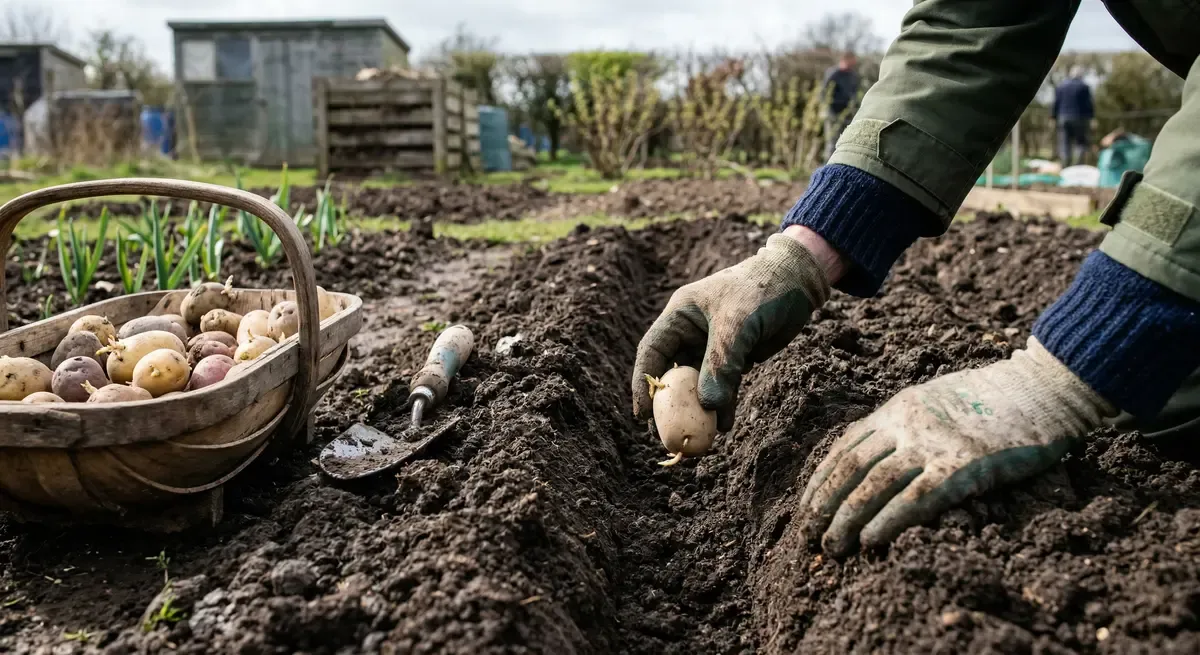
Two years ago I planted my first earlies on the first weekend of March because a gardening book said “plant in March.” The soil was cold, heavy with rain, and the seed potatoes sat in it for three weeks doing nothing. When I finally dug one up to check, it had started to rot. The ones that did sprout came up just in time for a late frost that blackened the shoots overnight. I got a harvest eventually, but it was small and late. The timing was not wrong in a general sense. It was wrong for my garden, that year, in that soil.
That experience taught me something I now think about with every crop: the calendar date matters far less than the conditions on the ground. With potatoes, the question is not really “when to plant” but “when is my soil ready and my frost risk low enough.”
The quick answer: it depends on frost dates and potato type
Potatoes are grouped into three categories based on how long they take to mature, and each group goes into the ground at a different time.
First earlies (varieties like Rocket, Swift, and Pentland Javelin) are the fastest. They take around 10-12 weeks from planting to harvest. Plant them 6-8 weeks before your last frost date. In mild parts of the UK, that means late February to mid March. In USDA zones 5-6, it is more like late March to mid April.
Second earlies (Charlotte, Kestrel, Nicola) take 13-16 weeks. Plant them 2-4 weeks after your first earlies go in.
Maincrops (King Edward, Maris Piper, Desiree) need 16-22 weeks and produce the big yields for storage. They go in 2-4 weeks after second earlies, once the soil has warmed properly and frost risk is low.
This staggered approach is not just about spreading the harvest. Each group has different frost tolerance during the critical emergence phase. First earlies are planted earlier because they are harvested before the heat of summer. Maincrops need the longest frost-free window, so they wait until conditions are settled.
If you do not know your last frost date, that is the first thing to sort out. The last frost date guide explains how to find yours and what the number actually means. You can also look it up directly with the Frost Date Finder.
Soil temperature matters more than the calendar
I have learned to trust my soil thermometer more than any planting chart. Potatoes need a minimum soil temperature of 7-10C (45-50F) at planting depth, which is about 10-15cm down. Below that, the seed potatoes sit dormant. In cold, wet soil they are more likely to rot than sprout.
The calendar date when soil hits 7C varies enormously depending on your location, soil type, and aspect. A south-facing raised bed with sandy soil might reach 7C in early March. A north-facing clay plot might not get there until mid April, even in the same town.
A soil thermometer costs a few pounds and removes the guesswork. Check the temperature at 10cm depth for a few mornings in a row. If it is consistently above 7C, you are in the window. If it is hovering around 5-6C, wait another week or two.
Raised beds and containers warm up faster than open ground because they have better drainage and more surface area exposed to the sun. If you are gardening on heavy clay, this is worth remembering. Your neighbours on sandy soil might be planting two weeks before you, and that is fine.
Planting by region
Potato planting dates vary widely depending on where you live. Here is a rough guide, but your local frost date and soil conditions should always take priority over regional averages.
United Kingdom
- South and south-west England, coastal Wales (mild, frost-free early): First earlies from late February. Second earlies from mid March. Maincrops from late March to early April.
- Midlands, East Anglia, northern Wales: First earlies from mid March. Second earlies from late March. Maincrops from mid April.
- Northern England, Scotland, Northern Ireland: First earlies from late March to early April. Second earlies from mid April. Maincrops from late April to early May.
United States
- Zones 8-10 (southern states, Pacific coast): First earlies from February to early March. Some gardeners in zone 9-10 plant a second crop in late summer for an autumn harvest.
- Zones 5-7 (mid-Atlantic, Midwest, Pacific Northwest): First earlies from late March to mid April. Maincrops from mid April to early May.
- Zones 3-4 (northern states, mountain regions): First earlies from late April to mid May. The season is short, so many gardeners here focus on earlies and skip maincrops entirely.
Southern hemisphere (Australia, New Zealand, South Africa)
The seasons are reversed. Plant first earlies in August to September and maincrops in September to October. In tropical and subtropical regions, potatoes grow best in the cooler months, so planting shifts to March through May.
The Crop Timeline Calculator can show you a personalised planting window based on your specific location and frost dates, which is more precise than any regional table.
Your potato planting date depends on where you are, not a generic chart.


Chitting: the six-week head start
Chitting is the process of encouraging seed potatoes to sprout before planting. It is not strictly necessary, but it gives first earlies a meaningful head start and helps you spot any duds before they go into the ground.
Start chitting about six weeks before your planned planting date. Stand the seed potatoes upright in egg boxes or seed trays with the end that has the most eyes facing up. Place them somewhere cool, light, and frost-free. A windowsill in an unheated room is ideal. Avoid warm, dark places, which produce long, pale, fragile shoots that snap off during planting.
After four to six weeks, the potatoes should have short, stubby, dark green or purple shoots about 1-2cm long. These are what you want. If the shoots are longer than 3cm and pale, the potatoes have been somewhere too warm or too dark.
For second earlies and maincrops, chitting is less critical because they have a longer growing season. But I still do it for maincrops because it lets me see which seed potatoes are viable. Any that have not sprouted after six weeks get composted rather than wasted in a planting hole.
What happens if you plant too early
Planting too early is the more common mistake, driven by enthusiasm and mild February days that feel like spring has arrived. The risks are real.
Cold, wet soil causes rot. Seed potatoes are essentially food stores. In waterlogged soil below 7C, they decompose instead of sprouting. You lose the seed potato and the planting slot.
Frost kills emerging shoots. Potato foliage is not frost-hardy. A hard frost (below -2C) will kill any growth above ground. The plant usually regrows from the tuber, but it loses several weeks of development. Each time the foliage gets frosted and regrows, the final yield drops.
You can protect against light frost. If shoots have emerged and frost is forecast, earth up the soil around them to cover the shoots completely. Horticultural fleece draped over the row also works. I keep a roll of fleece near my potato beds from March through May for exactly this reason.
The upside of planting a little early is a slightly earlier harvest, which matters most for first earlies. The downside is losing the crop entirely to rot or repeated frost damage. In my experience, waiting an extra week or two for the soil to warm up costs very little time but avoids the worst outcomes.
What happens if you plant too late
Late planting is less risky than early planting, but it has its own trade-offs.
First earlies planted late still produce. They just harvest later. If you plant first earlies in May instead of March, expect to harvest in July or August instead of June. The yield is usually fine.
Maincrops need a long season. This is where late planting causes real problems. A maincrop variety that needs 20 weeks to mature must go in early enough to finish before the first autumn frost. If your first frost arrives in mid October, planting maincrops in June leaves only 18-19 weeks. The tubers will be smaller and the skins will not have set properly for storage.
Late plantings face more pest pressure. Potato blight spores are most active in warm, humid conditions from July onwards. A late-planted crop spends more of its growing season in peak blight conditions. First earlies planted on time are often harvested before blight arrives, which is one of their main advantages.
If you have missed the ideal window for maincrops, consider switching to a second early variety instead. They mature faster and still give a decent yield for fresh eating, even if they are not ideal for long-term storage.
Container potatoes: more flexible timing
Growing potatoes in containers opens up the timing window because you control the soil temperature and can move the containers under cover if frost threatens.
A large container (at least 30 litres, ideally 40-50) filled with multipurpose compost warms up faster than open ground. You can start first earlies in containers two to three weeks earlier than you would in the ground, as long as you can move them into a greenhouse, porch, or against a south-facing wall if frost is forecast.
Container growing also works well for late-season planting. Some gardeners plant a batch of first earlies in containers in June or July for a Christmas harvest, keeping them in a greenhouse or polytunnel as autumn temperatures drop.
The basics are simple: fill the container one-third full, place three to four seed potatoes on the surface, cover with 10-15cm of compost, and keep adding compost as the shoots grow (the container equivalent of earthing up). Water consistently. Containers dry out faster than beds, and inconsistent watering causes hollow or cracked tubers.
Putting it all together
The right time to plant potatoes is when your soil is warm enough and your frost risk is manageable for the type you are planting. First earlies go in first, maincrops go in last, and the gap between them is usually four to eight weeks depending on your climate.
If you are unsure about your timing, a soil thermometer and your local frost date will tell you more than any planting chart. And if you want to see how all three types fit into your season as a single timeline, the Crop Timeline Calculator lays it out clearly.
The one thing I would tell my past self: do not rush it. A potato planted into warm soil two weeks late will almost always outperform one planted into cold soil two weeks early. The soil does not care what the calendar says.
See when potatoes fit into your growing season.