| Window | Timing | Best for |
|---|---|---|
| Early spring | March-April (UK); as soon as ground is workable (US) | Bare root plants |
| Late summer/autumn | August-October | Potted runners; stronger first harvest next year |
Everbearing varieties fruit the same year if spring-planted. June-bearers fruit in year two.
The first strawberries I ever planted went into the ground in late June. I had bought a punnet of runners from a garden centre on impulse, dug a quick row in the sunniest spot I had, and watered them in. They survived. They even grew. But they did not fruit that year, and by the following spring half of them had rotted over winter because they never developed strong enough roots to handle the wet soil.
The timing was wrong. Not dramatically wrong, not a frost-killed-everything disaster, but quietly wrong in a way that cost me an entire season. I did not understand then that when you plant strawberries matters almost as much as where you plant them or how far apart they go. The planting window determines whether you get fruit this year or next, whether the roots establish before winter, and whether the plants are strong enough to survive their first cold season.
I have planted strawberries in every month from March to October since then. Some of those timings worked brilliantly. Others taught me expensive lessons. Here is what I have learned about getting the timing right.
The quick answer: two main windows
If you want a single answer, here it is. There are two good times to plant strawberries:
- Early spring (March to April in the UK, or as soon as the ground is workable in the US). This is the traditional window, especially for bare root plants. The soil is warming up, the days are lengthening, and the plants have the whole growing season ahead of them.
- Late summer to early autumn (August to October). This is the window many experienced growers prefer. The soil is warm from summer, roots establish quickly, and the plants go into winter already settled. They come out strong the following spring.
Which window is better depends on what type of strawberry you are planting, whether you are buying bare root or potted plants, and what you want from the first year.
Why the type of strawberry changes the timing
Not all strawberries behave the same way through the season, and the type you choose determines what “good timing” actually means.
June-bearing varieties produce one large flush of fruit over two to three weeks in early summer. They are the heavy croppers, the ones that give you enough berries to make jam. But they only fruit on second-year growth. If you plant them in spring, you should remove the flowers in year one (more on that later) and wait for the real harvest in year two. Popular June-bearers include ‘Elsanta,’ ‘Cambridge Favourite,’ and ‘Honeoye.’
Everbearing varieties produce two or three flushes through the season, typically in early summer and again in early autumn. Plant them in early spring and you can expect some fruit from midsummer onwards in the same year. ‘Flamenco’ and ‘Buddy’ are reliable choices.
Day-neutral varieties fruit continuously from late spring through to the first frost, as long as temperatures stay between roughly 4 and 29 degrees Celsius. These are the most rewarding for impatient gardeners. Plant them in spring and you will be picking berries within a few months. ‘Albion,’ ‘Mara des Bois,’ and ‘Seascape’ are well-regarded day-neutral varieties.
The practical difference: if you want fruit this year, plant everbearing or day-neutral varieties in early spring. If you are happy to wait and want the biggest possible harvest, plant June-bearers in spring or autumn and let them build strength for a full crop the following year.
How frost dates determine your planting window
Strawberries are surprisingly cold-hardy once established. Dormant plants can survive temperatures well below freezing. But freshly planted strawberries, especially bare root ones that have not yet grown new roots, are vulnerable to hard frost.
Your last spring frost date sets the earliest safe planting time for bare root strawberries. You want the ground to be workable and the worst of the freezing nights behind you, but you do not need to wait until all frost risk has passed. Strawberry foliage tolerates light frost without damage.
In practice, this means:
- UK: Plant bare root strawberries from mid-March in the south to mid-April in the north. Potted runners can go in from April onwards.
- US zones 3-5: Plant from late April to mid-May, once the ground thaws and the soil temperature reaches about 4 to 7 degrees Celsius.
- US zones 6-7: Plant from mid-March to mid-April.
- US zones 8-10: Plant from late February to mid-March, or shift to autumn planting (October to November) to avoid summer heat stress.
If you do not know your frost dates, the Frost Date Finder will show you the spring and autumn dates for your location. Those two dates frame your planting windows.
Spring planting: the traditional approach
Spring is when most gardeners plant strawberries, and for good reason. The days are getting longer, the soil is warming, and the plants have months of growing weather ahead to establish roots and foliage.
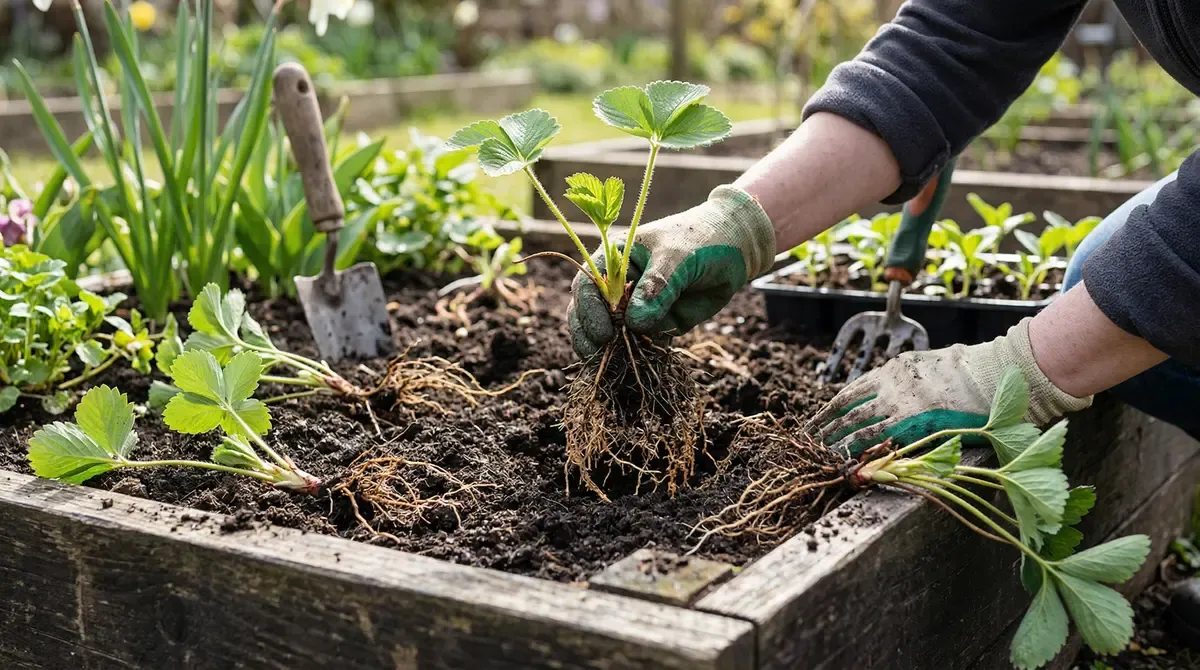
Bare root plants are the classic spring choice. They arrive dormant, with no leaves and a tangle of pale roots. They look dead. They are not. Bare root strawberries are dug from nursery fields in late winter while dormant, stored in cold conditions, and shipped ready to plant. They are cheaper than potted plants, especially in bulk, and they establish quickly when planted at the right time.
The ideal window for bare root planting is narrow: from the time the ground is workable until about four weeks after your last frost date. Plant too early and the roots sit in cold, wet soil and may rot. Plant too late and the plants struggle to establish before summer heat arrives.
Potted runners give you more flexibility. Because they already have an active root system in compost, they handle transplanting with less shock. You can plant potted strawberries from mid-spring right through to early summer without much risk, though earlier is still better because it gives the roots more time to spread into the surrounding soil before fruiting begins.
For spacing guidance once you have your timing sorted, the strawberry spacing guide covers the distances for every growing system.
Time your strawberry planting to your local climate.


Autumn planting: the approach experienced growers prefer
I resisted autumn planting for years because it felt counterintuitive. Why put plants in the ground just before winter? But after trying it, I understand why so many commercial growers and experienced gardeners swear by it.
When you plant strawberries in late summer or early autumn (August to October in the UK, September to November in milder US zones), the soil is still warm from months of summer sun. Roots grow rapidly in warm soil, and the plants establish a strong root system before the ground cools. They go dormant over winter already anchored and settled, then burst into vigorous growth the following spring.
The result is often a noticeably stronger first harvest compared to spring-planted strawberries of the same variety. The plants have had months of root development that spring-planted ones simply have not had by the time fruiting begins.
Autumn planting works best with potted runners, since bare root plants are typically only available in early spring. Some specialist nurseries sell cold-stored bare root runners in late summer, which are bare root plants held in cold storage since winter and released for summer planting. These work well for autumn establishment.
The risk with autumn planting is winter damage. In very cold climates (US zones 3-4, Scottish Highlands), newly planted strawberries may not establish enough root mass before the ground freezes. A thick mulch of straw or bark after the first hard frost helps insulate the crowns. In milder areas, autumn planting is low-risk and high-reward.
Why planting time affects your first-year harvest
The connection between planting date and first-year fruit is straightforward once you understand how strawberries grow.
A strawberry plant needs to establish roots, grow a canopy of leaves, and develop flower buds before it can produce fruit. Flower buds for June-bearing varieties actually form in autumn, triggered by shortening day length. This means a June-bearer planted in spring will form its flower buds the following autumn and fruit the spring after that. There is no shortcut. The biology requires two seasons.
Everbearing and day-neutral varieties are different. They form flower buds in response to temperature rather than day length, so they can initiate flowering within weeks of planting. A day-neutral strawberry planted in April can be flowering by June and fruiting by July. The harvest will be lighter than a fully established plant, but it is real fruit in the first year.
This is why the advice differs so sharply between types. Telling someone to “plant strawberries in spring for a summer harvest” is only true for everbearing and day-neutral varieties. For June-bearers, it is misleading.
The Crop Timeline Calculator accounts for these differences. Enter your strawberry variety and planting date, and it shows you when to realistically expect fruit based on the type and your local growing conditions.
Bare root vs potted plants: different timing rules
The format you buy your strawberries in changes the planting calendar.
Bare root strawberries have a tight window. They must be planted while dormant or just breaking dormancy, which means early spring in most climates. Once they leaf out fully, bare root plants struggle to establish because the leaves lose water faster than the undeveloped roots can replace it. If your bare root plants arrive and you cannot plant them immediately, heel them into a trench of moist soil or store them in the fridge (not the freezer) for up to a week.
Potted runners are more forgiving. The intact root ball means they can be planted from spring through autumn without the same transplant shock. The trade-off is cost. Potted plants typically cost two to three times more than bare root, which adds up if you are planting a full bed.
Cold-stored runners are a hybrid option. These are bare root plants held in commercial cold storage at around -2 degrees Celsius, which keeps them dormant well past their natural season. They can be planted from late spring through summer and establish quickly because they “think” it is still early spring. Commercial growers use cold-stored runners extensively for staggered planting and extended harvest seasons.
For a small garden, potted runners planted in spring or autumn are the simplest option. For a larger planting on a budget, bare root in early spring is hard to beat on value.
Regional timing at a glance
United Kingdom
| Region | Spring window | Autumn window |
|---|---|---|
| South West, coastal | Early March onwards | September to November |
| South East | Mid-March to April | September to October |
| Midlands | Late March to April | September to early October |
| Northern England | April | September to early October |
| Scotland, lowlands | April to early May | Late August to September |
| Scotland, highlands | May | August to early September |
United States (by USDA zone)
| Zone | Spring window | Autumn window |
|---|---|---|
| 3-4 | Late April to May | Not recommended (too cold) |
| 5-6 | April to early May | September to October |
| 7 | March to April | October to November |
| 8-9 | February to March | October to November |
| 10 | January to February | November to December |
In warmer zones (8-10), autumn planting is often preferred over spring because it avoids the stress of establishing plants in summer heat. In colder zones (3-4), spring planting is safer because autumn-planted strawberries may not survive the winter.
Container strawberries: more flexible timing
One advantage of growing strawberries in pots is that the planting window stretches wider. You can move containers to sheltered spots during cold snaps, bring them under cover if frost threatens, and control the soil temperature more easily than in open ground.
Container strawberries can be planted from early spring right through to early autumn in most climates. The main constraint is not frost but establishment time. Plants need at least six to eight weeks of growing weather after planting to develop enough roots to sustain themselves. As long as you can provide that, the timing is flexible.
I have planted container strawberries as late as September and had them fruit well the following June. The pots spent winter against a south-facing wall, which kept the soil a few degrees warmer than the open garden. By spring, the roots had filled the pot and the plants were ready to go.
If you are growing in containers, the strawberry spacing guide has specific recommendations for pot sizes and plant numbers.
The first-year sacrifice: removing flowers for stronger plants
This is the advice that every new strawberry grower hates hearing. For June-bearing varieties planted in spring, you should remove all the flowers in the first year. Every single one. Do not let the plant fruit.
The reason is resource allocation. A strawberry plant that flowers and fruits in its first year diverts energy away from root and crown development. The roots stay shallow, the crowns stay small, and the plant goes into its first winter weaker than it should be. The fruit you get is a handful of small berries. The fruit you lose, by having a weaker plant in year two, is a full harvest of large, abundant berries.
I did not follow this advice with my first planting. I wanted strawberries and I wanted them now. The plants fruited lightly, produced a few dozen small berries, and then half of them died over winter. The ones that survived produced a mediocre crop the following year. When I replanted and actually removed the flowers, the difference in year-two vigour was obvious. Bigger crowns, more runners, and easily three times the fruit.
For everbearing and day-neutral varieties, the advice is slightly different. Remove flowers for the first six weeks after planting to let the roots establish, then allow the plant to fruit from midsummer onwards. This gives you some first-year fruit without completely sacrificing establishment.
It is a patience game. The first-year sacrifice pays for itself many times over in years two and three.
Track your strawberry plantings season by season.
Getting the timing right
Strawberry timing is not complicated, but it is specific. The right planting date depends on your climate, your strawberry type, and whether you are buying bare root or potted plants. Get it right and the plants establish fast and fruit at the earliest possible moment. Get it wrong and you lose a season, or worse, lose the plants entirely.
If I were starting a new strawberry bed today, I would plant potted everbearing runners in early April for some first-year fruit, and add a row of bare root June-bearers at the same time for a heavy crop the following year. That combination gives you something to pick this summer and something to look forward to next year.
The Frost Date Finder will tell you when your spring window opens. The Crop Timeline Calculator will show you what to expect from each variety at your planting date. And the strawberry spacing guide will help you fit everything into whatever space you have. Between those three, the guesswork is gone.