| Method | Between Plants | Between Rows |
|---|---|---|
| Matted row | 45–60 cm | 90–120 cm |
| Hill system | 30 cm | 60–75 cm |
| Raised bed | 25–30 cm (grid) | — |
My first strawberry bed was a single row of twelve plants, spaced about 20 centimetres apart because that was what felt right. By midsummer, the runners had turned it into an impenetrable mat. The plants on the edges fruited well. The ones in the middle produced tiny, misshapen berries that rotted before they ripened, buried under layers of foliage that never dried out after rain.
The spacing was wrong, but not in the way I expected. It was not simply “too close” or “too far.” It was wrong for the system I was using. That is the thing about strawberry spacing that most guides gloss over. The right distance between plants depends entirely on how you plan to grow them.
The quick answer: it depends on the system
If you are looking for a single number, here is the short version:
- Matted row: 45 to 60cm between plants, rows 90 to 120cm apart. Runners fill the gaps.
- Hill system: 30cm apart in staggered rows, all runners removed.
- Raised bed: 25 to 30cm grid spacing, runners removed.
Those numbers cover most home garden situations. But the differences between these systems matter more than you might think, and picking the wrong spacing for your setup leads to exactly the problems I had in that first bed. The rest of this guide explains why each system needs different spacing and how to get it right.
Why strawberry spacing is different from most crops
With most vegetables, spacing is straightforward. You look up the mature size of the plant, add a margin for airflow, and that is your distance. A tomato needs 45 to 60cm. A lettuce needs 25 to 30cm. The plant stays where you put it.
Strawberries do not stay where you put them. They send out runners, long stems that creep along the soil surface and root new daughter plants at their tips. A single strawberry plant can produce a dozen runners in a season, each one capable of establishing a new plant 30 to 60cm from the parent.
This changes the spacing calculation completely. You are not just spacing for the plant you put in the ground. You are spacing for the plant it will become, plus all the offspring it will produce. In some systems, you want those runners. In others, you do not. That decision drives everything.
The other factor is crown density. A strawberry plant fruits from its crown, the central growing point where the leaves emerge. As the plant ages, it develops multiple crowns. A three-year-old plant might have five or six crowns, each one producing flowers and fruit. But if the crowns are packed too tightly, whether from runners or from planting too close, they shade each other out and the fruit quality drops.
Spacing by growing system
Matted row
The matted row is the traditional system for June-bearing strawberries and the one most allotment growers use. You plant a single row and let the runners fill in the space between plants to create a dense strip about 30 to 45cm wide.
Plant spacing: 45 to 60cm apart within the row. Row spacing: 90 to 120cm between rows (centre to centre). Runner management: Allow runners to root within the row strip. Remove any that grow into the path between rows.
The wide row spacing looks wasteful at first. But the runners need room to fill in without the rows merging into each other, and you need a path for picking. Once the rows fill in, you will be harvesting every few days during the fruiting season, and you need to reach every plant without stepping on the bed.
In the first year, a matted row looks sparse. By the second year, the runners have filled the gaps and you have a continuous strip of plants. By the third year, the strip can become too dense. Most growers renovate after harvest by mowing the foliage, narrowing the rows back to 30cm, and thinning plants to about 15cm apart within the strip. This keeps the bed productive for another year or two.
Hill system
The hill system treats each strawberry plant as an individual. You remove every runner as it appears, forcing the plant to put all its energy into crown development and fruit production. The result is fewer but larger berries from bigger, more vigorous plants.
Plant spacing: 30cm apart in staggered double or triple rows. Row group spacing: 60 to 75cm between groups of rows. Runner management: Remove all runners throughout the season.
This system works well for everbearing and day-neutral varieties, which produce fewer runners naturally and fruit over a longer period. It also suits gardeners who want a tidy, manageable bed rather than a sprawling mat.
The trade-off is labour. Removing runners every week or two through the growing season takes time. If you let them go for a month, the bed starts turning into a matted row whether you intended it or not. I find it easiest to check the bed when I am picking fruit, since I am already there and the runners are easy to spot.
Raised beds
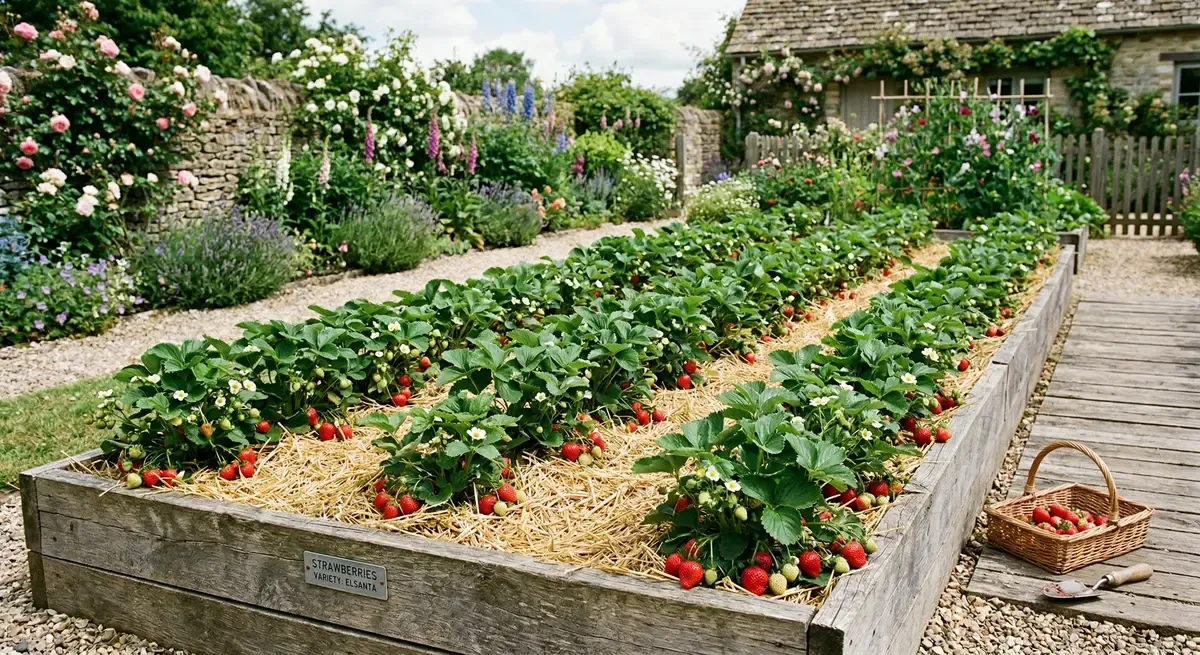
Raised beds suit strawberries well. The drainage is better, so crown rot is less of a worry. The soil warms earlier in spring. And the height makes picking easier on your back. Spacing in a raised bed follows the hill system logic, since you generally do not want runners filling a carefully planned bed.
Plant spacing: 25 to 30cm in a grid pattern. Runner management: Remove all runners.
In a standard 120cm wide raised bed, you can fit four rows of strawberries with 30cm spacing, giving you roughly 24 to 32 plants in a 120cm by 240cm bed. That is enough for a steady supply through the season if you choose an everbearing variety.
The tighter spacing works in raised beds because the soil is typically richer and better drained than ground-level beds. But do not push it below 25cm. Strawberries need airflow around the fruit to prevent botrytis, and in a raised bed where the plants are at waist height, you notice mouldy fruit immediately.
A spacing calculator is useful here for working out exactly how many plants fit your specific bed dimensions without guessing.
Plan your strawberry bed before you plant it.


Containers and pots
Strawberries grow surprisingly well in containers. A single plant in a 20cm pot will fruit, but a 30 to 40cm pot with two or three plants is more productive and looks better.
Spacing: 15 to 20cm between plants in the same container. Pot size: At least 20cm diameter per plant, 15cm deep minimum. Runner management: Remove runners, or train one or two into adjacent pots to propagate new plants.
The main challenge with containers is water. Strawberries in pots dry out fast, especially during fruiting when the plants are thirsty. Terracotta pots look lovely but lose moisture through the walls. Plastic or glazed ceramic holds water better. Either way, check daily in warm weather.
Hanging baskets
Hanging baskets work for strawberries because the fruit hangs over the edge, away from soil-borne diseases and slugs. Plant three to five plants per 30cm basket, spaced evenly around the rim.
Everbearing varieties are the best choice for baskets. They fruit over a longer period, giving you a steady trickle rather than one big flush. Day-neutral varieties like ‘Albion’ or ‘Mara des Bois’ are popular choices.
The downside is the same as containers but worse. Hanging baskets dry out even faster because they are exposed to wind on all sides. In midsummer, you may need to water twice a day. A drip irrigation line run up to the basket solves this if you have several.
Strawberry towers and vertical planters
Vertical planters, whether commercial strawberry towers or DIY stacked pots, let you grow a lot of plants in a small footprint. Most tower systems have planting pockets spaced 15 to 20cm apart vertically, with one plant per pocket.
The spacing is built into the design, so there is not much to adjust. The thing to watch is light. Plants on the north-facing side of a tower get noticeably less sun than those facing south. Rotate the tower every week or two if it is freestanding, or accept that one side will produce less.
Watering is the other challenge. Water runs down through the tower, so the top plants often dry out while the bottom ones sit in excess moisture. A slow drip at the top, rather than a heavy pour, distributes water more evenly.
June-bearing vs everbearing vs day-neutral
The type of strawberry you grow changes the spacing equation, because each type behaves differently through the season.
June-bearing varieties produce one large crop over two to three weeks in early summer. They send out abundant runners after fruiting and are the natural fit for matted row systems. Space them wider (45 to 60cm) because you want those runners to fill in. Popular varieties include ‘Elsanta,’ ‘Cambridge Favourite,’ and ‘Honeoye.’
Everbearing varieties produce two or three flushes of fruit through the season, typically in early summer and again in early autumn. They produce fewer runners than June-bearers. Space them at 25 to 30cm in hill or raised bed systems. ‘Flamenco’ and ‘Buddy’ are reliable choices.
Day-neutral varieties fruit continuously from late spring through to the first frost, as long as temperatures stay between roughly 4 and 29 degrees Celsius. They produce very few runners and are ideal for containers, raised beds, and hill systems at 25 to 30cm spacing. ‘Albion,’ ‘Mara des Bois,’ and ‘Seascape’ are well-regarded day-neutral varieties.
It comes down to runners. Varieties that throw out lots of runners need wider initial spacing to accommodate the spread. Varieties that produce few runners can go closer together, and they will stay that way through the season.
For a deeper look at how spacing interacts with other crops in your garden, the plant spacing guide covers the general principles that apply across vegetables, fruit, and hedges.
Managing runners: when to let them fill in and when to cut
Runners are not a problem to solve. They are a tool to use or not use, depending on your system.
Let runners fill in when:
- You are growing in a matted row system and want the row to establish quickly.
- You want to propagate new plants for free. Peg a runner into a small pot of compost next to the parent plant, let it root for four to six weeks, then cut the stem and move the new plant wherever you need it.
- You are establishing a new strawberry bed and want full coverage by the second year.
Remove runners when:
- You are growing in a hill system, raised bed, or container where space is fixed.
- Your plants are in their first year and you want them to establish strong root systems before reproducing. Many growers remove all runners and flowers in the first season to build plant vigour for a bigger harvest in year two.
- The bed is already at full density and additional plants would cause overcrowding.
To remove a runner, trace it back to the parent plant and cut it close to the crown with clean scissors or secateurs. Do not pull it, as that can damage the parent plant’s crown. Check every week or two during the growing season. Runners appear fast, and a plant you cleaned up on Monday can have new runners reaching 30cm by the following weekend.
One approach I have found useful is to let the strongest two or three runners root each year as replacements, then remove the oldest plants. Strawberry plants decline after three or four years, and this rolling replacement keeps the bed productive without having to replant the whole thing at once.
Keep track of what each strawberry bed is doing.
Getting the spacing right from the start
Strawberry spacing is not complicated once you know which system you are using. The mistake I made in that first bed was not that I planted too close in absolute terms. Thirty centimetres would have been fine in a hill system with runners removed. It was that I planted at hill-system spacing and then let the runners do whatever they wanted, which gave me matted-row density without matted-row structure.
Pick your system first. Then space accordingly. If you are not sure which system suits your garden, start with a raised bed at 30cm spacing with runners removed. It is the most forgiving approach and works with all three strawberry types. You can always experiment with matted rows later once you have a feel for how your varieties behave.