| Type | Between Plants | Between Rows |
|---|---|---|
| Sweet / bell peppers | 45–50 cm | 60–75 cm |
| Chillies (jalapeño, cayenne) | 30–40 cm | 50–60 cm |
| Compact / patio | 25–30 cm | 40–50 cm |
My first year growing peppers, I planted twelve seedlings in a bed that should have held six. They looked so small at transplanting time. Tiny stems, a few leaves each, plenty of space between them. By August, the bed was an impenetrable wall of foliage. The plants were tall enough, but the fruit was disappointing. Small peppers, not many of them, and the lower leaves had gone yellow and mouldy from sitting in permanent shade and damp.
The following year I gave each plant proper space. Same variety, same soil, same watering. Half the number of plants produced nearly twice the fruit. That was the season I stopped guessing at spacing and started measuring.
Pepper spacing is not complicated, but it varies by type, growing method, and how much room you have.
The quick answer: how far apart to plant peppers
For most pepper varieties, plant 40-50cm apart with 60-75cm between rows. That is the range that works for the majority of sweet and hot peppers in open ground or raised beds.
But “most peppers” covers a lot of ground. A compact chilli plant and a full-sized bell pepper have very different appetites for space.
Sweet and bell peppers are the largest plants in the pepper family. They grow wide and bushy, with heavy fruit that pulls branches outward. Give them 45-50cm between plants. Anything less and the branches tangle, airflow drops, and you end up reaching through a thicket to find fruit.
Chilli peppers vary enormously by variety, but most are more compact than bells. Smaller varieties like cayenne and Thai chillies can go in at 30-35cm spacing. Medium varieties like jalapeño do well at 35-40cm. Larger chilli plants like habanero and Scotch bonnet need the full 40-45cm because they bush out more than you expect.
Compact and dwarf varieties bred for containers or small spaces can be planted at 25-30cm. These are varieties specifically selected for a smaller growth habit. If the seed packet or label says “compact” or “patio,” you can tighten the spacing. If it does not say that, assume standard spacing.
Why pepper spacing matters
Peppers are not like lettuce or radishes where you can get away with cramming them in and thinning later. They are long-season plants that occupy their space for months. Getting the spacing wrong at transplanting time means living with the consequences until the end of the season.
Airflow is the biggest reason to space peppers properly. Peppers are susceptible to fungal diseases, particularly botrytis (grey mould) and bacterial leaf spot. These thrive in still, humid conditions. When pepper plants are packed tight, the air between them does not move. Morning dew and rain sit on the leaves for hours. I have watched botrytis take out half a crop of bell peppers planted at 30cm spacing while the same variety at 50cm stayed healthy all season.
Sun exposure affects fruit production directly. Pepper flowers need sunlight to set fruit. When plants are too close, the interior of the canopy gets shaded, and flowers in those shaded areas often drop without producing. You end up with fruit only on the outer edges of the plant, which means less harvest per plant and per square metre.
Fruit size suffers when plants compete for nutrients and water. A pepper plant with adequate space puts its energy into fewer, larger fruit. A crowded plant spreads its resources thin and produces many small, often misshapen peppers. If you are growing bells for stuffing or slicing, this matters a lot.
Spacing by growing method
The right distance between pepper plants depends partly on how your growing area is set up.
Row gardening
Traditional row spacing for peppers is 40-50cm between plants within the row and 60-75cm between rows. The wider row spacing accounts for walking access and allows you to get between the rows for watering, feeding, and harvesting without brushing against the plants and knocking off fruit.
If you stake or cage your peppers (which I recommend for bell peppers and any heavy-fruiting variety), you can tighten the row spacing to 50-60cm because the plants grow more vertically and take up less lateral space.
Raised beds
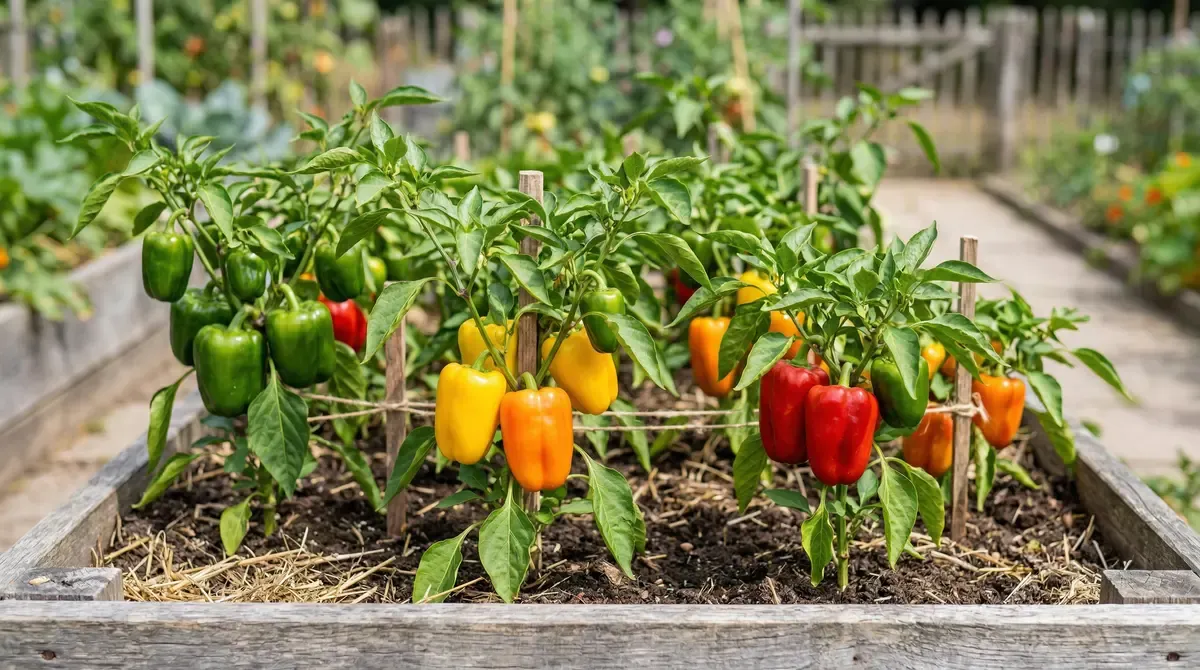
Raised beds let you reduce spacing slightly because the soil is better, drainage is improved, and there is no foot traffic compaction. In a raised bed, plant peppers at 40-45cm spacing in an offset grid pattern rather than straight rows. This honeycomb arrangement fits more plants per square metre while maintaining adequate airflow between them.
In a standard 120cm wide raised bed, that gives you two rows of peppers with plants staggered. A 120cm by 240cm bed comfortably holds eight to ten bell pepper plants or twelve to fourteen compact chilli plants. For help planning the exact layout, a spacing calculator takes the guesswork out of fitting plants into your bed dimensions.
Containers and grow bags
Container growing works differently because each plant has its own isolated root space. The question becomes less about distance between plants and more about pot size.
I cover containers in detail further down, but the short version: one pepper plant per 30cm pot, or two to three compact chilli plants in a 45-50cm container. Grow bags (the standard 60-litre type) hold two to three pepper plants comfortably.
Plan your pepper layout before transplanting day.


Variety-specific spacing guide
These assume open ground or raised bed growing. For containers, see the next section.
Bell peppers (California Wonder, Big Bertha, Gypsy): 45-50cm apart. These are the largest pepper plants and produce the heaviest fruit. They need staking in exposed positions. Do not be tempted to go below 45cm. I have tried it, and the yield per plant drops enough that you would have been better off with fewer, well-spaced plants.
Jalapeño: 35-40cm apart. More compact than bells but still a decent-sized bush, and prolific enough that airflow matters. At 35cm they do fine in raised beds with good soil. In heavier ground, give them the full 40cm.
Habanero and Scotch bonnet need 40-45cm, which surprises people because the seedlings look so small. They grow into wide, branching plants that take up nearly as much room as bells. And since habaneros have a long season, they occupy that space for months.
Cayenne is one of the easier peppers to fit into tight spaces. 30-35cm works because the plants grow tall and narrow rather than bushy, so airflow between them stays reasonable even at closer spacing.
Sweet banana and Italian frying peppers: 40-45cm apart. Long, pendant fruit on medium-sized plants. The fruit hangs down and can touch the soil if the plant is not staked, so leave enough room for air underneath.
Padron and shishito: 35-40cm. These produce absurd quantities of small peppers, and you will be picking from them constantly. You need to reach into the plant without crushing the one next to it.
For a broader look at spacing across different vegetables, the plant spacing guide covers everything from lettuce to courgettes.
Growing peppers in containers
Container growing is where most people run into pepper spacing problems, because it is tempting to put multiple plants in one pot. Sometimes that works. Often it does not.
Pot sizes
20-25cm pots: suitable for compact chilli varieties only. One plant per pot. These dry out fast in summer, so expect to water daily or even twice daily in hot weather.
30cm pots: the standard size for one pepper plant of any variety. This gives enough root space for a full-sized bell pepper or a generous chilli plant. One plant per pot, no exceptions.
40-45cm pots or half barrels: you can fit two compact chilli plants in these, planted on opposite sides. For bell peppers, still stick to one plant. The extra soil volume helps with water retention and nutrient availability, which means healthier plants and more fruit.
Grow bags (35-60 litre): two pepper plants in a 35-litre bag, three in a 60-litre bag. Space them evenly along the length. Grow bags dry out faster than pots of equivalent volume because of the larger surface area, so factor in more frequent watering.
Container tips that affect spacing
Depth matters as much as width. Pepper roots go down 25-30cm. A wide, shallow container might look like it has room for two plants, but if the roots cannot go deep enough, both plants will suffer. Choose pots that are at least 30cm deep.
Wind exposure changes everything. Containers on balconies or rooftops get more wind than ground-level beds. Wind dries out soil faster and can damage plants that are not staked. In exposed positions, give container peppers slightly more space between pots (if you are grouping them) so air can circulate without creating a wind tunnel effect.
Feeding is more critical in containers. In-ground peppers can send roots out to find nutrients. Container peppers are limited to what is in the pot. Overcrowding in containers means the nutrient supply runs out faster, and you need to feed more frequently. One well-fed plant in a 30cm pot will always outperform two hungry plants in the same space.
Common spacing mistakes
After years of growing peppers and helping other growers plan their plots, these are the mistakes I see most often.
Spacing based on seedling size. A pepper seedling at transplanting time is 15-20cm tall with a handful of leaves. It looks like it needs 15cm of space. By midsummer, that same plant is 60-80cm tall and 40-50cm wide. Always space based on the mature size, not the transplanting size.
Ignoring the third dimension. Spacing is not just about the horizontal distance between stems. Pepper plants grow upward and outward. Two plants 45cm apart at soil level might have their canopies overlapping by 15cm at the top. Staking and pruning help manage this, but you need to account for it when planning.
Treating all peppers the same. A cayenne and a bell pepper have very different space requirements. Using a single spacing number for all your peppers means some are too close and others have wasted space between them. Take five minutes to look up the mature size of each variety you are growing.
Compensating with pruning instead of spacing. Some growers plant too close and then try to manage the overcrowding by aggressive pruning. This can work for tomatoes, but peppers do not respond as well to heavy pruning. You lose fruiting branches and stress the plant. It is better to get the spacing right from the start.
Ready to plan your layout? The Plot Designer guide shows you how to place plants with correct spacing on a map of your actual garden.
See exactly where each pepper goes before you plant.