| Method | Spacing Between Plants |
|---|---|
| Ground / bush | 90–120 cm |
| Trellised / climbing | 30–45 cm |
| Raised bed with trellis | 30–40 cm |
My first cucumber crop looked promising until about mid-July. I had planted six seedlings in a 120cm raised bed, all on the ground with no support, spaced roughly 30cm apart because that is what I do with most things. By the time the vines hit their stride, the bed was an impenetrable tangle of leaves. I could not find the fruit without lifting handfuls of foliage, and every cucumber I did find had a yellow belly from sitting on damp soil. Half the plants had powdery mildew by August.
The problem was not the cucumbers. It was the spacing. And with cucumbers specifically, the right spacing depends almost entirely on one decision: whether you grow them on the ground or up a trellis.
The quick answer: ground vs trellis changes everything
Cucumbers are one of the few vegetables where the spacing depends almost entirely on how you grow them. Most vegetables have a fairly narrow range. Cucumbers have two completely different numbers.
Ground or bush cucumbers: 90-120cm between plants. These varieties sprawl outward, and each plant can easily cover a square metre of ground by midsummer. They need that space for airflow and to keep fruit off damp soil.
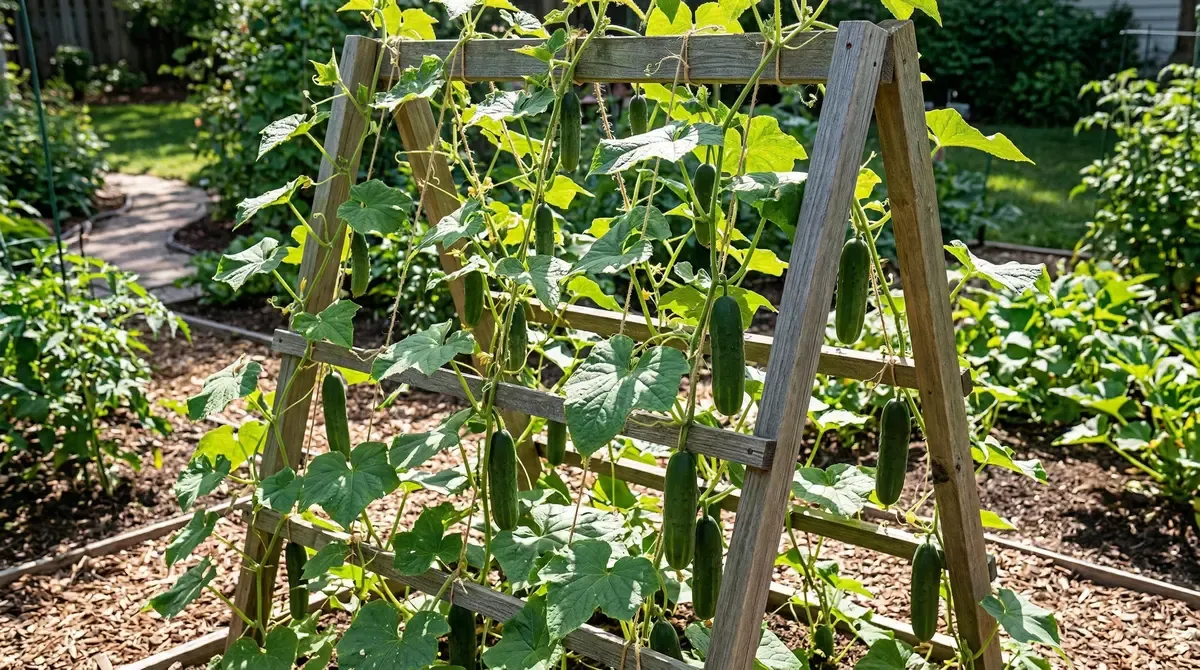
Trellised or climbing cucumbers: 30-45cm between plants. When you train cucumbers vertically, the vines grow upward instead of outward. The footprint of each plant shrinks to a narrow column, and you can fit three or four plants in the space one bush plant would occupy.
That is a three-to-one ratio. If you have limited space, growing cucumbers vertically is one of the biggest wins in the garden. The plant spacing guide covers the general principles, but cucumbers are a special case worth understanding on their own.
Why the trellis distinction matters so much
Most vegetable spacing is about the mature size of the plant. A cabbage needs 45cm because that is how wide it grows. Simple enough. Cucumbers are different because they are vines, and vines can be directed.
A cucumber vine left on the ground will send runners in every direction, each one producing leaves, tendrils, and side shoots. The plant becomes a flat disc of foliage, sometimes 150cm across. All of that growth happens at ground level, where air movement is poorest and moisture lingers longest. This is why ground-grown cucumbers are so prone to powdery mildew. The leaves sit in still, humid air, and the fungus thrives.
Put that same plant on a trellis and the vine grows upward. The leaves spread out vertically instead of horizontally. Air moves freely around them. Morning dew dries faster. Fruit hangs in the air instead of resting on soil. The plant takes up perhaps 30cm of ground space instead of 120cm, and it is healthier for it.
This is why I now grow almost all my cucumbers vertically. The spacing savings alone are worth it, but the drop in disease is what sold me. I went from losing plants to mildew every August to harvesting clean cucumbers into October.
Spacing by growing method
The right distance between cucumber plants depends on your setup. Here are the numbers that work in practice.
Traditional rows (in-ground)
For bush cucumbers in rows, space plants 90-120cm apart within the row, with 120-150cm between rows. That between-row distance accounts for the sprawling vines and gives you a path to walk through for harvesting.
For trellised cucumbers in rows, space plants 30-45cm apart along the base of the trellis. Rows of trellises should be 90-120cm apart. The trellis itself should be at least 150cm tall. Cucumbers will climb higher if you let them, but 150cm keeps the fruit within easy picking reach.
Raised beds
Raised beds change the equation because the soil is better and you do not walk on it. Bush cucumbers in a raised bed can go at 60-90cm spacing, slightly tighter than in-ground rows because you are not wasting space on walking paths.
The bigger advantage of raised beds is vertical growing. Install a trellis along one end or down the centre of the bed and plant climbing cucumbers 30-40cm apart along it. A 120cm x 240cm bed with a trellis down one long side can support six to eight cucumber plants while leaving the rest of the bed free for other crops.
I use a simple A-frame trellis made from bamboo canes in my raised beds. It sits along the north edge so it does not shade the rest of the bed. The cucumbers climb up both sides, and I plant lettuce and herbs in the sunny space in front.
Containers
Cucumbers grow well in containers, as long as the pot is big enough. Use at least a 30-litre container for one plant, or a 40-litre for a bit more root room. One plant per pot is the rule. Trying to squeeze two into a single container leads to root competition and smaller fruit.
If you use a large trough or half-barrel (60cm diameter or wider), you can fit two plants with a small obelisk or trellis between them. The trellis is not optional in containers. Ground-sprawling cucumbers in pots trail over the edges, dry out faster, and produce poorly.
Containers dry out much faster than beds, so consistent watering matters more than precise spacing. A cucumber in a 30-litre pot on a hot day can need watering twice. Mulch the surface to slow evaporation.
Vertical growing and small spaces
If space is truly tight, cucumbers are a great candidate for vertical growing. A single trellised cucumber plant needs only about 30cm of ground space and produces just as much fruit as a sprawling one, sometimes more, because the fruit grows straighter and is easier to spot.
You can grow cucumbers up netting, string, wire panels, or even a sturdy tomato cage. The tendrils grip onto almost anything. I have seen people grow them up a chain-link fence, along a balcony railing, and up a repurposed ladder. As long as the support holds the weight of the vines and fruit, it works.
For the spacing calculator, enter your bed dimensions and select a climbing cucumber variety to see how many plants fit along your trellis.
Plan your cucumber spacing with real data.


Spacing by cucumber variety
Not all cucumbers grow the same way. The variety you choose affects how much space each plant needs.
Slicing cucumbers
These are the standard long cucumbers you slice for salads. Varieties like Marketmore, Burpless Tasty Green, and Telegraph. They produce vigorous vines and large leaves. On the ground, give them the full 90-120cm. On a trellis, 40-45cm works well. These are the hungriest and thirstiest cucumber types, so do not skimp on spacing.
Pickling cucumbers
Pickling varieties like National Pickling, Calypso, and Parisian Gherkin tend to be slightly more compact than slicing types. The vines are shorter and the leaves smaller. You can reduce spacing by about 10-15% compared to slicing cucumbers. On the ground, 75-100cm. On a trellis, 30-40cm.
Pickling cucumbers also produce more fruit per plant, which means more weight on the trellis. Use sturdy supports.
Burpless and long Asian types
Varieties like Suyo Long, Chinese Long, and Japanese climbing cucumbers produce very long fruit that really benefits from trellising. Grown on the ground, these cucumbers curve and develop flat spots. On a trellis, they hang straight and grow longer. Space them 40-45cm apart on a trellis. They are vigorous climbers and will happily reach 200cm or more.
Mini and snack cucumbers
Compact varieties like Mini Munch, Ministar, and Picolino are bred for small spaces. The vines are shorter, the leaves smaller, and the fruit is bite-sized. These are the most forgiving on spacing. On the ground, 60-75cm is enough. On a trellis, 25-30cm. They are also the best choice for containers and balcony growing.
Bush varieties
True bush cucumbers like Spacemaster, Bush Champion, and Patio Snacker have been bred to stay compact without a trellis. They form a bushy mound rather than long trailing vines. Space them 60-90cm apart. They do not need a trellis, though a small cage helps keep the fruit off the soil.
Bush varieties produce less per plant than vining types, but they fit into spaces where a full-sized cucumber vine would not work.
Common cucumber spacing mistakes
I have made most of these myself, and I see them in other gardens constantly.
Planting too close without a trellis. This is the most common mistake. Cucumber vines on the ground need far more space than people expect. That 30cm seedling will be a 120cm sprawl within weeks. If you cannot give them 90cm or more, grow them vertically.
Ignoring airflow. Cucumbers are magnets for powdery mildew, and poor airflow is the primary cause. When leaves overlap and touch, moisture sits on them for hours. Even with correct spacing, remove lower leaves as the plant grows to keep air moving at the base. With incorrect spacing, mildew is almost guaranteed.
Spacing for the seedling, not the adult plant. A cucumber seedling is 10cm across. The adult plant is a metre or more. It feels wasteful to leave 90cm of empty soil around a tiny plant, but that space fills in fast. Plan for the plant it will become, not the plant it is today.
Forgetting that cucumbers grow fast. From transplant to full-sized vine takes about four to six weeks. If you plant cucumbers next to slow-growing crops, the cucumbers will overwhelm them before they have a chance. Give neighbouring plants a head start, or put the cucumbers where their spread will not smother anything important.
Not thinning direct-sown seedlings. If you sow cucumber seeds directly into the soil, you often get two or three seedlings per station. It feels brutal to remove them, but leaving all three means none of them will produce well. Thin to one strong seedling per station at the spacing distances above.
Skipping the mulch. This is not strictly a spacing issue, but it makes a big difference for ground-grown cucumbers. A layer of straw or compost mulch between plants keeps fruit clean, retains moisture, and suppresses weeds. Without mulch, ground-grown cucumbers sit on bare soil, which splashes mud onto the fruit when it rains and encourages rot.
So which spacing do you actually use?
Cucumber spacing comes down to one question: are you growing up or out? If you have the space for ground-sprawling plants, give them 90-120cm and accept that they will take over their patch. If space is limited, or you want healthier plants with less disease, put up a trellis and plant at 30-45cm.
I grow all my cucumbers vertically now. The spacing savings let me fit more plants into my raised beds, the fruit is cleaner, and I have not lost a plant to powdery mildew since I made the switch. A simple trellis made from bamboo and string costs almost nothing and pays for itself in extra harvests.
If you are planning your beds and want to see exactly how many cucumber plants fit your space, the spacing calculator does the maths for you. And if you are growing cucumbers alongside other crops, the plant spacing guide covers the broader picture of how to arrange everything so nothing gets crowded out.
Ready to plan your layout? The Plot Designer guide shows you how to place plants with correct spacing on a map of your actual garden.
Know your cucumber sowing dates too.