| Type | Between Bulbs | Between Rows |
|---|---|---|
| Onion sets | 10–15 cm | 25–30 cm |
| Multi-sown clumps | 25–30 cm (all directions) | — |
| Spring onions | 1–2 cm | 10–15 cm |
My first onion harvest was a bag of marbles. Dozens of bulbs, none of them bigger than a golf ball. The variety was fine, the soil was fine, the watering was fine. The problem was that I had planted the sets about 5cm apart because I wanted to fit as many as possible into a 120cm bed. I thought more plants meant more onions. Technically that was true. But what I actually got was more tiny, disappointing onions.
The following year I gave them proper space. Same variety, same bed, same soil. The only change was spacing, and the bulbs came out two to three times the size. That taught me something I wish I had learned sooner: the spacing on the back of the packet is not a suggestion. After choosing the right variety, it is the single biggest thing you control.
The quick answer: onion spacing by planting method
Spacing depends on how you are planting: sets, direct-sown seeds, or transplants each have different requirements.
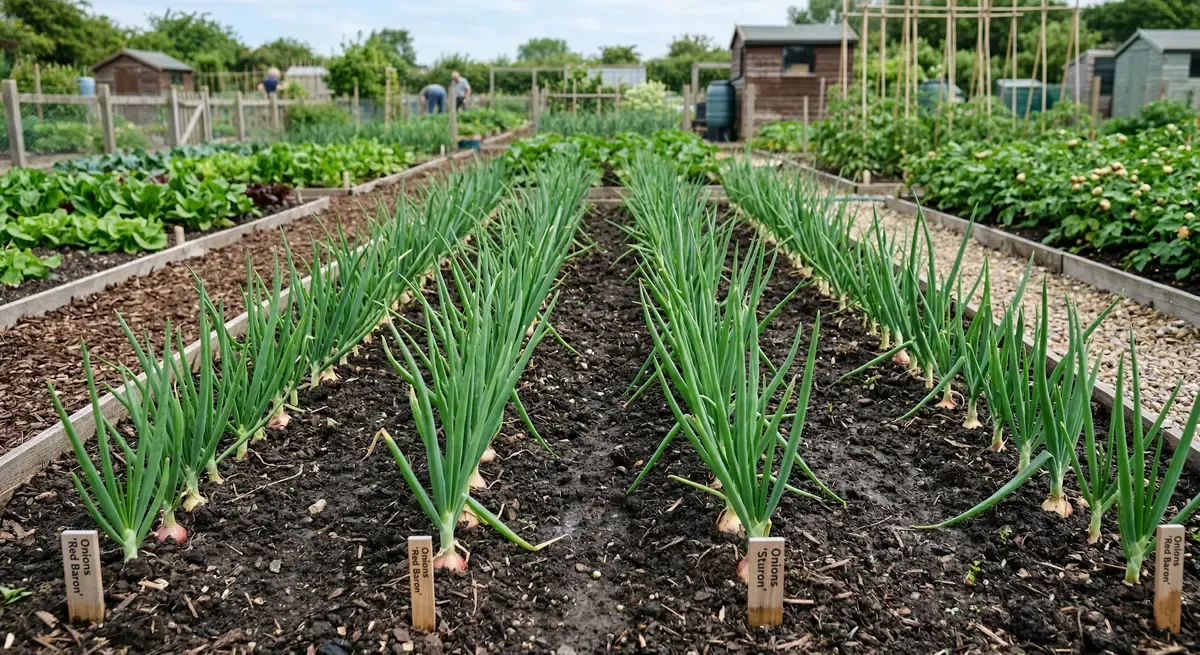
Onion sets (the small dormant bulbs most people start with) go in at 10-15cm apart within the row, with 25-30cm between rows. Push each set into the soil so the tip just shows above the surface. The wider 15cm spacing produces larger bulbs. The tighter 10cm spacing gives you more onions per row, but they will be smaller.
Direct-sown seeds should be sown thinly along the row and then thinned to 10cm apart once the seedlings are established. This is the part most people skip, and it is exactly why their onions stay small. Thinning feels wasteful, but the seedlings you remove can go into salads as spring onions, so nothing is lost.
Transplants (seedlings started indoors or bought as plugs) follow the same final spacing as sets: 10-15cm apart, rows 25-30cm apart. The advantage of transplants is that you skip the thinning step entirely because each plant is already individual.
If you are planning a bed and want to know exactly how many onions fit, a spacing calculator takes the guesswork out of it.
Why spacing controls bulb size
Onions are greedy. Each plant needs a generous share of water, nutrients, and sunlight to build a decent bulb. When you crowd them, every plant gets less of all three, and the bulbs reflect that directly.
The relationship is simple. More space per plant, bigger bulb. Less space, smaller bulb. The total yield by weight from a given area is often surprisingly similar whether you plant at 10cm or 15cm spacing. You just choose whether you want fewer large onions or more small ones.
There is a practical sweet spot. Below 8cm spacing, bulbs compete so heavily that many fail to size up at all. Above 20cm, you are wasting growing space without gaining much extra size. For most gardeners growing standard bulb onions, 10-15cm hits the balance between good bulb size and efficient use of the bed.
Light matters too. Onion leaves are upright and narrow, so they do not shade each other as badly as broad-leaved crops. But when rows are too close together, the outer leaves of adjacent rows overlap, and the inner plants get less light for photosynthesis. That 25-30cm row spacing keeps the canopy open enough for every plant to catch full sun.
Spacing by onion type
Not all alliums need the same room.
Bulb onions (the standard kitchen onion). 10-15cm between plants, 25-30cm between rows. This applies to all common varieties, whether white, red, or yellow. Larger exhibition varieties benefit from the wider end of that range, or even 20cm if you are growing for size.
Spring onions (scallions). These are harvested young, long before they need real space. Sow seeds 1-2cm apart in rows 10-15cm apart. You can also broadcast them in a wide band and harvest by pulling every other one as they grow. Spring onions are one of the few crops where dense sowing is genuinely the right approach.
Shallots. Plant individual bulbs 15-20cm apart in rows 30cm apart. Each shallot multiplies into a cluster of 4-8 bulbs, so they need more room than standard onions. If you crowd shallots, the clusters push against each other and the individual bulbs stay small and misshapen.
Leeks. Drop transplants into holes 15cm apart in rows 30cm apart. Leeks are more forgiving of close spacing than bulb onions because you are growing them for the stem, not the bulb. But tighter than 15cm and the stems stay thin. If you want thick, chunky leeks for winter soups, give them the full 15cm.
For more on vegetable distances, the plant spacing guide covers everything from carrots to courgettes.
The multi-sowing technique
This is the method that changed how I grow onions entirely. Instead of sowing one seed per module, you sow 3-4 seeds per cell and transplant the whole clump without separating them. The bulbs grow together, gently pushing each other apart as they size up, and you harvest a neat cluster of medium onions.
The technique comes from Charles Dowding and the no-dig approach, though commercial growers have used variations of it for decades. It works because onions are surprisingly tolerant of root competition within a small group. They do not fight each other the way, say, two courgettes in the same hole would.
How to space multi-sown clumps. Plant each clump 25-30cm apart in all directions, in a grid pattern rather than rows. Each clump replaces what would have been 3-4 individually spaced plants, but takes up roughly the same total area. The result is similar yield with far less transplanting work.
Why it works so well. You use fewer modules, do less pricking out, and transplanting is faster because you handle clumps instead of individual seedlings. The onions within each clump end up slightly smaller than individually spaced ones, but the total harvest per square metre is comparable. For home cooking, medium onions are often more practical than large ones anyway.
Which types suit multi-sowing. Round varieties work best because they push apart cleanly. Flat or torpedo-shaped onions can get distorted in a clump. Spring onions are excellent multi-sown at 6-8 seeds per cell. Shallots do not suit this method since they already multiply naturally.
Planning your onion bed?


Raised bed and container spacing
Raised beds let you tighten things up a bit. The soil is typically richer, drainage is better, and nobody is walking on it and compacting the ground. So onions can go in closer than they would in open ground.
Raised bed spacing. Keep the 10-15cm plant spacing, but you can reduce row spacing to 20-25cm. In a 120cm wide bed, that gives you five rows instead of four, which adds up over the length of the bed. Grid planting (equal spacing in all directions rather than rows) is even more efficient and works well with multi-sown clumps.
Container spacing. Onions grow surprisingly well in pots and troughs, provided the container is at least 20cm deep. Space bulb onions 10cm apart in all directions. A 40cm diameter pot fits about 7-8 onions in a circular pattern. Spring onions are even better suited to containers. Sow them densely in a window box or trough and harvest as needed.
The biggest issue with containers is water. Onions in pots dry out faster than those in the ground, and inconsistent watering causes bulbs to split or bolt. Water regularly and mulch the surface to hold moisture. A layer of grass clippings or compost works well.
Depth matters. Onion roots are relatively shallow, but they still need 15-20cm of soil to develop properly. Shallow containers (under 15cm) restrict root growth and limit bulb size regardless of how well you space the plants above ground.
Common spacing mistakes
These mistakes come up again and again, but they are all easy to avoid.
Not thinning direct-sown seedlings. This is the most common mistake by far. Onion seedlings look so small and harmless that it feels wrong to pull half of them out. But if you skip thinning, you end up with the marble-sized bulbs I grew in my first year. Thin to 10cm as soon as the seedlings have two true leaves. Use the thinnings in salads.
Rows too close together. Even if the spacing within the row is correct, cramming rows to 15-20cm apart causes problems. The foliage overlaps, airflow drops, and you create conditions that favour downy mildew, which is the most damaging onion disease in damp climates. Keep rows at 25cm minimum.
Planting sets too deep. This is not strictly a spacing issue, but it affects how much room the bulb has to expand. The tip of the set should sit just above the soil surface. Buried sets waste energy pushing upward before they can start swelling outward.
Ignoring the variety. A large exhibition onion like Ailsa Craig needs 15-20cm. A small pickling onion like Paris Silverskin is fine at 5-8cm. The spacing on the packet is there for a reason, and it is calibrated to that specific variety. Treat it as a starting point, not a one-size-fits-all rule.
Putting it together
Onion spacing is one of those things that sounds fussy until you see the difference it makes. The gap between a 5cm-spaced row and a 15cm-spaced row is not subtle. It is the difference between a harvest you are proud of and one that goes straight into the compost.
The numbers are simple. Sets and transplants at 10-15cm apart, rows at 25-30cm. Multi-sown clumps at 25-30cm in a grid. Spring onions dense, shallots wide, leeks somewhere in between. Get those right and the onions will do the rest.
Track your whole garden in one place — veg, fruit trees, and perennials.