| Chill category | Hours needed | Example varieties |
|---|---|---|
| Low chill | 150-400 | Florida Prince, Tropic Beauty, Eva’s Pride |
| Mid chill | 400-700 | Redhaven, Hale Haven, Contender |
| High chill | 800-1,050 | Elberta, Reliance, Veteran |
I learned about chill hours for peach trees the expensive way. In 2022, I planted an Elberta peach in a spot that gets full sun, good drainage, and plenty of space. The tree looked perfect through its first winter. Then spring arrived and nothing happened the way it should have.
Half the buds sat dormant while the other half pushed weak, uneven growth. The tree flowered in patches over three weeks instead of all at once. It set a handful of fruit, dropped most of them by June, and the few that hung on were small and flavourless. The tree was not sick. It simply had not gotten cold enough.
Elberta needs around 800 chill hours. My location, after a particularly mild winter, had delivered closer to 550. That single number, the gap between what the tree needed and what it received, explained everything. It was the moment I realised that chill hours are not an optional detail on a nursery tag. For peach trees, they are the deciding factor in whether you get fruit or not.
What chill hours mean for peach trees
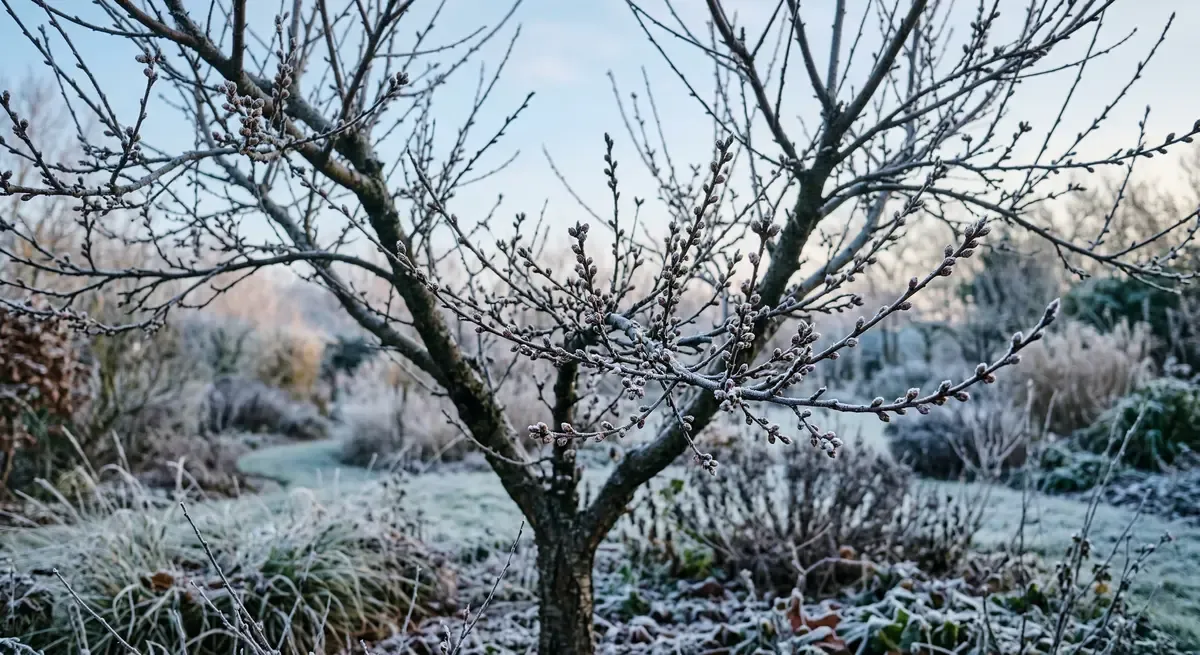
Every deciduous fruit tree needs a period of winter cold to complete its dormancy cycle. Chill hours are the measure of that cold exposure, typically counted as hours between 0°C and 7°C (32°F and 45°F) accumulated from autumn through late winter.
Peach trees are more sensitive to chill than most other fruit trees. Apples and pears have some flexibility. A tree that falls 100 hours short of its requirement might still produce a decent crop. Peaches do not offer that margin. When a peach tree misses its chill target, the effects are immediate and obvious. The bloom is weak, pollination fails, and the fruit that does set is not worth picking.
This sensitivity is why variety selection matters so much with peaches. A Redhaven peach and a Florida Prince peach are both peaches, but one needs 800 hours of winter cold and the other needs 150. Plant the wrong one for your climate and no amount of good soil, careful pruning, or attentive watering will compensate. The cold requirement is non-negotiable.
If you are not sure how chill hours work across different fruit types, the chill hours by zip code guide covers the three counting models and how to interpret the numbers on nursery labels.
Peach varieties by chill hour requirement
This is the table I wish I had found before I planted that Elberta. Peach varieties span an enormous range, from 150 hours in subtropical Florida to over 1,000 hours in northern climates. Picking a variety that matches your local chill accumulation matters more than anything else you do.
Low chill (under 400 hours)
These varieties were bred for warm-winter climates in Florida, Southern California, and the subtropics. If your area accumulates fewer than 400 chill hours, these are your options, and they are genuinely good options. Modern low-chill peaches produce excellent fruit.
| Variety | Chill hours | Flavour profile | Best zones |
|---|---|---|---|
| Florida Prince | 150 | Sweet, mild acidity, melting flesh. One of the earliest to ripen. | 8b-10 |
| Tropic Beauty | 150-200 | Rich, sweet flavour with firm flesh. Excellent for fresh eating. | 8b-10 |
| Desert Gold | 200-300 | Classic peach flavour, semi-freestone. Good for both eating and preserving. | 8-10 |
| Eva’s Pride | 200-300 | Intensely sweet, low acid, large fruit. One of the best-tasting low-chill varieties. | 8-10 |
Florida Prince and Tropic Beauty are the workhorses of warm-climate peach growing. If you are in zone 9 or 10, start with one of these. Eva’s Pride is worth seeking out if you can find it. The flavour rivals many high-chill varieties, which is not something you could say about low-chill peaches a generation ago.
Medium chill (400-850 hours)
This is the range where most backyard peach growers land. These varieties perform well across a broad swath of the US, from the upper South through the mid-Atlantic and into the lower Midwest. They represent the classic peach flavours most people picture.
| Variety | Chill hours | Flavour profile | Best zones |
|---|---|---|---|
| Hale Haven | 600-700 | Rich, full flavour. Large fruit, freestone. Reliable producer. | 6-8 |
| Redhaven | 750-800 | The benchmark peach. Balanced sweet-tart, freestone, firm flesh. | 5-8 |
| Belle of Georgia | 750-800 | White flesh, sweet and aromatic. Less acidic than yellow peaches. | 5-8 |
| Elberta | 800-850 | Classic old-fashioned peach flavour. Large, yellow, freestone. The canning standard. | 5-8 |
Redhaven and Elberta sit at the upper end of this range. In zones 7b-8a, where winter temperatures fluctuate, these varieties may underperform in mild years. If you are in that borderline territory, Hale Haven at 600-700 hours gives you more breathing room. For warm-climate growers who want classic peach flavour without the high chill requirement, the low-chill peach varieties guide covers more options.
High chill (850+ hours)
If you live where winters are reliably cold, these varieties reward you with hard-won dependability. They were bred for northern climates and can handle deep freezes that would kill less hardy peach trees.
| Variety | Chill hours | Flavour profile | Best zones |
|---|---|---|---|
| Canadian Harmony | 850-900 | Sweet, aromatic, freestone. Excellent cold hardiness. | 4-7 |
| Reliance | 1,000 | Very sweet, soft flesh. The standard for cold-climate peach growing. Survives -25°F. | 4-7 |
| Contender | 1,050 | Balanced flavour, freestone. Extremely cold-hardy. Late blooming reduces frost risk. | 4-7 |
Reliance and Contender are the go-to choices for zones 4 and 5, where other peach varieties simply do not survive. Reliance in particular has opened up peach growing in places like Minnesota and Vermont where it was previously impossible. The flavour is genuinely good, not just “good for a cold-hardy peach.”
Track your peach trees from planting to harvest.


How to find your chill hours
Before you order a peach tree, you need to know what your location actually delivers in winter. The most reliable sources are your state’s cooperative extension service, which publishes chill hour data by weather station, and university tools like the UC Davis Chill Calculator for California or AgWeatherNet for the Pacific Northwest.
Leaftide’s chill hour validator takes a different approach. Instead of giving you a raw number, it checks your location against specific variety requirements. You pick the peach variety you want to grow, and it tells you whether your area typically accumulates enough chill hours to support it. I built this because the raw numbers were never the problem for me. The problem was knowing whether 650 hours was enough for the specific tree I wanted to plant.
Keep in mind that chill hours vary year to year. A location that averages 700 hours might drop to 500 in a warm winter and reach 900 in a cold one. When choosing varieties, aim for the lower end of your typical range rather than the average. That buffer is what separates a tree that fruits reliably from one that has a bad year every third season.
What happens when peach trees do not get enough chill
I described my Elberta’s first spring earlier, but the full picture is worth understanding because the symptoms are not always immediately obvious.
Delayed and uneven bloom. Instead of the whole tree flowering together over a week or two, buds open in stages across three or four weeks. This matters more than it sounds. Peach flowers need to be open at the same time for effective pollination, even on self-fertile varieties. Staggered bloom means staggered fruit set, which means uneven ripening and smaller harvests.
Poor fruit set and early drop. Flowers that do open may not set fruit at all, or they set fruit that the tree drops in early summer. The tree does not have the energy reserves to support a full crop because it spent too much energy sorting out its disrupted dormancy cycle.
Weak vegetative growth. New shoots are shorter than normal. The canopy looks thin. The tree is not dying, but it is not thriving either. Over multiple years of insufficient chill, this weak growth compounds. Branches that should be producing fruit wood instead produce blind wood, sections of branch with leaves but no fruit buds.
Long-term decline. One mild winter is recoverable. The tree has a bad season and bounces back the following year if chill is adequate. But if your area consistently falls short of a variety’s requirement, the tree enters a downward spiral. Each year it starts weaker, recovers less, and gradually loses vigour. I have seen peach trees that looked acceptable for three or four years before the cumulative damage became undeniable.
You cannot fix a chill deficit with better care. The only fix is choosing a variety that matches what your climate actually provides.
Tips for borderline climates
If your chill hours sit right at the edge of a variety’s requirement, there are a few things you can do to tip the odds in your favour.
Choose varieties at the low end of your range. If your area averages 700 chill hours, do not plant a variety that needs 700. Plant one that needs 500-600. That margin absorbs the warm winters that will inevitably come. Nothing else you do for a borderline tree matters as much.
Pay attention to microclimate. Cold air sinks. A peach tree planted at the bottom of a slope, where cold air pools on still nights, will accumulate more chill hours than one planted at the top. North-facing positions stay cooler longer in late winter, which can add meaningful chill hours in marginal areas. Conversely, a south-facing wall that radiates warmth can reduce local chill accumulation.
Avoid early-warming spots. A sheltered, south-facing position might seem ideal for a peach tree, but in borderline climates it can work against you. The warmth encourages early bud break before the tree has completed its chill requirement. A more exposed position keeps the tree cooler longer, which is what it needs.
Track your observations across years. This is where record-keeping pays off. If you log bloom dates, fruit set, and harvest quality each year alongside winter temperature data, you build a picture of how your specific microclimate interacts with your specific variety. After three or four years, you will know whether your peach tree is reliably getting what it needs or whether you are fighting the climate. I track all of this in Leaftide, and the year-over-year comparison is what finally convinced me to replace my Elberta with a lower-chill variety better suited to my location.
Consider multiple varieties. If you have space, planting both a medium-chill and a low-chill peach gives you insurance. In cold winters, both produce well. In mild winters, the low-chill variety still delivers while the medium-chill one struggles. You get peaches either way.
For a complete list of chill hour requirements across all fruit tree varieties, see Chill Hour Requirements: Complete Variety Reference.
Give your peach trees a permanent record.