How to Grow Sugar Sumac
Rhus ovata
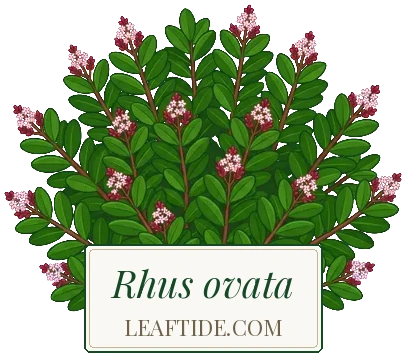
Sugar sumac, or sugar bush, is a long-lived evergreen shrub from the chaparral of southern California, Arizona and Baja California, grown for its glossy, leathery leaves and the red buds that open to clusters of pink-white flowers in late winter and spring. Give it full sun or light shade and well-drained soil, ideally planted in autumn. Water every two weeks in dry spells through its first summer only; after that it needs no summer water, and watering established plants in heavy soil invites root rot. It takes about -9 °C (16 °F). Skip the fertiliser, and shape it lightly after flowering into a dense screen, an informal hedge or a small tree.
 In your Leaftide garden


- Height
- 3 m (10 ft)
- Spread
- 3 m (10 ft)
- Flowers
- March - April
- Light
- Full sun to part shade
- Water
- Low
- Feed
- No feeding
Yearly Lifecycle
Care Essentials
Not needed in the ground. It is adapted to poor, dry chaparral soil, and feeding gives soft, sappy growth that is more prone to dieback. Plants in pots can have a weak balanced feed once in spring.
Watch For
- Root rot when established plants get summer water, especially in heavy soil
- Branch dieback after a long drought or on stressed plants
- Scale insects on stems and leaves
- Frost damage to the flower buds in a hard late-winter frost
Companions
Ceanothus, Manzanita, Toyon, Cleveland Sage, California Buckwheat
Care Requirements
Light
Full sun to light shade
Grows densest and flowers best in full sun, and takes the full heat of a sunny, open slope. Inland it is happy with light afternoon shade; in deep shade it grows thin and flowers poorly.
Watering
Low; water only in the first summer, then none
Water every two weeks in dry spells during the first summer so the roots go deep. After that, plants in the ground need no summer water, and regular watering in heavy soil is a common cause of root rot. In an extreme drought, one deep soak a month is plenty; plants in pots need water whenever the compost is dry.
Fertilizing
No feeding
It is adapted to poor, dry soil and needs no fertiliser in the ground. Feeding gives soft growth that is more prone to dieback.
Pruning
Light shaping after flowering
In late spring, once flowering is over, shorten wayward shoots and remove dead or crossing stems. It can be kept as an informal hedge or raised into a small multi-stemmed tree; avoid hard cuts in summer heat.
Spacing
About 250 cm (8 ft) apart
The species grows 2-3 m (6.5-10 ft) tall and wide, and old plants can reach 4-5 m (13-16 ft). Space plants about 250 cm (8 ft) apart, or about 150 cm (5 ft) for an informal hedge or screen.
Support
No support needed
It forms a dense, self-supporting shrub with stiff branches. Young plants on windy slopes need no stake if they are planted small.
Growing Tips
Plant in autumn, on a slope if you can
Planting at the start of the cool, wet season lets the roots settle before the first dry summer. A slope, mound or gritty bed keeps water moving away from the roots, which matters most in clay.
No summer water once established
From its second summer, a plant in the ground lives on rainfall. Regular summer watering, especially in heavy soil, is the usual way to lose one to root rot; in an extreme drought, one deep soak a month is plenty.
Shape after the flowers
The red buds form on the shrub months before they open, so any trim made in autumn or winter cuts off the flowers. Shape it lightly once flowering is over and leave it alone for the rest of the year.
Pests & Diseases
Pest Scale Insects
Identification: Small brown or white bumps along stems and leaf undersides; sticky honeydew and black sooty mould on the leaves below
- Scrape off light infestations with a soft brush or a thumbnail
- Wipe the leaves with soapy water to remove honeydew and sooty mould
- A plant oil or fatty acid spray labelled for scale on ornamental shrubs, applied when the young crawlers are active
Disease Root Rot
Symptoms: Leaves wilt, yellow and drop even though the soil is moist; branches die back one after another and the roots are dark and soft
Treatment: Stop watering and improve drainage; badly affected plants rarely recover and are best replaced
Prevention: Plant in free-draining soil, give established plants no summer water, and keep irrigation for nearby lawns and beds well away from the root zone
Disease Branch Dieback
Symptoms: Single branches wilt and turn brown while the rest of the shrub stays green; the wood under the bark is stained dark
Treatment: Cut out affected branches into clean, healthy wood in dry weather and clean the blades between cuts
Prevention: Avoid hard pruning in summer heat and do not overwater; a deep soak in an extreme drought helps a stressed plant resist it