How to Grow North American Cottonwood
Populus deltoides
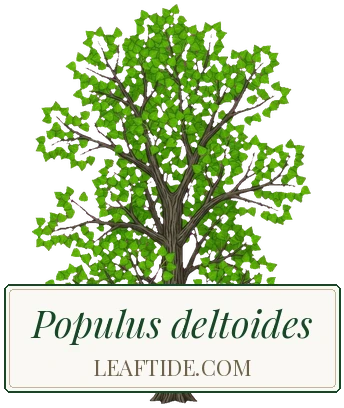
North American Cottonwood is a large, fast-growing native deciduous tree reaching 20-30 m (66-98 ft) at maturity. Plant in full sun in a spacious location, well away from buildings, drains, and underground pipes. It thrives in moist to wet soils and is one of the few large trees that tolerates periodic flooding. Young trees establish quickly with minimal care; water during prolonged dry spells in the first two years. Prune only in full dormancy (late autumn to early winter). Female trees produce "cotton" (fluffy seeds) in early summer; choose a male clone if this is a concern. Not suitable for small gardens.
 In your Leaftide garden


Yearly Lifecycle
Care Essentials
Young trees benefit from a balanced slow-release fertiliser in early spring for the first 2-3 years. Established cottonwoods are vigorous and need no supplemental feeding.
Watch For
- Cottonwood leaf beetle
- Poplar aphids
- Marssonina leaf spot
- Cytospora canker
Companions
Willows, Alder, Native grasses, River birch
Care Requirements
Light
Full sun
Requires at least 6-8 hours of direct sunlight daily. Naturally found in open riparian corridors and plains. Does not tolerate heavy shade.
Watering
Moist to wet soils; drought tolerant once established
Thrives in moist to seasonally flooded soils. Water young trees weekly during dry spells in the first two years. Established trees are largely drought tolerant but grow fastest with reliable moisture.
Fertilizing
Minimal; mulch annually
Young trees benefit from a balanced slow-release fertiliser in early spring for 2-3 years. Apply 7-10 cm (3-4 in) of wood chip mulch annually. Established trees need no supplemental feeding.
Pruning
Minimal pruning in full dormancy only
Remove dead, damaged, or crossing branches in late autumn or early winter when fully dormant. Cottonwoods have a strong natural form and heavy pruning is not required.
Spacing
15-20 m (49-66 ft) from buildings and drains
Allow at least 15-20 m (49-66 ft) clearance from buildings, foundations, underground pipes, and drains. Roots are vigorous and water-seeking. Not suitable for small gardens.
Growing Tips
Site well away from infrastructure
Cottonwood roots are aggressive and water-seeking. Plant at least 15 m (49 ft) from buildings, foundations, drains, and underground pipes. River banks and open fields are ideal.
Choose male trees to avoid cotton
Female trees shed large amounts of cottony seed in early summer which can clog gutters and HVAC systems. Many nurseries sell male clones to avoid this. Ask at the point of purchase.
Deep watering when young
Although cottonwoods love moisture, young trees should be deep-watered weekly during their first two growing seasons to encourage deep root development. Established trees are largely self-sufficient.
Apply deep mulch annually
Spread 7-10 cm (3-4 in) of wood chip or composted bark over the root zone each spring. Keep mulch 15 cm (6 in) clear of the trunk. This conserves soil moisture and suppresses competing grass.
Prune in full dormancy only
Make any structural cuts between late autumn and early winter when the tree is fully dormant. Avoid cutting in spring when sap is actively rising.
Pests & Diseases
Pest Cottonwood Leaf Beetle
Identification: A North American beetle of poplars and willows. Young black larvae feed in groups on the undersides of leaves and leave them skeletonised; older grey-brown larvae with pale spots eat whole leaves down to the midrib. Several generations a year.
- On young trees, pick off or hose off groups of larvae and the yellow egg clusters under the leaves.
- Leave ladybirds and their larvae alone: they eat the eggs and pupae.
- Established trees shrug off the damage. Act only when a young tree is being stripped again and again.
- On a small, heavily stripped tree, a natural pyrethrin spray, following the label. Keep it away from ponds and streams, as it is toxic to fish.
Disease Marssonina Leaf Spot Marssonina populi
Symptoms: Brown spots with darker margins on the leaves from midsummer. The spots join up and the tree drops its leaves early. Young twigs can be infected and killed.
Treatment: Rake up and remove fallen leaves in autumn, as the fungus overwinters on them. Mature trees usually cope; on a young tree hit year after year, a fungicide labelled for ornamental trees can protect the new leaves in a wet spring, following the label.
Prevention: Plant in an open, sunny spot with good air flow.
Disease Poplar Rust Melampsora spp.
Symptoms: Small yellow-orange powdery pustules on the undersides of the leaves, turning dark brown to black later. Worst in late summer and autumn, when it can bring leaf fall forward.
Treatment: Rarely serious enough to treat. Rake up and remove fallen leaves to cut the spores carried into next year.
Disease Cytospora Canker Cytospora chrysosperma
Symptoms: Sunken, discoloured patches on the bark of branches and trunk, mostly on stressed or damaged trees. In damp weather orange-red threads of spores ooze from small pimples on the canker. The branch beyond the canker dies back.
Treatment: No cure. Cut out cankered branches well below the dead area in dry weather and clean your tools between cuts.
Prevention: Keep the tree growing strongly: water young trees in drought and avoid wounding the bark with mowers and strimmers.