How to Grow Juniper
Juniperus communis
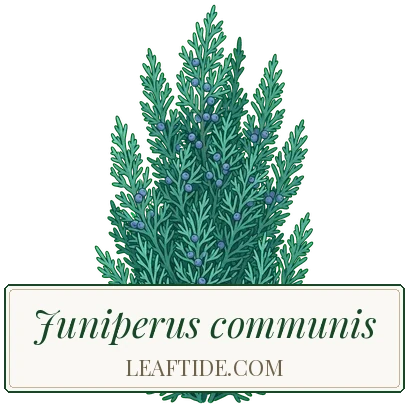
Junipers are tough, drought-tolerant evergreen shrubs or small trees that thrive in full sun with well-drained soil. They range from prostrate ground-cover forms to tall columnar specimens. Once established they need very little care. Never cut into old bare wood as they will not regrow. The blue berry-like cones are actually modified scales and take 2-3 years to ripen.
 In your Leaftide garden


- Height
- 2 m (6.5 ft)
- Spread
- 1.5 m (5 ft)
- Light
- Full sun
- Water
- Low
- Prune
- Light trim only
Yearly Lifecycle
Care Essentials
Light feed in spring with a balanced fertiliser. Established plants rarely need feeding.
Watch For
- Juniper scale
- Juniper webber moth
- Phytophthora root rot
- Rust
Care Requirements
Light
Full sun; no shade tolerance
Full sun essential. Junipers become sparse and leggy in shade. Even light shade reduces density.
Watering
Drought-tolerant once established
Water newly planted junipers regularly for the first year. Once established, they are extremely drought-tolerant and rarely need supplemental watering except in prolonged drought.
Fertilizing
Rarely needs feeding once established
Light balanced feed in spring if growth seems slow. Established plants in reasonable soil rarely need feeding.
Pruning
Light trim only; never cut bare wood
Light trim of green growth only in late spring or early summer. Never cut into old bare wood: junipers cannot regenerate from leafless branches.
Growing Tips
Drainage is non-negotiable
Junipers absolutely require well-drained soil. In heavy clay, plant on a mound or add generous grit. Waterlogged roots cause rapid decline.
Never cut into bare wood
Never cut back into old leafless wood. Unlike yew, juniper cannot regenerate from bare branches. Only trim green growth.
Pests & Diseases
Pest Juniper Scale
Identification: Tiny round white scales with a yellowish centre, about 1.5 mm across, crowd the foliage. Heavy infestations turn shoots yellow and make them die back. Unlike most scale insects it leaves no sticky honeydew.
- Light infestations do little harm; leave them to ladybirds, parasitic wasps and birds.
- Cut out the worst shoots. Big colonies usually build up on plants already weakened by drought or poor drainage, so a badly encrusted plant is often best replaced.
- Spray a plant oil insecticide in early summer, when the young crawlers hatch (the start of summer in the UK).
Pest Juniper Webber Moth
Identification: Small brown striped caterpillars spin silk between the needles, binding shoots into brown, webbed clumps full of droppings. The damage shows most in spring.
- Cut out and bin the webbed shoots in spring, trimming only back to green growth.
- On small plants, pull the webs apart and pick out the caterpillars.
Disease Phytophthora Root Rot
Symptoms: Foliage thins and dulls, branches die one after another and the whole plant declines, usually on wet or heavy ground. Dug-up roots are brown and rotten, and the outer skin of the root slips off easily.
Treatment: There is no cure once a plant is declining. Dig it out with its roots and do not plant another juniper in the same wet spot.
Prevention: Plant only where water drains away quickly, on a mound or raised bed if the soil is clay, and do not overwater established plants.
Disease Juniper Rust Gymnosporangium spp.
Symptoms: In wet spring weather, orange, jelly-like horns or tongues swell out of woody galls or swollen sections of stem. The fungus spends the other half of its life on a plant of the apple family: pear in Europe (pear rust), apple and crabapple in North America (cedar-apple rust), and hawthorn, quince or rowan for other species.
Treatment: Prune out galls and swollen stems in late winter, before they release spores in spring, cutting back to green growth.
Prevention: The rust rarely does the juniper serious harm; the leaf spots on pears or apples nearby are usually the bigger problem. Avoid planting susceptible junipers (e.g. J. sabina, J. chinensis, J. virginiana) right next to pears or apples.
Disease Tip and Twig Blight
Symptoms: Shoot tips turn pale, then reddish-brown, and die back, most often on soft new growth in warm, wet spring weather (Phomopsis) or on one-year-old twigs in early spring (Kabatina). There is a sharp line between dead and healthy tissue.
Treatment: In dry weather, prune out the browned tips back to healthy green foliage and bin them.
Prevention: Give plants full sun and room for air to move through them, and avoid wetting the foliage with sprinklers.