How to Grow Date Palm
Phoenix dactylifera
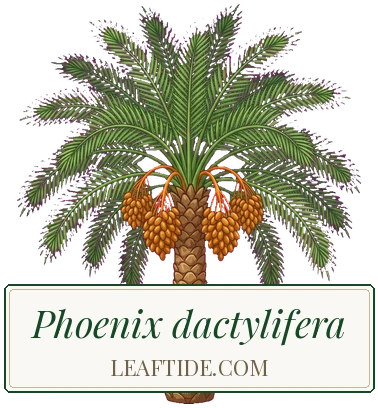
Date palms are iconic desert trees that need sustained heat and dry conditions to produce their sweet edible fruits. They tolerate brief frost when mature but require hot summers for fruiting. Dioecious, so both male and female trees are needed for pollination, or hand-pollinate. In cooler climates they make impressive ornamental specimens under glass but will not fruit. Plant in very well-drained sandy soil in full sun. Takes 4-8 years from offsets to first fruit.
 In your Leaftide garden


- Height
- 20 m (66 ft)
- Spread
- 8 m (26 ft)
- Spacing
- 10 m (33 ft)
- Harvest
- August - September
- Light
- Full sun
- Water
- Low
- Prune
- Remove dead fronds only
Growing from seed
Track from seed- Germination
- 3 to 6 weeks
- Before sowing
- Clean all flesh off the stones and soak them in water for a few days, changing the water daily.
- First fruit
- 6 to 10 years from sowing
Seedlings won't match the variety the seed came from.
Yearly Lifecycle
Care Essentials
Feed monthly with a balanced palm fertiliser from spring to autumn. Reduce to every 8-10 weeks in winter. Supplement with magnesium and potassium for healthy frond growth and fruit production.
Watch For
- Red palm weevil larvae boring into trunk
- Bayoud disease (Fusarium wilt) causing frond dieback
- Scale insects on frond stems
- Spider mites in dry indoor conditions
- Leaf spot in humid poorly ventilated conditions
Care Requirements
Light
Full sun essential
Date palms need full direct sunlight for at least 8 hours daily. They thrive in intense heat and will not fruit without sustained high temperatures and maximum light exposure.
Watering
Deep infrequent watering
Water deeply but infrequently once established. Date palms are drought-tolerant desert trees. Allow soil to dry between waterings. Young trees need more regular water until established.
Fertilizing
Monthly palm feed spring to autumn
Feed monthly with a balanced palm fertiliser during the growing season. Supplement with magnesium and potassium. Reduce to every 8-10 weeks in winter.
Pruning
Remove dead fronds only
Only remove completely dead or brown fronds. Never cut green fronds as the palm recycles nutrients from them. Remove fruit stalks after harvest.
Spacing
10m (33 ft) apart minimum
Space trees at least 10m (33 ft) apart to allow full canopy development. Date palms have wide-spreading root systems. Allow room for offshoots around the base.
Support
No support needed
Mature date palms are self-supporting with strong trunks. Young trees may benefit from staking in windy locations until the trunk thickens sufficiently.
Growing Tips
Needs sustained heat to fruit
Date palms require long hot summers (above 35C for months) to ripen fruit. In cooler climates they grow well as ornamental palms but will not produce edible dates.
Dioecious pollination
Male and female flowers are on separate trees. For fruit production you need at least one male per 50 females, or hand-pollinate by transferring male pollen to female flower clusters in spring.
Excellent drainage essential
Plant in very well-drained sandy or gravelly soil. Date palms are desert-adapted and tolerate drought well but rot in waterlogged soil. They are surprisingly salt-tolerant.
Pests & Diseases
Pest Red Palm Weevil
Identification: Holes in the crown or trunk that push out chewed fibres, often with a brown, sticky ooze, and fronds in the centre of the crown that wilt and collapse. The cream, legless grubs, up to 5 cm (2 in) long, tunnel inside the trunk and crown, and an attacked palm usually dies. Palms with a trunk under about 5 cm (2 in) across are not at risk. It occurs around the Mediterranean, in the Middle East, North Africa and Asia; it is absent from northern Europe.
- Report a suspected attack to your local plant health service. A badly attacked palm can't be saved: fell it and have it chipped or destroyed so the weevils don't spread, following any local rules.
- Where it is sold for this use, apply entomopathogenic nematodes (Steinernema carpocapsae) to the crown and frond bases as a preventive treatment.
Pest Red Spider Mite
Identification: Fine pale speckling on the leaflets of palms grown indoors or under glass, which then look dull and bronzed. In heavy attacks you can see tiny mites and fine webbing on the undersides.
- Rinse the fronds with water and raise the humidity around the plant; the mites build up fast in hot, dry air.
- Under glass, release the predatory mite Phytoseiulus persimilis in spring and summer, before numbers build up.
Disease Pink Rot Nalanthamala vermoeseni
Symptoms: Rotting spots on frond bases, leaf stalks, flower stalks or the growing tip, often with pinkish spore masses and a brown, syrupy ooze. New fronds can come out stunted, distorted or dead.
Treatment: Correct whatever is stressing the palm first, because the fungus mainly attacks weak or wounded plants. Cut out affected fronds with clean, disinfected tools.
Prevention: Plant at the original depth in free-draining soil, don't overwater, and never strip the old leaf bases off the trunk, which leaves wounds.
Disease Graphiola Leaf Spot (False Smut) Graphiola phoenicis
Symptoms: Tiny raised black cups, under 2 mm across, on both sides of the oldest leaflets, sometimes with short pale threads and yellow spores. The disease is mostly cosmetic.
Treatment: Usually no treatment is needed. Remove badly affected old fronds only if the palm shows no nutrient deficiency, because cutting off deficient fronds makes the deficiency worse.
Prevention: Feed regularly with a palm fertiliser so the older fronds stay healthy.
Disease Potassium Deficiency
Symptoms: The oldest fronds show fine yellow, translucent and brown spots on the leaflets, and the leaflet tips turn brown, brittle and break off. The crown thins as old fronds die early; in severe cases the new fronds are small and frizzled and the trunk starts to taper.
Treatment: Feed with a palm fertiliser containing potassium and magnesium, at the rate on the label. Leave the discoloured old fronds on the palm, as it draws potassium from them for new growth.
Prevention: Use a palm fertiliser rather than a high-nitrogen lawn feed, which makes the deficiency worse, especially on sandy soils.
Spacing & Planting
| Plant spacing | 10 m (33 ft) |
| Row spacing | 10 m (33 ft) |
| Mature height | 20 m (66 ft) |
| Mature spread | 8 m (26 ft) |
Dioecious palm requiring both male and female trees for fruit. Needs hot dry climate. One of the oldest cultivated fruit trees.