How to Grow Indoor Cyclamen
Cyclamen persicum
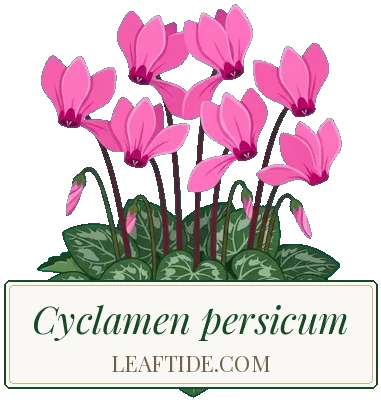
Indoor cyclamen is a cool-season flowering houseplant that blooms from autumn through spring with elegant swept-back petals in shades of pink, red, white, and purple above marbled heart-shaped leaves. Keep in a cool bright room (10-15C), away from direct sun and radiators. Always water from below to prevent rot on the tuber crown. When leaves yellow in late spring, reduce watering and let the plant rest dormant through summer. Resume watering in early autumn when new shoots appear from the tuber.
 In your Leaftide garden


- Height
- 30 cm (12 in)
- Spread
- 25 cm (10 in)
- Flowers
- October
- Light
- Bright indirect light
- Water
- Moderate
Yearly Lifecycle
Care Essentials
Feed every two weeks with a half-strength balanced liquid fertiliser while in active growth and flower (autumn to spring). Stop feeding entirely when the plant enters summer dormancy.
Watch For
- Grey mould (Botrytis) on flowers and leaf stems
- Cyclamen mite causing distorted leaves
- Root rot from overwatering or water sitting on the tuber crown
- Yellowing leaves from warm temperatures
Pet Safety
Care Requirements
Light
Bright indirect light, no direct sun
Place in a bright north- or east-facing window. Direct sunlight scorches leaves and shortens flowering. In winter, a few hours of gentle morning sun is tolerable.
Watering
Water from below, keep moist but not wet
Stand pot in a saucer of water for 15-20 minutes, then drain completely. Never let water sit on the tuber crown. Reduce watering sharply when leaves die back in summer.
Fertilizing
Half-strength feed every two weeks in active growth
Use a balanced liquid fertiliser at half the recommended strength every two weeks from autumn through spring. Stop feeding entirely during summer dormancy.
Pruning
Remove spent flowers by twisting at base
Twist and pull spent flower stems cleanly from the tuber rather than cutting. Remove yellowing leaves the same way. This prevents stubs that can rot.
Spacing
One tuber per 12-15 cm (5-6 in) pot
Plant one tuber per pot with the crown sitting above the compost surface. Repot into a slightly larger pot only when roots fill the current one, typically every 2-3 years after dormancy.
Support
No support needed
Indoor cyclamen are compact and self-supporting. No staking or support is required.
Growing Tips
Water from below
Stand the pot in a saucer of water for 15-20 minutes, then drain. Never pour water over the tuber crown or into the centre of the plant as this causes rot.
Cool rooms extend flowering
Cyclamen flower longest in cool rooms (10-15C). Near a radiator or in a warm living room, they finish flowering weeks earlier. A cool hallway, porch, or unheated bedroom is ideal.
Dormancy is not death
When leaves yellow and die back in late spring, the plant is entering its natural summer rest. Move to a cool shaded spot, stop watering almost entirely, and wait for new growth in autumn.
Keep the tuber crown above soil
When potting, ensure the top third of the tuber sits above the compost surface. A buried crown invites rot.
Pests & Diseases
Pest Vine Weevil
Identification: Plump, cream-coloured, C-shaped grubs with brown heads eat the tuber and roots, so a plant can wilt and collapse suddenly while the compost is still moist. Adult beetles notch the leaf edges.
- Tip the plant out, destroy any grubs, and repot into fresh compost if the tuber is still firm.
- Water pathogenic nematodes (Steinernema kraussei, which works at lower temperatures) into the compost following the pack instructions.
Pest Cyclamen Mite
Identification: Microscopic mites feed in the growing centre. Young leaves are stunted, thickened, curled and brittle, and flower buds are distorted or fail to open. The mites are too small to see without a lens.
- Isolate the plant straight away and remove the worst-affected leaves and buds.
- Badly distorted plants rarely recover: discard them (not onto the compost heap) to protect other cyclamen.
Disease Grey Mould Botrytis cinerea
Symptoms: Fluffy grey mould and soft brown rot on flowers, flower stalks and leaf bases, which can spread to the tuber crown in cool, humid, still air.
Treatment: Pull off affected flowers, leaves and stalks cleanly at the base, then improve air movement and lower the humidity. Keep the leaves and crown dry.
Prevention: Twist spent flowers and yellowing leaves off rather than cutting them, water from below and do not crowd plants.
Disease Tuber and Crown Rot
Symptoms: The crown turns soft and dark, leaves and flowers suddenly flop and yellow, and the tuber is mushy when lifted.
Treatment: Once the tuber is mushy the plant will not recover: discard it. If only the surface of the crown is soft, cut it away to firm tissue and repot in fresh, free-draining compost with the top of the tuber sitting above the surface.
Prevention: Water from below, drain the saucer after 15 to 20 minutes and keep the top of the tuber above the compost.
Disease Fusarium Wilt Fusarium oxysporum f. sp. cyclaminis
Symptoms: Leaves yellow, often on one side of the plant first, then wilt and collapse although the compost is moist. A cut tuber shows brown streaks inside.
Treatment: There is no cure. Discard the plant and its compost, and wash the pot thoroughly before reusing it.
Prevention: Buy healthy plants and pot on into fresh compost and clean pots.