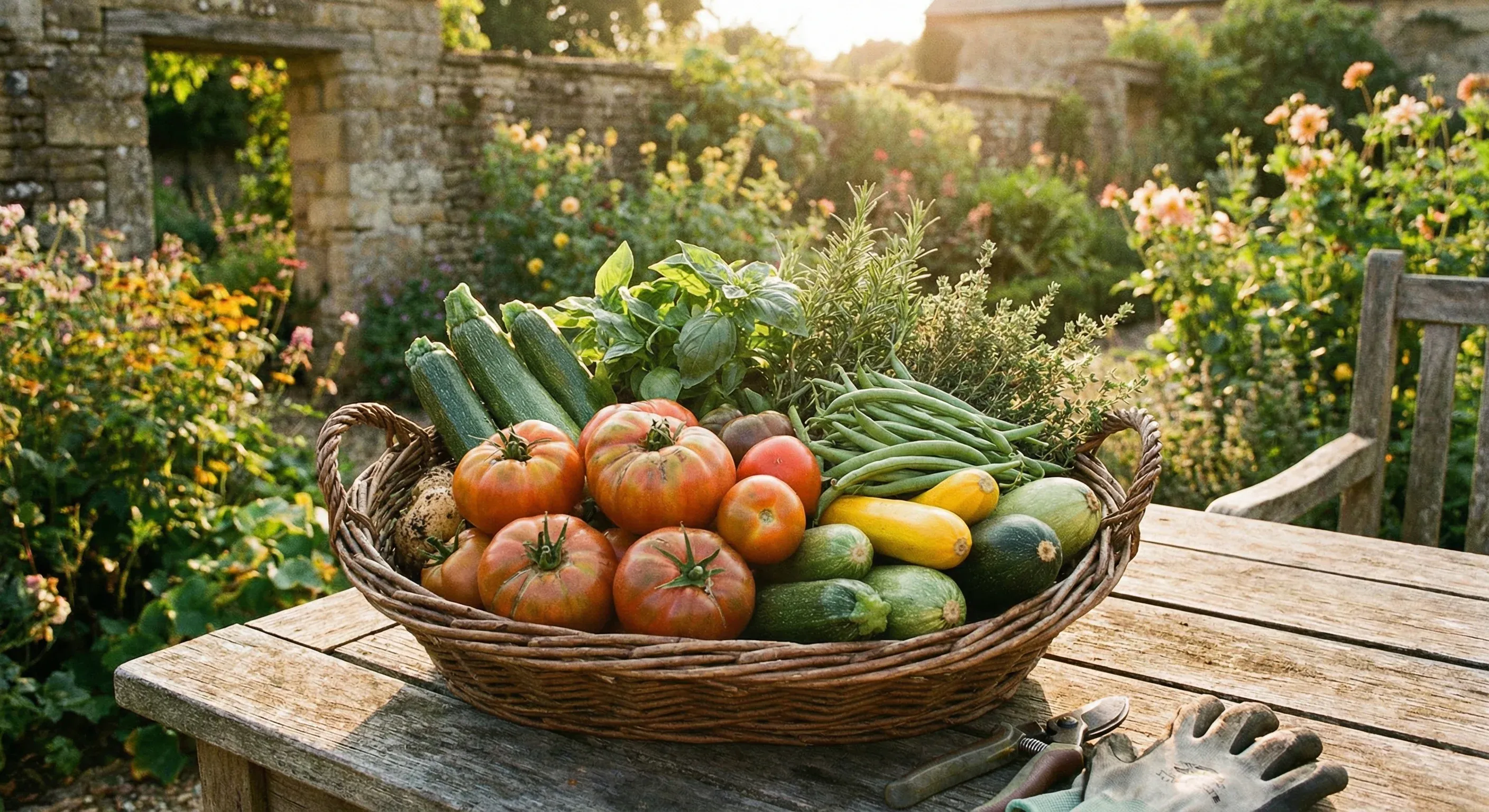
I used to think I knew which plants performed well. The tomatoes were obviously productive. The runner beans were clearly worth growing. The beetroot did fine.
Then I started writing down what I actually picked, and the story changed completely.
The tomatoes were productive, yes, but one variety produced three times more than another in the same bed. The runner beans gave me a decent harvest over two weeks, then nothing. The beetroot I thought was “fine” yielded about 2kg from a 3-metre row. The same space planted with chard would have fed me for months.
None of this was visible without records. My memory told me everything went reasonably well. The numbers told a different story.
The problem with gardening by feel
Most gardeners assess their harvest by impression. You remember the good days, the satisfying basket of tomatoes, the first courgette of the season. The disappointing weeks fade. By winter, the whole season blurs into a vaguely positive memory, and you plant the same things again without questioning whether they earned their space.
This is how I gardened for years. I grew what I had always grown, in roughly the same quantities, and assumed it was working because I harvested something. The bar was low: if a plant produced any food at all, it was a success.
But “some food” is not the same as “good use of limited space.” A raised bed that produces two meals of beetroot over an entire season is not pulling its weight, no matter how satisfying those two meals were. You only see this when you have something to compare against.
Harvest tracking sounds tedious. It is not. It is just having enough information to make better decisions next year.
What to actually record
The temptation is to track everything: weight in grams, exact count, quality rating, days since planting. That level of detail is fine for a research trial, but it kills the habit for most home gardeners. I tried it once. The spreadsheet lasted three weeks.
What actually works is recording three things each time you harvest:
The date. This tells you when each variety starts and stops producing, which is more useful than you might think. If your “early” potatoes are not ready until late July, they are not early for your climate. If your autumn raspberries start cropping in August, you have more flexibility than the books suggest.
The variety. Not “tomatoes” but “Sungold” or “Costata Romanesco” or “Boltardy.” Without the variety name, your harvest data is useless for comparison. You cannot decide which tomato to grow again if you do not know which one produced well.
A rough amount. This does not need to be precise. “A colander full,” “enough for two meals,” “about 1kg,” “four decent-sized fruits.” The goal is comparison across seasons, not scientific accuracy. If you harvested “a handful” of French beans last year and “three colanders” this year, you know something changed.
That is it. Date, variety, amount. Anything more and you will stop doing it by July.
When to record (and when people give up)
The single biggest reason harvest tracking fails is delayed recording. You come inside with an armful of courgettes, put them on the counter, start cooking, and tell yourself you will write it down later. You do not write it down later.
I have tried every approach. The end-of-week summary never happened because I could not remember Tuesday’s harvest by Sunday. The dedicated notebook stayed in the kitchen while I was in the garden. The spreadsheet required opening a laptop, which felt like too much friction for “I picked some beans.”
What finally worked was logging the harvest while I was still outside, or at least before I put anything down. A quick note on my phone. Ten seconds. Done.
The habit sticks when the friction is low enough that you do it automatically, the same way you might take a photo of something interesting. If recording a harvest takes longer than eating it, the system is too complicated.
What harvest data actually tells you
Raw harvest dates and amounts are useful on their own. But the interesting part is what shows up after a full season, or after two or three years of notes.
Which varieties earn their space
This is the most practical insight. When you can compare two tomato varieties grown in the same conditions, the difference is often stark. I have had varieties that produced steadily for eight weeks alongside others that gave one flush and then stopped. Without records, both felt like “good tomatoes.” With records, the choice for next year was obvious.
The same applies to any crop where you grow multiple varieties. Which courgette was more productive? Which lettuce bolted first? Which bean variety kept going into autumn? You cannot answer these questions from memory alone.
When your garden actually produces
Plotting harvest dates across a season reveals gaps. You might discover that nothing is ready in the first two weeks of July, or that everything ripens at once in August and you are drowning in produce while September is bare.
These gaps are invisible without records. Once you can see them, you can plan around them: stagger sowing dates with a succession planting schedule, choose varieties with different maturity times, or accept the glut and plan to preserve.
Whether a crop is worth the effort
Some crops take enormous effort for modest returns. Others produce abundantly with almost no attention. Yield records help you see this clearly.
I grew sweetcorn for three years before I admitted it was not worth it in my garden. Each plant produced one or two cobs. The space those plants occupied could have grown months of salad leaves. The sweetcorn was fun, but the maths did not work. I only saw this because I had written down what each bed actually produced.
This is not about maximising every square metre. If you love growing sweetcorn, grow sweetcorn. But make that choice with open eyes, not because you assumed it was productive when it was not.
Tracking harvests for permanent plants
Seasonal vegetables are simple enough: you plant, you harvest, the season ends. Permanent plants, fruit trees and berry bushes and perennial herbs, add another dimension because their harvests span years.
An apple tree that produced poorly this year might be in an off year, or it might be declining. A blueberry bush that cropped heavily might be at its peak, or it might do even better next year. You cannot see these trends without multi-year records. Logging each tree as a permanent plant with its own profile is the easiest way to build that history.
For fruit trees, I record the harvest date, a rough yield estimate, and any notes on fruit quality. “Good crop, some scab on north side” or “Light year, late frost damaged blossom” gives me context when I look back. Over three or four years, you start to see which trees are reliable, which are biennial bearers, which spots in the garden produce the best fruit. The orchard record keeping guide covers what else to track beyond harvests.
Berry bushes are similar. Tracking when the first and last fruits ripen helps with planning, and noting the overall yield tells you whether a bush is still productive or needs replacing.
From records to decisions
Harvest data sitting in a notebook is just data. It becomes useful when you review it and let it change what you do.
I do this in winter, when the garden is quiet and I am planning the next season. I look at what each variety produced, when it produced, and whether it was worth the space. Then I make three lists:
Grow again. Varieties that produced well and tasted good. These get an automatic spot next year.
Try differently. Crops that underperformed but might do better with a different approach. Maybe the carrots need a different bed, or the squash needs an earlier start. Crop rotation can also play a role: a crop that struggled might do better in soil that has not grown the same family recently.
Drop. Varieties that disappointed and do not deserve another chance. This is the hardest list to make, because hope is a powerful thing in gardening. But space is limited, and every underperformer is taking room from something that might thrive.
Without harvest records, all three lists are based on feelings. With records, they are based on evidence. The difference shows in the garden.
How Leaftide handles this
I built Leaftide partly because I wanted harvest tracking that did not feel like homework. Each plant has its own profile where you log events as they happen, including harvests. The date is captured automatically, and you can add a note about quantity or quality.
Because every plant is tracked by variety, comparing performance is easy. You can see that the Sungold tomatoes produced from July through September while the Costata Romanesco courgettes peaked in August and tailed off. For permanent plants, the record builds year after year, so you can spot trends across seasons without flipping through old notebooks.
The timeline view shows the full lifecycle of each plant: when it was sown, transplanted, started flowering, and when you harvested. That context makes the harvest data more meaningful. A late harvest makes more sense when you can see that flowering was also late, which might trace back to a cold spring.
What did your garden actually produce last year?
Free for up to 30 plants. No card needed.
Starting simple
If you have never tracked harvests before, do not try to record everything from day one. Start with one crop. Pick whatever you harvest most often, probably tomatoes or courgettes or salad leaves, and just note the date and a rough amount each time you pick.
Do that for one season. In winter, look at what you recorded. You will be surprised by what the data shows, and that surprise is what makes the habit stick. Next year, expand to a few more crops. The system grows naturally once you have seen the value.
The goal is not to turn your garden into a data project. You just want to remember what actually happened, so next year starts with knowledge instead of guesswork.
Sources and further reading
- RHS: Keeping a Garden Diary. Royal Horticultural Society guidance on recording garden observations.
- Garden Organic. Advice on crop planning and rotation from the UK’s organic growing charity.
Related: What to Track in Your Garden Journal covers the broader principles of garden record-keeping. When Will My Tomatoes Actually Be Ready? explains how climate-based predictions work.