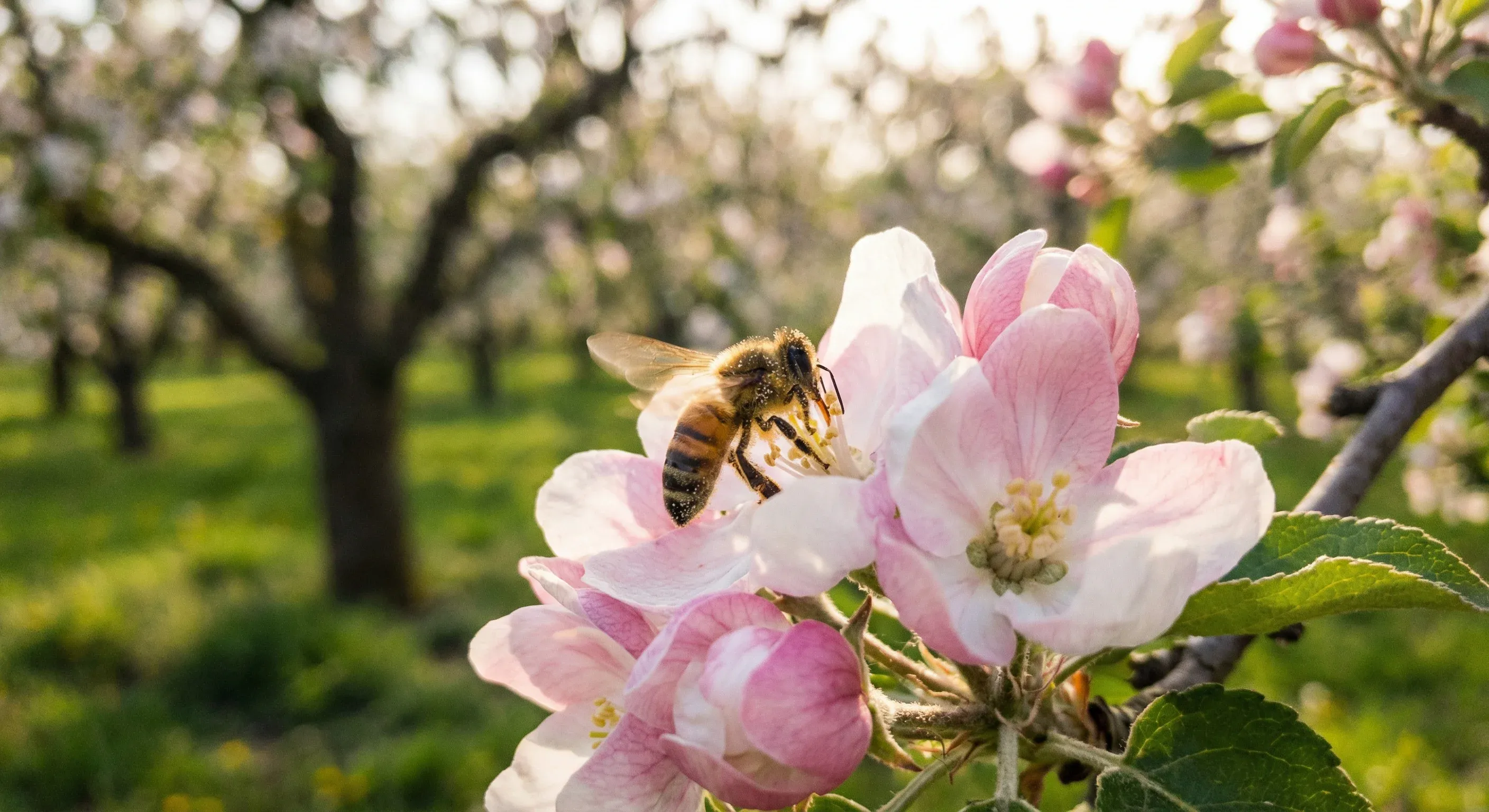
If you have ever planted a fruit tree that flowered beautifully and then produced nothing, pollination is almost certainly the reason. It catches people out every year, and it is probably the most common cause of fruitless fruit trees.
I get messages about this regularly. Someone plants a lovely apple tree, waits two or three years for it to mature, watches it bloom in spring, and then nothing. No fruit. The tree is healthy, the flowers looked fine, but the fruit never came. Nine times out of ten, the problem is that there was no compatible pollination partner nearby.
Understanding pollination groups is not complicated, but it does require knowing a few things before you buy. I did not know any of this when I planted my first orchard trees, and it cost me a few wasted years. If you are still choosing trees, the rootstock guide covers the other decision that matters just as much.
Why most fruit trees cannot pollinate themselves
Most apple and pear varieties, and many sweet cherries, need pollen from a different variety to set fruit. This is called cross-pollination. The tree’s own pollen is genetically incompatible with its own flowers, so even though it produces pollen and has perfectly good blossoms, it cannot do the job alone.
This is a deliberate evolutionary strategy. Cross-pollination promotes genetic diversity, which makes the species more resilient. Good for the species, slightly inconvenient for the gardener who only has room for one tree.
Not all fruit trees work this way. Peaches, nectarines, apricots, most figs, and tart cherries are generally self-fertile. A single tree will produce fruit without any help. But apples, pears, and sweet cherries are the ones that trip people up, because they are also the ones most commonly planted in home gardens.
How pollination groups work
Pollination groups are numbered categories based on flowering time. For apples, the groups run from 1 (earliest to bloom) through to 7 (latest). Pears use a similar system, typically groups 1 to 4.
The principle is simple: for cross-pollination to work, both trees need to be in flower at the same time. A very early bloomer and a very late bloomer will never overlap, so their pollen is useless to each other even if they are genetically compatible.
The rule of thumb is that a variety can be pollinated by another variety in the same group or one group either side. So a group 3 apple can be pollinated by group 2, 3, or 4 varieties. A group 1 apple can only look to groups 1 and 2, since there is nothing earlier.
In practice, weather affects bloom timing from year to year. A cold spring might delay early varieties while late varieties catch up, creating more overlap than the groups suggest. But the group system gives you a reliable baseline for planning.
Apple pollination groups
Apples are where pollination groups matter most, because almost all apple varieties need a partner and the range of bloom times is wide.
The rough breakdown:
- Group 1 and 2 (early): These bloom first. Varieties like Lord Lambourne and Beauty of Bath. They need partners from groups 1, 2, or 3.
- Group 3 (mid-season): The largest group. Cox’s Orange Pippin, James Grieve, Sunset, Discovery. Lots of partners available in groups 2, 3, and 4.
- Group 4 (mid-late): Spartan, Ellison’s Orange, Ashmead’s Kernel. Partners from groups 3, 4, and 5.
- Group 5 to 7 (late): Fewer varieties bloom this late. Finding partners can be trickier, but Crawley Beauty and Court Pendu Plat are in this range.
Group 3 is the sweet spot for home orchards. The most popular varieties sit here, and there are plenty of compatible partners to choose from. If you are planting your first apple tree and want to keep things simple, start with a group 3 variety and add a second from group 2, 3, or 4.
One thing worth knowing: crabapples are good pollinators for domestic apples. If your neighbour has an ornamental crabapple and it blooms at the right time, that might be all you need.
The triploid problem
Some apple varieties are triploid, meaning they have three sets of chromosomes instead of the usual two. This makes their pollen sterile. A triploid tree cannot pollinate anything, not even itself.
Bramley’s Seedling is the most famous example. It is one of the best cooking apples in the UK, but it needs two other apple varieties nearby to fruit. One to pollinate the Bramley, and a second to pollinate the first, since the Bramley cannot return the favour.
This means a minimum of three trees if you want to grow a triploid variety. The two partners must also be compatible with each other and in overlapping pollination groups. It sounds complicated, but in practice, any two non-triploid apples from adjacent groups will sort it out.
Other common triploid apples include Blenheim Orange and Jonagold. If you are short on space, these are varieties to think carefully about before committing to. Training trees as espaliers can help fit more varieties into a small area, which also makes it easier to include the extra pollination partners a triploid needs.
Pear pollination
Pears follow the same group system as apples, but with fewer groups (typically 1 to 4) and some quirks.
Conference is partially self-fertile, which is why it is the most commonly planted pear in UK gardens. It will set some fruit on its own, but the crop improves noticeably with a partner. Williams’ Bon Chrétien (Bartlett in North America) is a reliable partner for Conference, and the two are in adjacent groups.
One important note: pears are less forgiving than apples when it comes to pollination distance. Pear blossom is less attractive to bees than apple blossom, so the trees need to be closer together for reliable pollination. Within 15 metres is better than 30.
Asian pears can cross-pollinate with European pears if the bloom times overlap, which gives you more flexibility if you want to grow both types.
Sweet cherries and compatibility groups
Sweet cherries use a different system. Instead of bloom-time groups, compatibility is determined by S-allele groups, which are about genetic compatibility rather than timing. Two cherries might bloom at exactly the same time but still be incompatible because they share the same S-alleles.
The practical solution is to plant a universal pollinator. Self-fertile sweet cherry varieties like Stella and Lapins can pollinate any other sweet cherry, regardless of S-allele group. If you are planting sweet cherries and do not want to research allele compatibility, just make sure one of your trees is a Stella or Lapins.
Tart cherries (Morello types) are self-fertile and do not need a partner at all.
Stone fruit: the easy ones
Peaches, nectarines, and apricots are almost all self-fertile. A single tree will produce fruit. If you only have room for one tree, these are the safe bet.
That said, self-fertile does not mean pollination is guaranteed. These trees still need pollinators (bees, mainly) to move pollen from the anthers to the stigma within the same flower. If you grow a peach against a south-facing wall and it blooms in early spring before the bees are active, you might need to hand-pollinate with a soft brush. This is more common in the UK than people expect.
Plums sit somewhere in between. European plums like Victoria are self-fertile. Japanese plums generally need a partner. If you are unsure about a specific plum variety, check before you buy.
Practical tips for getting pollination right
Check before you plant. Look up the pollination group and type for every fruit tree before you buy it. Our pollination checker lets you search any variety and see its compatible partners instantly.
Survey what is already nearby. Your neighbour’s apple tree counts. A crabapple in the front garden counts. Before assuming you need to plant a partner, look at what is already flowering within 30 metres.
When in doubt, plant a universal pollinator. Golden Delicious works for most apples. Stella works for sweet cherries. Conference works reasonably well on its own for pears. These are safe choices if you want to keep things simple.
Record what you plant. Variety names, pollination groups, planting dates. In five years, you will not remember which group your apple is in, and you will need to know when choosing a new tree. Leaftide’s permanent plant catalogue is built for exactly this: logging your trees with their variety details so you can look them up later.
Do not pair two triploids. Neither can pollinate the other. If you want a Bramley and a Blenheim Orange, you still need a third, non-triploid tree to pollinate both.
Know your trees before you plant them.
Free for up to 30 plants. No card needed.
When pollination is not the problem
If your tree has a partner, the groups overlap, and you are still not getting fruit, the issue might be elsewhere. Late frosts can kill blossoms. Poor weather during flowering keeps bees away. Young trees sometimes need a few years before they are mature enough to hold fruit. Biennial bearing (a heavy crop one year, almost nothing the next) is common in some apple varieties. The first year fruit tree care guide covers what to expect in those early seasons.
Pollination is the first thing to rule out, but it is not the only thing.
Getting it right from the start
The best time to think about pollination is before you plant. Once a tree is in the ground and established, you are committed. Adding a partner three years later is possible, but it means another three years of waiting for the new tree to mature.
If you are planning an orchard, even a small one with two or three trees, spend ten minutes checking pollination compatibility first. You do not want to find out in year three that your trees cannot pollinate each other. Keeping an orchard record with each tree’s variety and pollination group means you can look it up instantly when choosing your next tree.
Our pollination checker covers over 60 varieties with full compatibility data. If you want to keep track of what you have planted, the permanent plant catalogue lets you log every tree with its variety, rootstock, and pollination group so you can reference it when choosing your next tree.