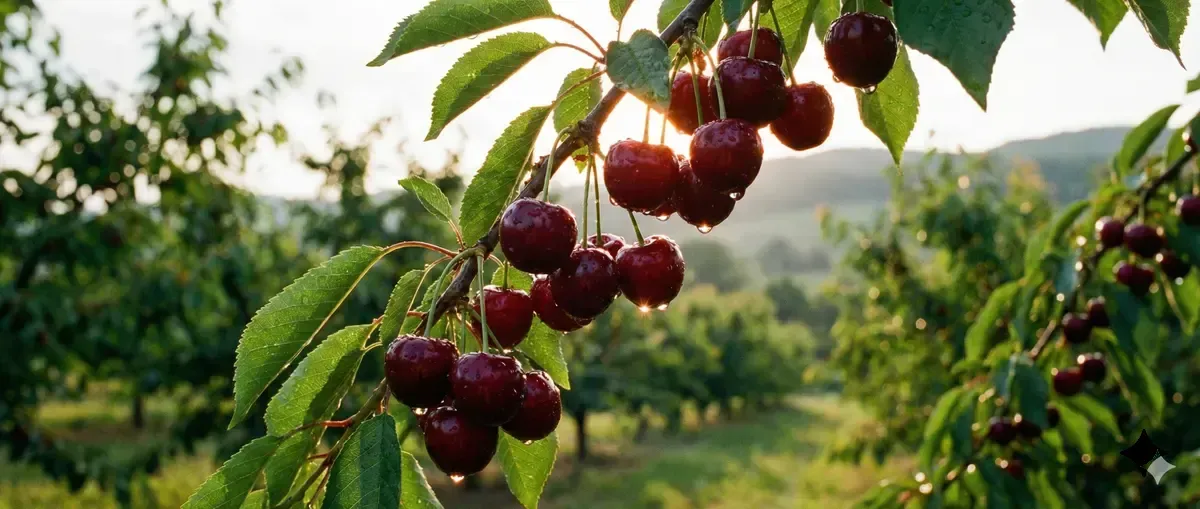
Every general pruning guide says winter. For cherry trees, following that advice could kill your tree.
Cherry trees are the exception to almost every pruning rule. Where apples and pears tolerate winter work, cherries demand summer pruning. Where most fruit trees can handle a bit of flexibility, cherries give you a narrow window. Get the timing wrong and you’re not just risking poor fruiting — you’re inviting disease that can kill the tree.
The reason is simple: cherry trees are highly susceptible to two serious diseases that enter through pruning wounds, and both are most active during the cold, wet months when traditional pruning happens.
Critical Timing
Cherry trees MUST be pruned in summer. In the US, this typically means late June through August depending on your zone and variety. In the UK, July to August. Winter pruning creates open wounds during peak disease season and significantly increases the risk of silver leaf disease and bacterial canker. This is not a preference — it’s essential for tree health.
Silver leaf disease: why timing is everything
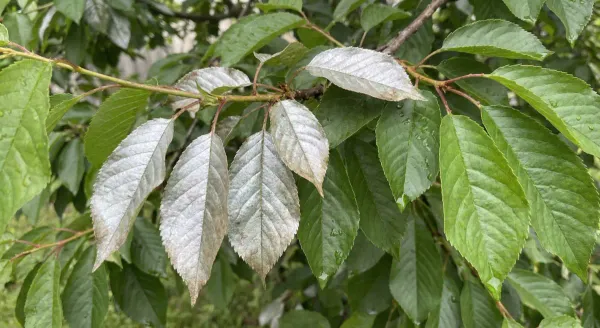
Silver leaf is caused by the fungus Chondrostereum purpureum. The name comes from the silvery sheen that appears on infected leaves, caused by air pockets forming between the leaf layers as the fungus spreads through the tree’s vascular system.
The fungus produces airborne spores from autumn through spring. These spores land on fresh wounds — pruning cuts, broken branches, damage from ties or stakes — and germinate if conditions are right. Once inside the tree, the fungus spreads through the wood, blocking water transport and eventually killing branches or the entire tree.
Here’s why pruning timing matters so much: if you prune in winter, you’re creating fresh wounds at exactly the time when spore counts are highest. The wound is an open door, and the pathogen is waiting outside.
Prune in summer, and the situation reverses. Spore counts are at their lowest. The tree is in active growth, so wounds heal quickly, often within weeks. By the time autumn arrives and spores become active again, the wound has sealed over and the entry point no longer exists.
This isn’t theoretical. Silver leaf is a documented concern across cherry-growing regions. Extension services from Washington State University to Oregon State to the RHS all emphasise the same point: once a tree is infected, there’s no chemical treatment. You can prune out infected wood, but only if you catch it early and only if you prune back to completely clean wood — which often means removing large sections of the tree.
Prevention is the only reliable strategy, and prevention means summer pruning.
Bacterial canker: the second reason
Silver leaf gets most of the attention, but bacterial canker is equally serious and follows the same pattern.
Bacterial canker is caused by Pseudomonas syringae, a bacterium that thrives in cold, wet conditions. It enters through wounds and causes sunken patches of dead bark that ooze amber-coloured gum. Leaves on affected branches develop small brown spots surrounded by yellow halos, then wilt and die.
Like silver leaf, bacterial canker is most active from autumn through spring. Pruning in winter creates wounds during peak infection season. The bacterium spreads in rain splash, so wet weather combined with fresh cuts is particularly risky.
Summer pruning avoids this. The weather is drier, bacterial activity is lower, and wounds heal before the wet season begins.
Both diseases follow the same logic: prune when the tree is growing and the pathogens are dormant, not the other way around.
The ideal pruning window
The ideal pruning window is mid to late summer, immediately after harvest. The exact timing depends on your location and variety.
In the US:
- USDA zones 5-6 (Pacific Northwest, parts of the Northeast): Late June to early August for most varieties. Sweet cherries like Bing and Rainier typically ripen mid-June to early July. Prune immediately after picking.
- USDA zones 7-8: Mid-June to late July. Warmer zones see earlier ripening, so the pruning window shifts earlier as well.
- Sour cherries like Montmorency ripen later than sweet cherries, typically mid to late July in zones 5-6, so pruning extends into August.
In the UK: July to August for most varieties, immediately after harvest.
This timing works because:
The tree has just finished fruiting and is putting energy into new growth. Wounds heal quickly because the cambium layer is active and sap flow is strong.
The weather is typically dry, which reduces the risk of bacterial infection entering through cuts.
You’re pruning at least two months before silver leaf spores become active in autumn. Even a large wound has time to callus over before the danger period begins.
If you’re growing a late-fruiting variety or your tree is particularly vigorous, you can extend pruning into early September, but don’t push it later than that. By mid-September, you’re entering the risk window.
For cherries that don’t fruit — ornamental varieties or young trees not yet in production — the same timing applies. Prune in summer, ideally late June through August depending on your zone, when the tree is in active growth and disease pressure is lowest.
Tools You'll Need
Sharp bypass secateurs, a pruning saw for larger branches, and — most importantly — sterilising solution. Tool hygiene matters more for cherries than any other fruit tree because of silver leaf and bacterial canker. Clean your tools between every cut if you suspect disease, and always between trees. Rubbing alcohol or a 10% bleach solution works.
Sweet cherries vs sour cherries
The timing is the same for both types, but the pruning approach differs because they fruit differently.
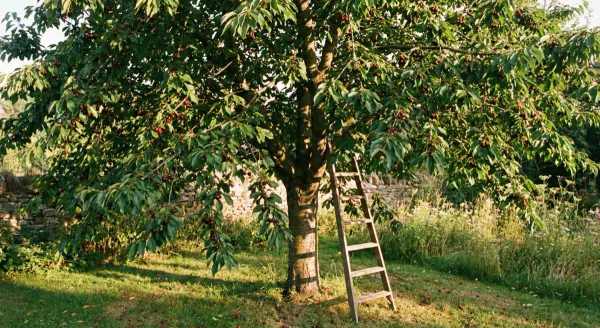
Sweet cherries (Prunus avium) — varieties like Bing, Rainier, Stella, and Lapins in the US, or Stella and Sunburst in the UK — fruit on short spurs that form on two-year-old and older wood. Once a spur is established, it continues fruiting for several years. This means sweet cherries need relatively little annual pruning. The main job is removing dead wood, crossing branches, and anything that’s crowding the centre of the tree or blocking light.
You’re maintaining structure rather than stimulating new growth. Prune too hard and you remove fruiting wood that won’t be replaced for two years.
Sour cherries — Montmorency in the US, Morello in the UK — fruit on the previous year’s wood, similar to peaches. The wood that grew last summer will fruit this summer, then it’s done. This means sour cherries need annual replacement pruning to encourage a constant supply of new fruiting shoots.
After harvest, cut out the branches that just fruited and tie in new shoots to replace them. This keeps the tree productive and prevents it becoming a tangle of old, unproductive wood.
The fruiting habit is different, but the timing rule is identical: prune in summer, after harvest, when disease risk is lowest.
Fan-trained cherries
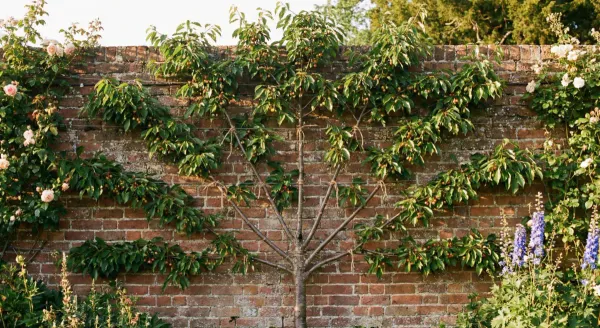
If you’re growing a cherry as a fan against a wall or fence — a common approach in the UK and increasingly popular in the US for space-limited gardens — the same timing applies but the technique is more specific.
After harvest, remove any shoots growing directly towards or away from the wall. These won’t fruit well and they crowd the framework. Tie in new shoots that are growing in the plane of the fan, spacing them about 10-15cm apart. Cut back the tips of shoots that have filled their allocated space to encourage fruiting spurs.
For sour cherries trained as fans, you’re doing replacement pruning: cutting out wood that fruited this year and tying in new shoots to fruit next year, exactly as you would with a freestanding tree.
The advantage of a fan is that you can see the structure clearly, which makes it easier to identify what needs removing. The disadvantage is that there’s more tying and training work. Either way, do it in summer.
Formative pruning exception
There’s one exception to the summer-only rule: formative pruning of young trees.
If you’re training a young cherry tree and need to establish the basic framework, you can do light formative work in late spring — May in the US (after the last frost in your zone), April to May in the UK. This is after the worst of the winter wet but before the tree puts all its energy into fruiting.
Spore counts for silver leaf are lower in late spring than in autumn or winter, though not as low as in summer. The risk isn’t zero, but it’s manageable if you’re only making a few cuts to establish the main branches.
Once the tree is established and fruiting, switch to summer pruning only. The formative exception is for young trees that need structural work and can’t wait until after a harvest that might not happen for another year or two.
Even then, keep the cuts minimal. If you can wait until summer, wait.
Month-by-month pruning calendar
| Month | What to Do |
|---|---|
| January-May | No pruning. Silver leaf spores are active. Leave the tree alone. |
| June | Earliest window in warmer zones (8-9). Wait for harvest to finish. |
| July | Main pruning window. Prune after harvest on a dry day. |
| August | Continue pruning if needed. Last chance before autumn. |
| September | Stop pruning. Silver leaf spore season begins. |
| October-December | No pruning. High disease risk. Only remove broken branches if absolutely necessary. |
Common mistakes
The biggest mistake is pruning in winter because that’s what you do with other fruit trees. Cherry trees are not other fruit trees. Winter pruning is the single most reliable way to introduce silver leaf or bacterial canker.
The second mistake is pruning in wet weather, even in summer. Rain splash spreads bacterial canker, and wet wounds are more vulnerable to infection. If it’s been raining, wait for a dry day.
The third mistake is removing too much wood at once. Heavy pruning creates large wounds that take longer to heal, extending the vulnerable period. If a tree needs significant work, spread it over two or three years rather than doing it all in one session.
The fourth mistake is not recognising the symptoms of disease early enough. If you see silvering on leaves, sunken bark, or gum oozing from branches, don’t wait. Prune out affected wood immediately, cutting back to clean wood, and do it on a dry day regardless of the season. Leaving infected wood in place allows the disease to spread.
The fifth mistake is assuming all cherry varieties have the same harvest timing. A Bing cherry in zone 6 ripens weeks earlier than a Montmorency in the same zone. Know your variety’s typical harvest window and plan pruning accordingly.
After you prune
Don’t apply wound sealant — summer wounds on cherry trees heal quickly in warm weather, which is exactly why you prune in summer. The tree’s natural callusing process is faster and more effective than any artificial coating.
Monitor cuts closely for the first few weeks. Any sign of silver leaf (silvery sheen on leaves near the cut) or bacterial canker (amber gum oozing from the wound) means you need to act quickly. Prune back to clean wood immediately, even if it means removing more of the branch than you’d planned.
Dispose of all pruned wood away from the tree. Don’t leave cherry prunings on the ground beneath the canopy — silver leaf spores can develop on dead wood and reinfect the tree or spread to neighbouring plants. Burn it if you can, or take it to green waste collection.
If you pruned a sour cherry, check that replacement shoots are growing well and tie them in as they develop through late summer. These are next year’s fruiting wood, so you want them positioned where they’ll get good light and air circulation.
What to record
Because timing is so critical for cherry trees, keeping a record of when you pruned and how the tree responded is more important than with most other fruit.
Note the date, what you removed, the weather conditions, and the tree’s overall health. If you’re managing multiple cherry trees, record each one separately — they won’t all need pruning in the same year or to the same extent.
A year later, you’ll know whether the tree responded well, whether any disease appeared, and whether your timing was right. This is particularly useful if you’re experimenting with the edges of the pruning window or dealing with a tree that’s shown signs of disease in the past.
For a structured approach to tracking pruning work across all your fruit trees, see our guide on keeping a fruit tree pruning log.
Never forget when you pruned
Free for up to 30 plants. No card needed.
Why this matters more than with other fruit
Apples and pears are forgiving. Prune them in winter and they’ll be fine. Prune them in summer and they’ll also be fine. The timing affects vigour and fruiting, but it rarely affects survival.
Cherry trees don’t give you that margin. Prune at the wrong time and you’re not just reducing next year’s crop — you’re risking the tree itself.
This is why plum trees follow the same rule. They’re in the Prunus genus, they’re susceptible to the same diseases, and they demand the same respect for timing.
If you’re planning a fruit garden and want to track pruning schedules for trees with different requirements, Leaftide’s permanent plants feature lets you record individual trees, log maintenance work, and set reminders for seasonal tasks like summer pruning.
The rule is simple: cherry trees are pruned in summer. Everything else is a mistake.
Sources
This article is based on guidance from university extension services and horticultural organisations:
- Oregon State University Extension: Training and Pruning Your Home Orchard
- Washington State University Extension: Cherry Training Systems
- RHS: Cherries — Grow Your Own
- RHS: Silver Leaf Disease
Plum trees face the same silver leaf risk and are also pruned in summer — see our guide on when to prune plum trees. For winter-pruned fruit trees, see when to prune apple trees and when to prune pear trees. For spring-pruned stone fruit, see when to prune peach trees.