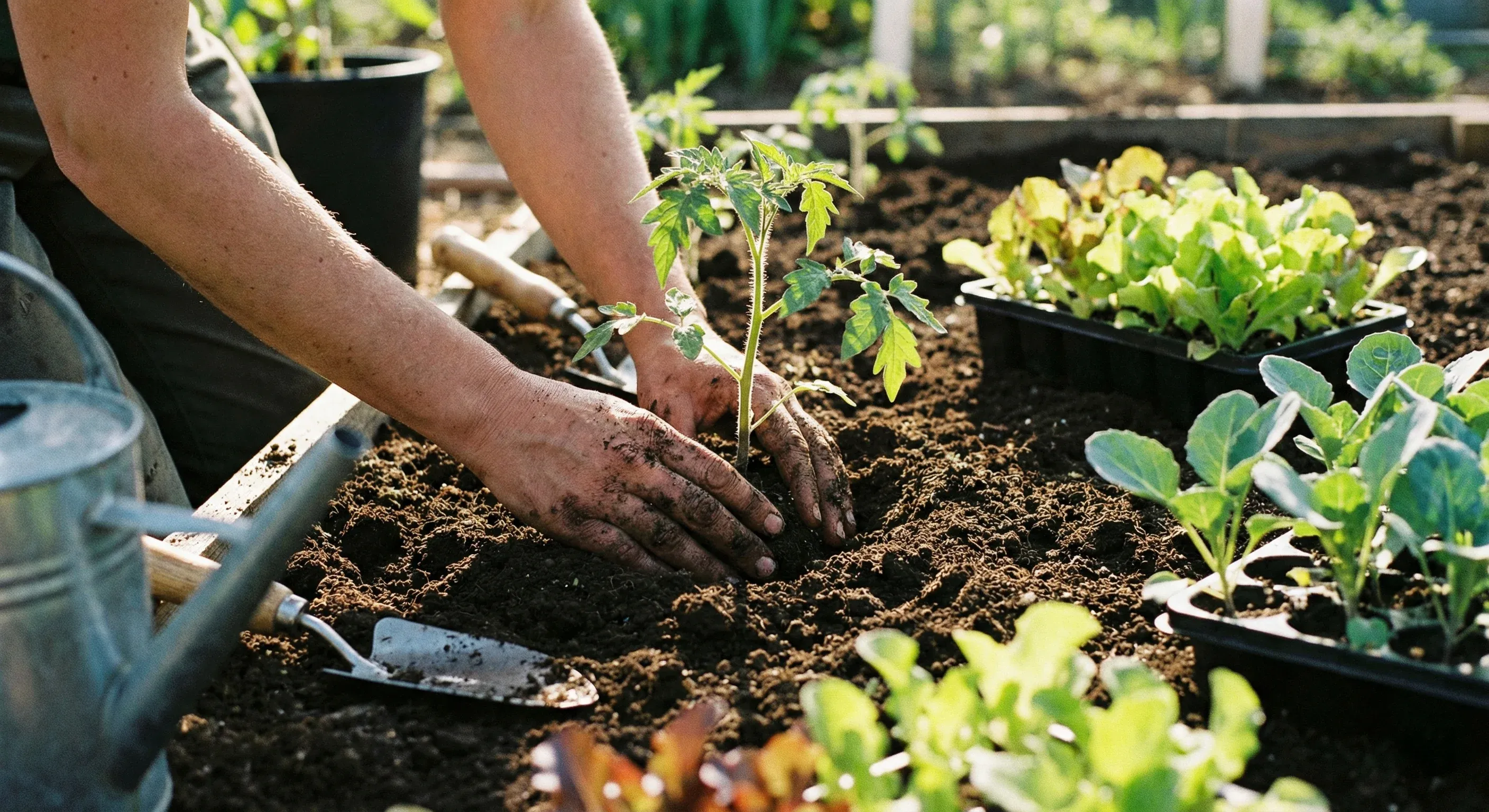
I have printed out more monthly planting calendars than I care to admit. Laminated ones from garden centres. PDFs from seed companies. Spreadsheets I found on Reddit. Every year I would stick one on the fridge, and every year it would lead me slightly astray.
The problem was never the calendars themselves. They were well-intentioned. The problem was that they were written for a place that was not my garden.
A calendar that says “sow tomatoes in March” might be perfect for someone in zone 9 with mild winters and a long growing season. For me, March tomato sowings meant leggy seedlings sitting on a windowsill for weeks with nowhere to go. The calendar was not wrong. It just was not written for my conditions.
If you have ever followed a monthly planting guide and felt like the timing was off, you are not imagining it. The timing probably was off, for you.
Why most planting calendars feel approximate
The typical monthly planting calendar works from broad assumptions. It picks a region, averages the frost dates across that region, and assigns crops to months. Sow peas in February. Start peppers indoors in March. Direct sow beans in May.
These are reasonable starting points. But “zone 6” covers an enormous range of actual growing conditions. A sheltered garden in a city centre and an exposed allotment on a hilltop can both sit in zone 6, yet their last frost dates might differ by three weeks. The calendar treats them the same.
Your altitude, the direction your plot faces, whether you grow in raised beds or open ground, all of it affects when you can safely plant. A south-facing wall that holds heat through the evening creates a different microclimate from a north-facing border that stays cool until midday. None of that shows up in a generic monthly chart.
I am not saying those charts are useless. They give you a rough shape of the season. But if you have ever planted something “on time” according to the calendar and watched it sit there doing nothing for a month, the chart was probably too early for your specific spot.
What planting zones actually tell you
USDA hardiness zones are based on one thing: the average annual minimum winter temperature. Zone 6 means your coldest winter nights typically reach somewhere between -23°C and -18°C. Zone 8 means -12°C to -7°C. That is it.
This is useful information if you are choosing permanent plants. It tells you whether a fig tree or a peach will survive your winters. It helps you pick apple varieties that will not be killed by a cold snap in January.
But zones say very little about your growing season for annual crops. Two gardens in the same zone can have wildly different frost dates, summer temperatures, rainfall patterns, and day lengths. Zone 7 in Virginia looks nothing like zone 7 in the Pacific Northwest, even though the winter minimum is similar.
When people search for a “planting calendar by zone,” what they usually need is a calendar based on their frost dates and local climate, not just their hardiness zone number. The zone is a starting point, but it is not the whole picture. The last frost date guide explains how to find your specific dates and what they mean in practice.
What actually drives your planting schedule
Three things matter more than your zone number when deciding what to plant each month.
Your last frost date in spring and first frost date in autumn define the boundaries of your growing season. Everything else works backwards from those two numbers. Tender crops like tomatoes, peppers, and courgettes cannot go outside until frost risk has passed. Hardy crops like peas, broad beans, and garlic can go out weeks or even months earlier.
Soil temperature determines when seeds will actually germinate. You can sow carrots in March if you like, but if your soil is still 5°C, they will sit there and do nothing. Most seeds need soil temperatures above 7-10°C to get going, and warm-season crops like beans and sweetcorn want 12°C or more.
Accumulated warmth through the season, sometimes measured as growing degree days, determines how quickly crops develop. A tomato plant does not care what month it is. It cares how much warmth it has received since germination. In a cool summer, development slows. In a warm one, it speeds up. This is why the same variety planted on the same date can be ready weeks apart in different years.
Put those three together and you have a planting schedule that actually reflects your conditions, built from your local climate data rather than a chart someone drew for an entire region. The climate-based sowing dates article explains how this works in detail.
A rough month-by-month guide (and its limits)
For what it is worth, here is a general sense of what happens through the year in a temperate climate. I am keeping this deliberately vague because the specifics depend entirely on where you are.
January and February are for planning and ordering seeds. In milder areas (zone 8 and above), you might start some hardy crops under cover. In colder zones, the ground is frozen and there is nothing to do outside.
March is when things start to stir. Indoor sowings of slow crops like peppers, aubergines, and chillis can begin if you have warmth and light. The seed starting indoors guide covers exactly how many weeks before your last frost each crop needs. Hardy crops like broad beans and peas can go out in milder regions. In colder areas, March is still too early for most things.
April is the big sowing month for many gardeners. Tomatoes, courgettes, and cucumbers can start indoors. Direct sowings of beetroot, carrots, and lettuce become possible as soil warms. But “April” means very different things in zone 5 versus zone 8.
May is transplanting season in most temperate climates, once frost risk drops. Tender crops move outside. Successional sowings of salads and radishes keep the harvest going. A succession planting schedule helps you plan how many rounds to fit in before autumn. In warmer zones, May is already well into the growing season.
June through August is about keeping things going and harvesting what is ready. Second plantings of beans, more salad, and overwintering brassicas like purple sprouting broccoli go in during this window too.
September and October bring the shift to autumn. Garlic goes in. Overwintering onion sets. Green manures on empty beds. In milder areas, you can still sow hardy salads under cover.
November and December are for tidying up, mulching, and thinking about next year.
That is the general shape. But notice how many times I said “in milder areas” or “depending on your zone.” The month alone does not tell you enough. You need to know your frost dates and your local conditions to turn that rough outline into an actual plan.
From generic calendar to personal timeline
I built Leaftide partly because I was tired of translating between generic calendars and my actual garden. The app uses your location to pull in local frost dates and climate data, then calculates sowing windows for each crop based on your specific conditions. Instead of “sow tomatoes in March,” it tells you something like “your ideal sowing window is 28 March to 15 May” with predicted transplant and harvest dates that follow from there.
The season calendar view shows all your crops on a single timeline, colour-coded by stage: when to sow, when things are growing, when to harvest. You can see at a glance what needs doing each month without consulting a separate chart. If you change your setup, say you add a propagator or switch from a bed to a container, the dates shift to reflect that.
It is just connecting your local climate data to each crop’s requirements instead of relying on a one-size-fits-all chart. But that connection makes a real difference. I stopped printing calendars from the internet after I started using it.
Your garden deserves its own calendar.
Free for up to 30 plants. No card needed.
Making any calendar work better for you
Whether you use an app or a chart on the fridge, a few things make any planting calendar more useful.
Find your actual frost dates. Not the ones for your region, but the ones for your specific area. Local weather stations, your national meteorological service, or tools like Leaftide’s Frost Date Finder can help. Once you know your average last spring frost and first autumn frost, you have the two anchors that everything else hangs from.
Adjust for your microclimate. If your garden is sheltered, south-facing, or in an urban area, you can probably plant a week or two earlier than the average frost date suggests. If you are exposed, on a slope, or in a frost pocket, add a week or two of caution.
Keep notes on what actually happened. The best planting calendar is the one you build over several seasons from your own observations. When did you actually sow? When did things germinate? When was the first harvest? After a few years, those notes become more reliable than any chart you could download. The garden journal tracking guide covers what is worth recording.
Use your zone for permanent plants, your frost dates for annuals. This is the simplest rule of thumb. Hardiness zones help you choose trees, shrubs, and perennials that will survive your winters. Frost dates and local climate drive the timing for everything you sow and harvest each year.
The calendar you actually need
The monthly planting calendar everyone searches for is a useful concept. Having a sense of what to do each month keeps you on track and stops you from missing key sowing windows. But the generic version, the one that treats an entire zone as a single garden, will always be approximate.
What works better is a calendar that starts from your frost dates, factors in your local climate, and adjusts to how you actually grow. You can build that yourself with a notebook and a few seasons of observation. Or you can let a tool like Leaftide do the calculation for you.
The point is the same either way: stop following someone else’s calendar and start following your own.
Work out your sowing dates for specific crops with the Crop Timeline Calculator, or find your local frost dates with the Frost Date Finder.