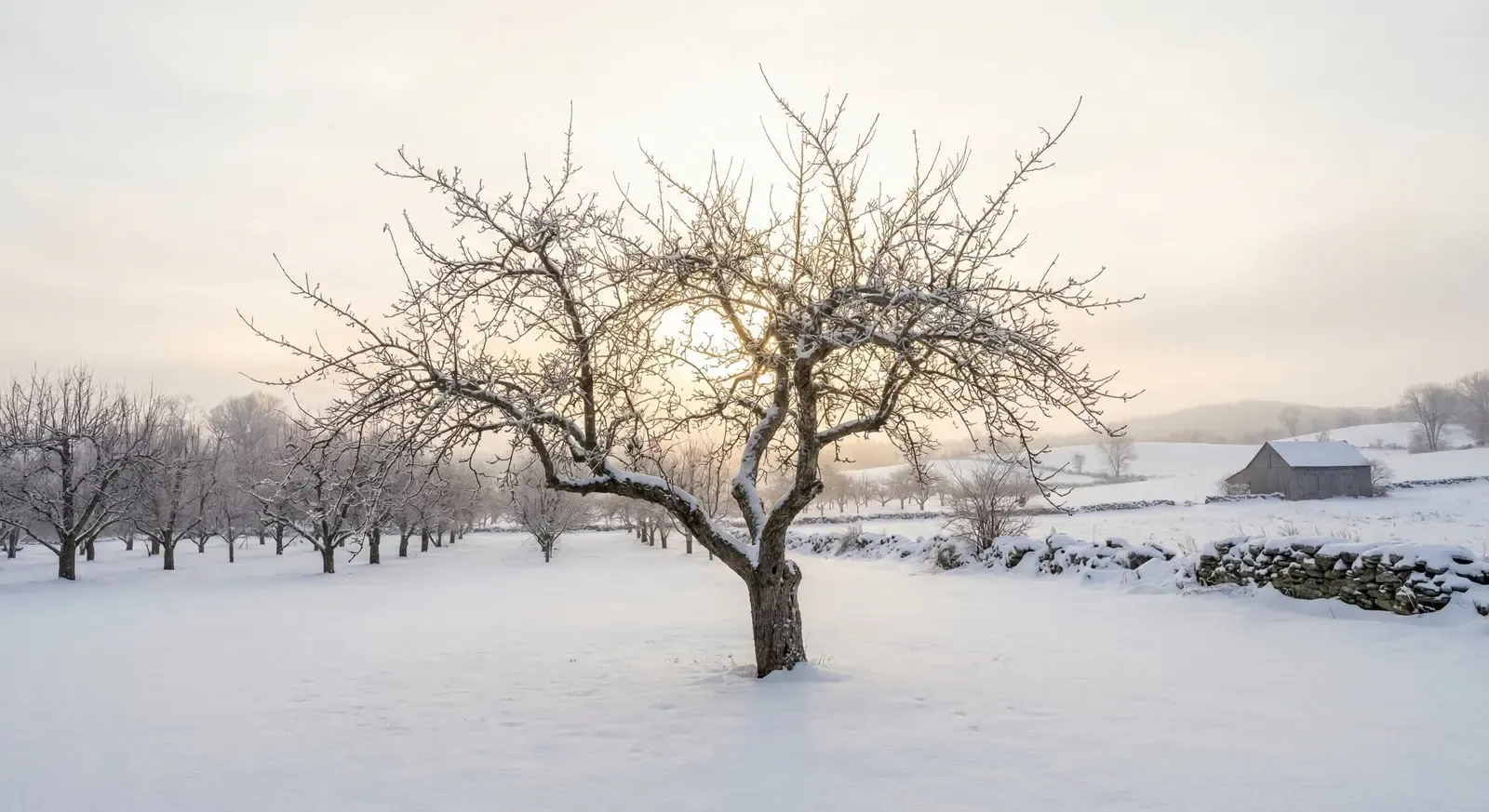
I planted a Fuji apple tree in 2021, the year I moved to a milder part of the UK. The nursery said it needed 800 chill hours. I had no idea what that meant, but the tree was on sale and Fuji apples are my favourite, so I planted it anyway.
Two springs later, I understood. The tree leafed out in patches. Half the buds sat there doing nothing while the other half pushed weak growth. It flowered sparsely, set three apples, and dropped two of them by June. The tree was healthy. It just hadn’t gotten cold enough.
That was when I started paying attention to chill hours. I looked up chill hours by zip code, cross-referenced extension service data, and realised this isn’t just an abstract number on a nursery tag. It’s the single most important factor in whether a fruit tree actually fruits where you live. If you’re choosing fruit trees for your garden, this number matters more than soil type, more than sun exposure, more than almost anything else you’ll read about on the label.
What chill hours actually are
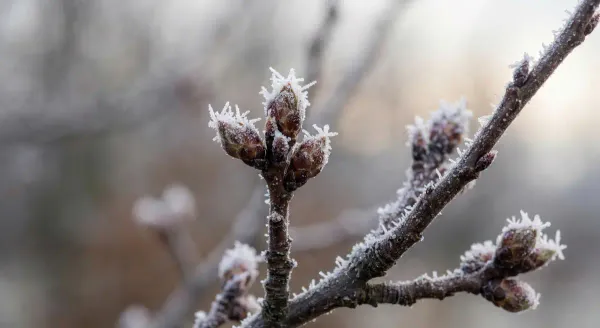
Every deciduous fruit tree goes dormant in winter. The leaves drop, growth stops, and the tree enters a rest period. This isn’t just the tree shutting down because it’s cold. Dormancy is an active biological process, and the tree needs a specific amount of cold exposure to complete it.
Think of it like a timer. Each hour of cold temperatures ticks the counter forward. When the counter reaches the tree’s requirement, dormancy is satisfied and the tree is ready to wake up when spring warmth arrives. If the counter never reaches the target, the tree gets stuck in a half-dormant state. It knows spring is here, but it hasn’t finished its internal reset.
The result is exactly what I saw with my Fuji: delayed, uneven bud break. Some buds open, others don’t. Flowering is weak and scattered. Pollination suffers because the flowers aren’t all open at the same time. Fruit set is poor. And the tree wastes energy trying to sort itself out instead of growing and producing.
This is why chill hours matter so much for fruit trees. It’s not about whether the tree survives winter. Most fruit trees handle cold just fine. It’s about whether the tree completes its dormancy cycle so it can fruit properly the following season.
The three chill hour models
When you see “800 chill hours” on a nursery tag, that number was probably calculated using one of three models. They don’t all count the same way, which is why the same location can have different chill hour totals depending on which model you use.
The simple model (hours below 45°F). This is the oldest and most straightforward. Every hour the temperature stays between 32°F and 45°F (0°C and 7°C) counts as one chill hour. Below freezing doesn’t count. Above 45°F doesn’t count. You just add up the qualifying hours from October through February.
Most nursery labels and gardening references use this model. It’s easy to understand and easy to calculate. The downside is that it treats all qualifying temperatures equally and ignores what happens above 45°F, which turns out to matter quite a bit.
The Utah model. Developed at Utah State University in the 1970s, this model recognises that not all cold is equally effective at satisfying dormancy. It assigns different values to different temperature ranges:
- 36-48°F (2.2-8.9°C): 1 full chill unit
- 48-54°F (8.9-12.2°C): 0.5 chill units
- 54-60°F (12.2-15.6°C): 0 chill units
- 60-65°F (15.6-18.3°C): -0.5 chill units (yes, negative)
- Above 65°F (18.3°C): -1 chill unit
That negative accumulation is the key insight. Warm spells in winter don’t just pause the chill counter. They actively reverse it. A few warm days in January can undo a week of cold nights. This is why the Utah model is more accurate in climates with fluctuating winter temperatures, which describes most of the US south of zone 6.
The dynamic model. This is the newest and most complex. Developed in Israel for warm-winter climates, it treats chill accumulation as a two-stage process. Cold temperatures create an intermediate compound, and moderate temperatures then convert it into a permanent chill “portion.” Once a portion is locked in, warm temperatures can’t reverse it.
The dynamic model is gaining traction in California and the Southeast because it handles warm-winter climates better than the Utah model. But it’s harder to calculate and most nursery labels don’t use it. You’ll mainly encounter it in university research and extension service publications.
Which model should you use?
For most home growers, the simple model (hours below 45°F) is fine. It’s what nursery labels reference and what most online calculators use. If you’re in a warm-winter area (zones 8-10) where winter temperatures fluctuate a lot, the Utah model gives a more realistic picture. Don’t worry about the dynamic model unless you’re deep into the research.
How to find chill hours for your area
This is the question everyone asks, and the answer is frustratingly scattered. There’s no single national database where you type in your zip code and get a definitive number. But there are several good sources, and cross-referencing a couple of them will give you a reliable estimate.
Your state’s cooperative extension service. This is the gold standard. University extension offices across the US track chill hour accumulation at weather stations throughout their state. Many publish annual reports or maintain online tools. Some of the best:
- UC Davis Chill Calculator (California): Tracks chill hours at dozens of stations across the Central Valley and coast. Uses all three models. If you grow fruit in California, this is your primary source.
- AgWeatherNet (Washington State): Real-time chill hour tracking for the Pacific Northwest. Covers Washington’s major growing regions with station-level data.
- University of Georgia Extension: Publishes chill hour maps and accumulation data for the Southeast, where chill hours are a constant concern.
- Texas A&M AgriLife: Maintains chill hour data for Texas, where the range from the Panhandle to the Gulf Coast spans 400 to 1,200+ hours.
Search for “[your state] extension service chill hours” and you’ll usually find something useful. The data is free and it’s based on actual weather station measurements, not estimates.
NOAA weather data. If your extension service doesn’t publish chill hour data directly, you can calculate it yourself from NOAA’s hourly temperature records. It’s tedious but accurate. Download hourly data for your nearest weather station, count the hours between 32°F and 45°F from November through February, and you have your chill hours under the simple model.
Online chill hour maps. Several websites publish maps showing estimated chill hour ranges by region. These are useful for a rough idea but they smooth over local variation. A hilltop and a valley floor five miles apart can differ by 200 chill hours because cold air pools in low spots. Use maps as a starting point, not a final answer.
Your own weather station. If you have a home weather station that logs hourly temperatures, you can calculate your exact chill hours. This is the most accurate option because it measures your actual microclimate, not a weather station that might be miles away at a different elevation.
Check your specific requirements
Leaftide’s chill hour validator lets you check whether your area meets the chill requirements for specific fruit tree varieties. It cross-references your location with variety data so you can see potential mismatches before you plant.
Chill hours by state and region
These are rough ranges based on typical winters. Your specific location within a state can vary significantly based on elevation, proximity to water, and urban heat island effects. Treat these as starting points.
Deep South (150-500 hours)
Florida, southern Texas, the Gulf Coast of Louisiana, Mississippi, and Alabama. This is low-chill territory. Coastal Florida might accumulate only 100-200 hours in a mild winter. Northern Florida and the Gulf states generally see 300-500 hours. Warm spells in January and February regularly erase accumulated chill under the Utah model.
If you’re here, you need low-chill varieties. Period. Planting a Honeycrisp apple in Pensacola is an expensive way to grow shade.
Southeast (400-800 hours)
Georgia, the Carolinas, Tennessee, northern Alabama, northern Mississippi. This is the tricky zone. Most years you’ll get 600-800 hours, which is enough for many standard varieties. But every few years, a warm winter drops you to 400-500, and your mid-chill trees have a bad season.
This variability is the real challenge. It’s not that you can’t grow 700-hour varieties here. It’s that you’ll have occasional years where they underperform. Choosing varieties at the lower end of your range gives you a buffer.
Mid-Atlantic and Midwest (800-1,200 hours)
Virginia, Maryland, Kentucky, Ohio, Indiana, Illinois, Missouri. Reliable chill accumulation in most years. You can grow the full range of standard varieties without worrying about chill deficiency. The concern here shifts to late frost damage rather than insufficient chill.
Northeast and Upper Midwest (1,000-1,500+ hours)
New England, New York, Michigan, Wisconsin, Minnesota. More chill than any fruit tree needs. The limiting factor here isn’t chill hours but winter hardiness. Your trees will complete dormancy just fine. The question is whether they survive -20°F in January.
Pacific Northwest (800-1,200 hours)
Western Washington and Oregon. Maritime influence keeps winters mild but consistently cool. Chill accumulation is steady and reliable. This is one of the best fruit-growing climates in the country, and chill hours are rarely a concern.
California (200-1,200+ hours)
California spans the full range. Coastal Southern California might see 200-400 hours. The Central Valley typically gets 700-1,000 hours but has been trending lower. The Sierra foothills and Northern California accumulate 1,000+ hours reliably.
The Central Valley is where chill hours are most actively studied and most actively declining. Commercial orchards that planted 900-hour varieties decades ago are now seeing inconsistent production as warm winters become more frequent.
Mountain West (800-1,500+ hours)
Colorado, Utah, Idaho, Montana. High elevation means plenty of chill. Like the Northeast, the concern is winter hardiness and late spring frost, not chill deficiency.
Southwest (100-600 hours)
Arizona, New Mexico, southern Nevada. Low-chill territory, similar to the Deep South. Phoenix averages 200-400 hours. Tucson is slightly better at 400-600. High-desert areas like Albuquerque and Santa Fe get 600-800+ hours due to elevation.
What happens when trees don’t get enough chill
I described my Fuji’s symptoms earlier, but the full picture is worth understanding because the effects aren’t always obvious. Insufficient chill doesn’t kill the tree outright. It degrades performance in ways that can take a few seasons to fully recognise.
Delayed and uneven bud break. This is the most visible symptom. Instead of the whole tree waking up together in spring, buds open in stages over weeks. Some branches leaf out while others sit bare. The tree looks patchy and confused. This is sometimes called “delayed foliation” in extension literature.
Reduced flowering. Fewer flower buds open, and the ones that do may open at different times. This is a problem for pollination. If your tree needs a pollination partner and they’re not flowering at the same time because both are struggling with chill, fruit set drops dramatically.
Blind wood. This is the term for branches that produce leaves but never develop fruit buds. The wood is alive and growing, but it’s unproductive. In severe cases, large sections of the tree become blind wood, and no amount of pruning will fix it because the underlying problem is physiological, not structural.
Poor fruit quality. Even when fruit does set, it may be smaller, misshapen, or drop prematurely. The tree didn’t have the energy reserves to support a full crop because it spent too much energy sorting out its disrupted dormancy.
Long-term decline. One bad year is recoverable. But if your area consistently falls short of a variety’s chill requirement, the tree enters a cycle of stress. Each year it starts behind, never fully recovers, and gradually declines. I’ve seen trees that looked fine for three or four years before the cumulative effect became obvious.
Chill hours are not negotiable
Unlike many growing requirements, you can’t compensate for insufficient chill with better soil, more water, or extra fertiliser. If a variety needs 800 hours and your area provides 500, the tree will underperform every year. Choose varieties that match your climate, not varieties you wish your climate could support.
Low-chill varieties for warm climates
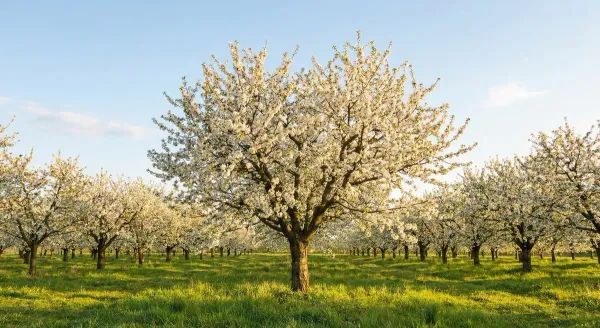
If you’re in zones 8-10 or anywhere that accumulates fewer than 600 chill hours, you’re not locked out of fruit growing. Breeders have developed excellent low-chill varieties, many of them in Florida and Southern California specifically for warm-winter climates.
Low-chill apples (200-400 hours)
- Anna (200-300 hours): The go-to low-chill apple. Developed in Israel, widely grown in Florida and the Gulf Coast. Sweet, mildly tart. Needs a pollinator like Dorsett Golden or Ein Shemer. See Anna pollination partners for compatible varieties.
- Dorsett Golden (200-300 hours): Golden Delicious type, good flavour, pollinates Anna. These two are almost always planted together in warm climates.
- Ein Shemer (200-300 hours): Another Israeli variety. Tart, good for cooking. Pollinates Anna.
- Tropic Sweet (250-300 hours): Developed by the University of Florida. Better disease resistance than Anna in humid climates.
Low-chill peaches (150-400 hours)
Peaches are actually the best fruit tree option for warm climates because many excellent varieties have been bred specifically for low chill.
- Florida Prince (150 hours): One of the lowest chill peaches available. Yellow flesh, good flavour. Ripens early.
- TropicBeauty (150 hours): Semi-freestone, developed by the University of Florida.
- Desert Gold (200-300 hours): Yellow freestone, reliable in the Southwest.
- Bonfire (200-300 hours): Ornamental and productive. Red-leafed dwarf, good for containers.
- Mid-Pride (250 hours): One of the best-flavoured low-chill peaches. Yellow freestone.
Low-chill cherries
True sweet cherries are difficult in low-chill areas. Most need 700+ hours. But there are options:
- Minnie Royal and Royal Lee (200-300 hours): Developed in California specifically for warm climates. They pollinate each other. These are the only reliable sweet cherry option below 500 hours.
- Stella (400-500 hours): Self-fertile, which is unusual for sweet cherries. Works in the upper end of the low-chill range.
Figs (100-200 hours)
Figs are the easiest fruit tree for warm climates. Most varieties need minimal chill and are self-fertile.
- Brown Turkey (100 hours): The most widely adapted fig. Grows almost anywhere that doesn’t freeze hard. See when to prune fig trees for timing and technique.
- Celeste (100-200 hours): Excellent flavour, good cold hardiness for a fig.
- Black Mission (100 hours): Classic fig flavour. Does well in California and the Southwest.
Other low-chill options
Pomegranates (100-200 hours), persimmons (100-400 hours), and many citrus varieties need minimal chill. Blueberries have low-chill cultivars too, particularly the Southern Highbush types developed for Florida and the Gulf Coast.
High-chill varieties for cold climates
If you’re in zones 4-6 with 1,000+ chill hours, your challenge isn’t chill accumulation. It’s choosing varieties that can handle the cold and still produce well. The good news is that most classic fruit varieties were developed in high-chill climates.
High-chill apples (800-1,200+ hours)
- Honeycrisp (1,000+ hours): The variety everyone wants. Needs serious cold to perform well. Don’t attempt it below zone 6.
- Cosmic Crisp (800-1,000 hours): Washington State’s flagship variety. Excellent storage apple. Needs a pollinator.
- Northern Spy (1,000+ hours): Old New England variety. Outstanding flavour, needs patience (slow to bear).
- Haralson (1,000+ hours): Developed in Minnesota. Extremely cold-hardy, tart, excellent for pies.
High-chill peaches (800-1,000 hours)
- Elberta (800-900 hours): The classic American peach. Yellow freestone, reliable producer.
- Reliance (800-1,000 hours): One of the hardiest peaches. Survives -25°F. Developed for New Hampshire.
- Contender (800-1,050 hours): Cold-hardy, good flavour, resists late frost damage to buds.
High-chill cherries (700-1,000+ hours)
- Bing (700-800 hours): The standard sweet cherry. Needs a pollinator.
- Montmorency (700-800 hours): The standard sour cherry. Self-fertile. Extremely productive.
- Rainier (700-900 hours): Premium sweet cherry. Yellow with red blush. Needs a pollinator.
High-chill pears (600-900 hours)
- Bartlett (800-900 hours): The classic pear. Needs a pollinator.
- Anjou (800 hours): Good storage pear. Pollinates Bartlett.
- Harrow Sweet (600-800 hours): Fire blight resistant. Good choice for the mid-range.
Match the rootstock too
Chill hours apply to the scion variety (the fruiting part), but rootstock affects cold hardiness. A Honeycrisp on M26 rootstock is less winter-hardy than the same variety on Bud 118. When buying trees for cold climates, ask about the rootstock. When buying for warm climates, ask about the rootstock’s heat tolerance. Record both the variety and rootstock when you plant — you’ll want this information later. Leaftide’s permanent plant profiles let you track both.
How climate change is shifting chill hours
This isn’t a political statement. It’s measurable data. Winter temperatures are rising across the US, and chill hour accumulation is declining in many regions. This is already affecting fruit production, and it’s something home growers need to factor into planting decisions.
What the research shows. A 2020 study published in PLOS ONE analysed chill hour trends across the US from 1981 to 2017. The findings were clear: chill accumulation declined significantly in the Southeast, parts of California, and the southern Great Plains. Some stations in Georgia and Alabama lost 100-200 chill hours over that period.
The Central Valley of California has been particularly affected. Researchers at UC Davis have documented declining chill in the Sacramento and San Joaquin valleys, where the majority of US stone fruit and nut production is concentrated. Varieties that were well-matched to the climate 30 years ago are now marginal in warm winters.
What this means for home growers. If you’re planting a fruit tree today, you’re making a 20-50 year commitment. The chill hours your area accumulates now may not be the chill hours it accumulates in 2040. This doesn’t mean you should panic, but it does mean you should build in a margin.
If your area averages 700 chill hours, planting a variety that needs exactly 700 hours is risky. One warm winter and you’re below the threshold. Choosing a variety that needs 500-600 hours gives you a buffer against the trend.
Regions most at risk:
- Southeast US: Already marginal for many mid-chill varieties. The trend is toward fewer reliable chill hours.
- Central Valley, California: Commercial growers are actively shifting to lower-chill cultivars. Home growers should take note.
- Southern Great Plains: Texas, Oklahoma, and Kansas are seeing more winter temperature variability, which hurts chill accumulation under the Utah model even when average temperatures seem adequate.
- Pacific Northwest: Still reliable, but the margin is narrowing in some lowland areas.
Regions least affected:
- Northeast and Upper Midwest: Still accumulating far more chill than any fruit tree needs. Climate change here manifests as late frost risk and winter temperature swings, not chill deficiency.
- Mountain West: High elevation provides a buffer. Chill hours remain abundant.
The practical takeaway: when choosing varieties, lean toward the lower end of your chill range rather than the upper end. A tree that needs 600 hours in an area that provides 800 will fruit reliably even if your area loses 100 hours over the next decade. A tree that needs 800 hours in an 800-hour area is one warm winter away from a bad season.
Chill hours and frost dates: two sides of the same coin
Chill hours and frost dates are related but measure different things. Chill hours tell you whether winter was cold enough for dormancy. Frost dates tell you when spring is safe for active growth. You need both to time your fruit tree management correctly.
A tree that completes its chill requirement early (say, by mid-January in a cold winter) is physiologically ready to grow. But if your last frost isn’t until mid-April, the tree needs to stay dormant for another three months. Most trees handle this fine. The risk comes when a warm spell in February tricks a chill-satisfied tree into breaking dormancy early, and then a late frost kills the flowers.
This is why pruning timing matters in the context of chill hours. A tree that’s completed its chill and is ready to grow will respond more vigorously to late-winter pruning. If you’re pruning cherry trees, the chill-dormancy-frost interaction is even more critical because cherries bloom early and are highly susceptible to late frost damage.
For a deeper look at how frost dates work and how to find yours, see our frost date guide. Understanding both numbers helps you make better decisions about variety selection, pruning timing, and frost protection. A variety with a low chill requirement in a high-chill area will break dormancy early and face more frost risk. A variety with a high chill requirement in a marginal area may not break dormancy at all.
Recording chill hours for your trees
If you’re serious about fruit growing, tracking chill hours year over year is one of the most useful things you can do. It turns “my tree had a bad year” into “my tree had a bad year because we only accumulated 550 chill hours, 200 below its requirement.”
That context changes everything. Instead of wondering whether you pruned wrong, watered wrong, or fertilised wrong, you can see the actual cause. And over several years, you build a picture of how reliable your chill accumulation is and whether the trend is shifting.
Record the variety’s stated chill requirement when you plant it. Then each spring, note how the tree performed: even bud break or patchy? Heavy bloom or sparse? Good fruit set or poor? Cross-reference that with the chill hours your area accumulated that winter (check your extension service’s data in March or April).
After three or four years, you’ll have a clear picture of whether each variety is well-matched to your climate. That’s information you can’t get any other way, and it’s the kind of long-term observation that makes the difference between a productive orchard and a frustrating one.
This is exactly the kind of data that gets lost in notebooks and forgotten spreadsheets. Attaching it to the individual tree’s record, alongside its pruning history and care log, means it’s there when you need it.
Know whether your trees are getting the cold they need.
Track each fruit tree with its variety, chill requirement, and year-by-year performance. When a tree has a bad season, you’ll know whether it was the weather or something you can fix.
Free for up to 30 plants. No card needed.
Sources
This article draws on research and guidance from university extension services and agricultural research institutions:
- UC Davis Fruit and Nut Research and Information Center: Chill Calculators
- University of Georgia Extension: Chill Hours and Fruit Production
- Texas A&M AgriLife TexasET Network: Chill Hours Data
- Washington State University AgWeatherNet
- Oregon State University Extension: Training and Pruning Your Home Orchard
- Penn State Extension: Fruit Tree Chilling Requirements
- Luedeling, E. et al. (2020). “Declining chill accumulation across the United States.” PLOS ONE.
For related guides, see first year fruit tree care, when to prune apple trees, and when to prune cherry trees. To track your fruit trees with variety details, chill requirements, and care history, see Leaftide’s permanent plant tracking.