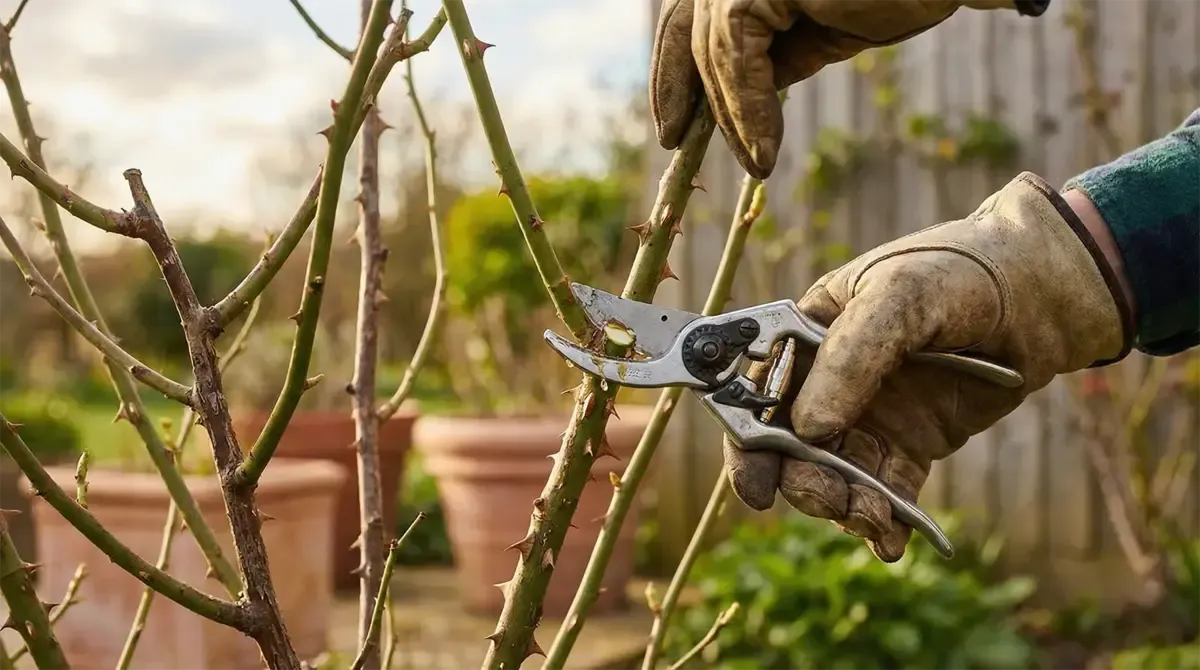
Why timing matters for rose pruning
Pruning roses at the wrong time is one of the most common mistakes UK gardeners make. Prune too early, and a mild winter spell triggers new growth that gets destroyed by the next frost. Prune too late, and you’ve wasted the energy the plant spent producing leaves you’re about to remove.
The challenge is that “late winter” means different things in Cornwall versus the Scottish Highlands. A gardener in London can safely prune in mid-February, while someone in the Highlands should wait until early April. The key is understanding your local frost risk and matching your pruning to when your roses naturally break dormancy.
This guide aggregates expert advice from the Royal Horticultural Society, David Austin Roses, and specialist rose growers to give you region-specific timing and proven techniques for every rose type.
When to prune roses: General timing
The Royal Horticultural Society recommends late winter (February or March) as the primary pruning window for most roses grown in the UK. This timing lets the plant stay dormant through the harshest months while avoiding the waste of pruning after it has leafed out.
If you prune too early (November or December), mild spells trigger new growth that gets killed by January frosts. However, “February or March” needs adjusting for your specific location.
Regional pruning timing (with frost dates)
The decisive factor in rose pruning isn’t the calendar date—it’s your local last spring frost date. The table below provides safe pruning windows for each UK region, based on Met Office historical frost data.
| Region | Last Frost Window | Recommended Pruning Window |
|---|---|---|
| South West England (Cornwall, Devon, Coastal) | Mid-March | Late Jan – Mid Feb |
| South East England (London, Kent, Surrey) | Late March – Early April | Mid Feb – Late Feb |
| Midlands & East Anglia (Birmingham, Norwich) | Mid-April – Late April | Late Feb – Early March |
| Wales (Coastal) | Mid-March | Mid Feb – Late Feb |
| Wales (Inland/Valleys) | Late April | Early March – Mid March |
| North England (Yorkshire, Lancashire, North East) | Late April – Early May | Mid March |
| Scotland (Lowlands) (Edinburgh, Glasgow) | Early May | Mid March – Late March |
| Scotland (Highlands & Islands) | Late May – Mid June | Late March – Early April |
| Northern Ireland (Belfast, Derry) | Late March – Mid April | Early March |
Important: These dates are averages. The best biological signal to prune is when your rose’s leaf buds start to swell and turn pink or red. If a severe cold snap is forecast, delay pruning regardless of the calendar date.
How to prune roses: Essential techniques
Before you make a single cut, you need the right tools and an understanding of proper technique. Poor pruning mechanics cause more damage than no pruning at all.
The tool debate: Bypass vs. Anvil secateurs
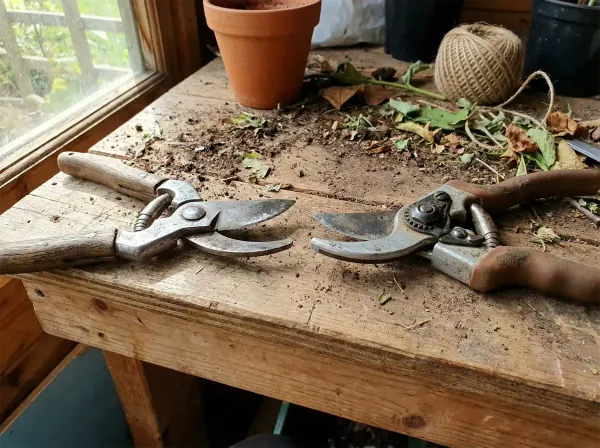
Use bypass secateurs only. These work like scissors, with two curved blades passing each other to create a clean slice that heals quickly.
Never use anvil secateurs on live rose stems. They crush the stem rather than cutting it, causing dieback and inviting disease. Reserve anvil secateurs for dead, dry wood only.
Both the RHS and David Austin Roses emphasize that sharp, clean tools are essential.
The “Four Ds” protocol
Before shaping your rose, perform a sanitary prune by removing:
- Dead wood: Brown, brittle, dry stems. Cut back until the pith (center of the stem) is white. If the pith is brown, the wood is dead—keep cutting.
- Dying wood: Stems with cankers, shriveling bark, or frost damage.
- Damaged wood: Stems crushed by plant ties or broken by wind.
- Diseased wood: Wood showing black spot lesions, rust pustules, or mildew.
This sanitary prune prevents disease spread and ensures you’re only working with healthy tissue.
The cut mechanics
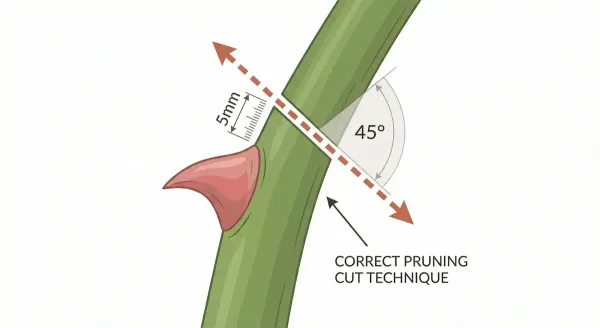
The angle: Traditional advice mandates a 45-degree angle sloping away from the bud to shed water. While the RHS still recommends this, modern trials by David Austin suggest it’s not strictly necessary for plant health. The crucial factor is that the cut is clean (sharp tools) and not jagged.
The position: Cut approximately 5mm above a bud. Too high leaves a “snag” that will die back and rot. Too low risks damaging the bud itself.
The direction: Cut to an outward-facing bud. This directs new growth away from the center of the plant, creating an “open goblet” shape. This open center increases airflow, which is your primary defense against fungal diseases like black spot in the humid UK climate.
Pruning by rose type
Not all roses are pruned the same way. The intensity and timing of pruning depends entirely on the rose’s classification and flowering habit. For specific timing in your region, refer to the regional timing table above.
Hybrid Tea roses (Large-flowered)

When: Late winter, usually February–March (see regional table)
How: Hybrid Teas require the hardest pruning of all rose types. They flower on new wood produced in the current season, so aggressive pruning forces vigorous new shoots.
According to the RHS guidance on modern bush roses, you should remove all wood older than 3 years and cut the remaining healthy canes down to 4–6 buds (approximately 15cm from the base). This channels all the plant’s energy into a few explosive shoots, resulting in the massive, long-stemmed blooms characteristic of Hybrid Teas.
The RHS explicitly notes that without annual hard pruning, Hybrid Teas degenerate into a “tangled mess of branches with very few flowers.”
Floribunda roses (Cluster-flowered)
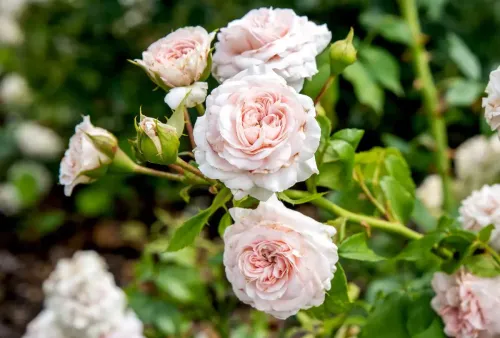
When: Late winter, usually February–March (see regional table)
How: Floribundas also flower on new wood, but the goal is a mass of color rather than individual specimen blooms. The RHS recommends a moderate prune, cutting stems back to 8–12 inches (25–30cm).
If you prune Floribundas as hard as Hybrid Teas, the plant will expend too much energy recovering size rather than setting flower clusters. Occasionally prune one or two old stems to the ground to encourage basal renewal.
Climbing roses
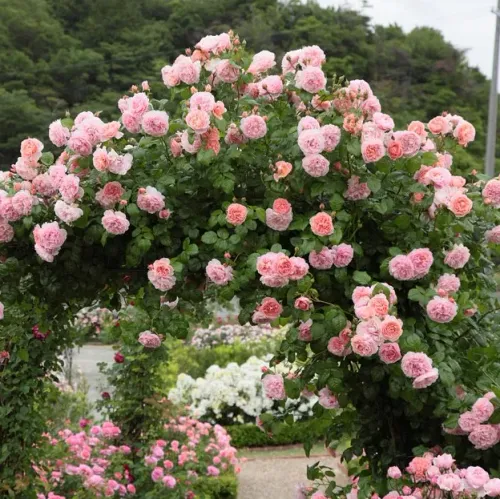
When: Winter, usually December–February (see regional table)
How: Climbers have a permanent framework of stiff canes that should not be removed annually. They flower on “laterals” (side shoots) that grow from this framework.
According to the RHS guidance on climbing roses, you should not cut the main canes unless they are dead or outgrowing the space. Instead, cut the side shoots (which carried last year’s flowers) back to 2–3 buds (approximately 10cm) from the main stem. This “spur pruning” concentrates energy into flowering spurs close to the framework.
The RHS notes that Climbers can be pruned earlier than bush roses because the structural framework is easier to assess when leaves have fallen, and the hardier wood is less susceptible to dieback.
Rambling roses

When: Late summer (August/September), immediately after flowering
How: This is the most critical timing distinction. Ramblers flower on the previous year’s wood. If you prune them in winter, you cut off all the flower buds for the coming summer, resulting in a flowerless year.
The RHS protocol for rambling roses—often called the “1-in-3 rule”—involves removing one-third of the oldest stems entirely to the ground and tying in the new, flexible green shoots that will carry next year’s flowers.
English Shrub roses (David Austin)
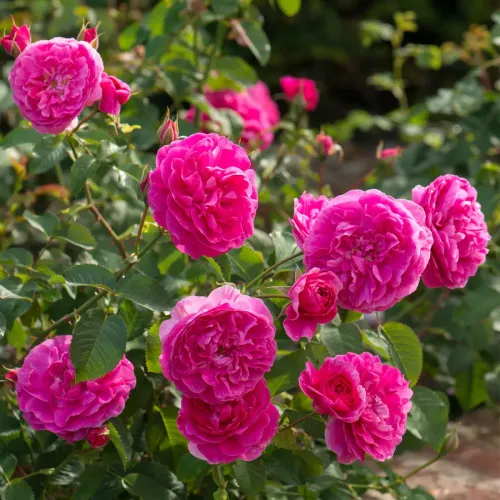
When: Late winter, usually February–March (see regional table)
How: David Austin Roses recommends a graduated approach based on your desired size:
- To maintain current size: Cut back by one-half
- To encourage tall shrubs: Cut back by one-third
- To renovate or reduce size: Cut back by two-thirds
Unlike Hybrid Teas, precision is less critical. Austin’s nursery managers even suggest that shearing (like a hedge) is acceptable for large plantings, though selective pruning is better for health.
Once-flowering shrub roses
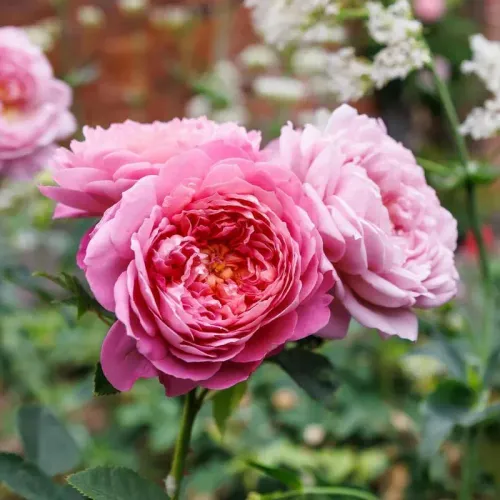
When: Late summer, immediately after flowering
How: Varieties such as Rosa gallica or species roses flower on old wood. According to the RHS guidance on shrub roses, these should be pruned immediately after flowering to avoid removing next year’s flower buds. Reduce the previous season’s growth by one-third and thin out older wood to encourage basal renewal.
Common mistakes to avoid
1. Pruning too early (the “tidy garden” error)
Pruning in November or December to “tidy up” triggers growth during mild spells. When the freeze returns, these tender shoots die, and frost can travel down the stem, killing the main cane.
Exception: Long stems on Hybrid Teas can be shortened by one-third in November to prevent wind rock, but the final prune must wait until spring.
2. The “poodle” cut (topiary pruning)
Snipping only the tips leaves a tall, dense bush with a bare, woody base and congested top. Airflow is restricted (increasing black spot), and blooms become smaller.
3. Ignoring tool hygiene
Moving between roses without cleaning blades spreads rose mosaic virus and fungal spores. Gardeners’ World recommends wiping blades with methylated spirits between bushes.
4. Forgetting which roses need summer pruning
Pruning Ramblers and once-flowering shrub roses in winter removes all flower buds for the coming season. These must be pruned immediately after flowering in late summer. If you grow multiple rose types, a tracking system helps you remember which need winter versus summer pruning.
Tracking your roses year after year
Rose pruning is an annual commitment. If you have a mixed collection of Hybrid Teas, Ramblers, Climbers, and shrub roses, you’re managing multiple pruning schedules—some in winter, some in summer.
What you need to remember for each rose:
- Winter or summer pruning?
- When you last pruned and what method you used
- What worked well in previous years
How permanent plant tracking helps
Digital tracking tools solve this by treating each rose as an individual plant with its own care history. In Leaftide, you can:
- Log each rose with its specific type (Hybrid Tea, Rambler, Climber, etc.)
- Set up care routines that remind you when pruning is due
- Record what you did each year, including observations
- View your pruning history to adjust timing based on results
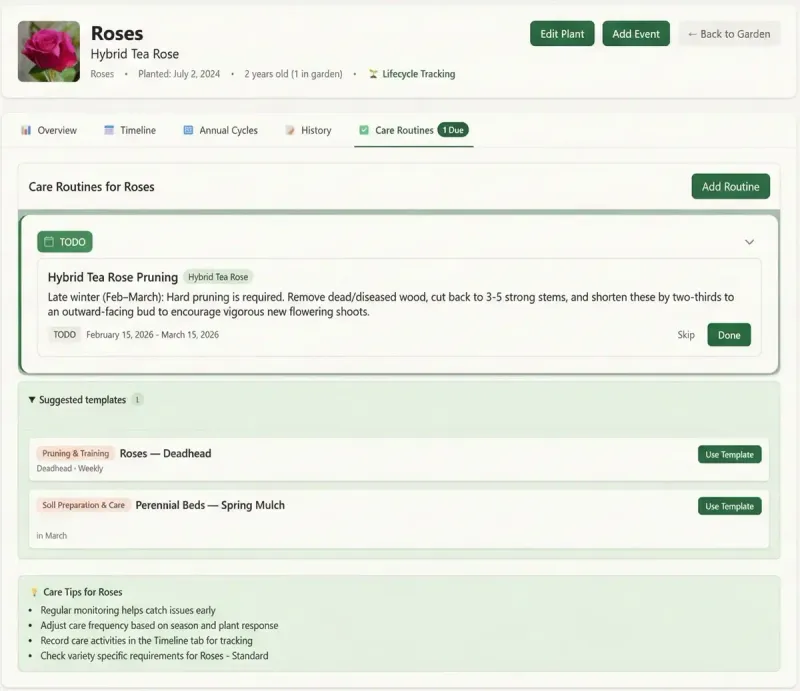
When February arrives, you see exactly which roses need attention. When August comes, you’re reminded about the Ramblers—the ones that would be flowerless next year if pruned in winter.
Never forget when you pruned
Leaftide creates a personalized care schedule for every rose in your garden, so you always know exactly when and how to prune.
Free for up to 30 plants. No card needed.
Learn more about tracking permanent plants in Leaftide →
Sources and further reading
This guide synthesizes expert guidance from the following authoritative sources:
Royal Horticultural Society (RHS):
- RHS Rose Pruning Guide
- Climbing Roses Pruning
- Rambler Roses Pruning
- Shrub Roses Pruning
- Modern Bush Roses Pruning
David Austin Roses:
Climate and Frost Data:
Gardening Media:
The regional frost timing table was compiled from Met Office historical data and represents average last frost dates. Always observe your local conditions and adjust accordingly.