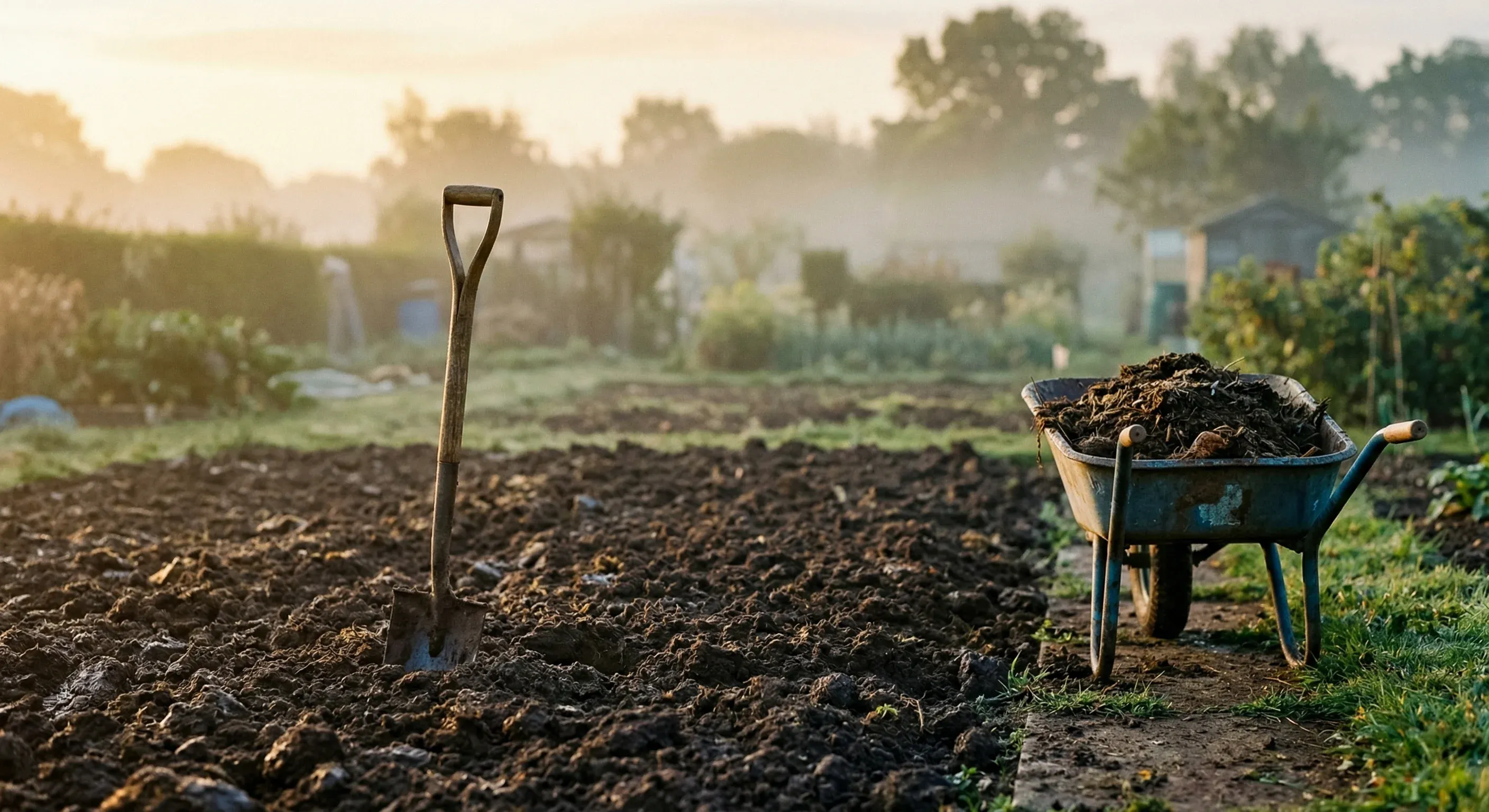
My first vegetable garden was on heavy London clay. I did not know it was clay at the time. I just knew that when it rained, the soil turned into something resembling modelling paste, and when it dried out, it cracked like a riverbed in a drought documentary. I planted tomatoes into it anyway, because I did not know any better. They survived, barely. The carrots I tried alongside them came out forked and stunted, having fought their way through soil that had the consistency of wet cement.
It took me an embarrassingly long season to realise that the problem was not the plants. It was the soil. Everything I have learned about growing vegetables since then starts from the same place: understand your soil first, then work with it rather than against it.
This is not a complicated subject. But it is the one that makes the biggest difference to everything you grow, and it is the one most beginners skip entirely.
Know what you are working with
Before you add anything to your soil, you need to know what you already have. There are three main soil types, and most gardens sit somewhere on the spectrum between them.
Clay soil holds water and nutrients well but drains poorly and compacts easily. It feels sticky when wet and sets hard when dry. If you can roll a handful into a smooth ball that holds its shape, you have clay. My London plot was textbook clay, and I spent years learning to work with it rather than cursing it.
Sandy soil is the opposite. It drains fast, warms up quickly in spring, and is easy to dig. But water and nutrients wash straight through it. If your soil feels gritty and falls apart when you squeeze it, you are dealing with sand.
Loam is the middle ground that every gardener wants. A mix of clay, silt, and sand in roughly balanced proportions. It holds moisture without waterlogging, drains well enough for roots to breathe, and has a crumbly texture that plants love. If your soil feels like this already, you are fortunate. Most of us are not starting there.
| Soil type | Feel | Drainage | Fertility | How to improve |
|---|---|---|---|---|
| Clay | Sticky when wet, hard when dry | Poor — waterlogged in winter | High but slow to release | Add organic matter, avoid compaction |
| Sandy | Gritty, falls apart | Too fast — dries out quickly | Low — nutrients wash through | Add organic matter to retain moisture |
| Loam | Crumbly, holds shape loosely | Good balance | Good | Maintain with annual compost |
| Chalky | Pale, stony, may fizz with vinegar | Fast | Low, often alkaline | Add organic matter, choose lime-tolerant plants |
The jar test is worth doing once. Fill a large glass jar about one-third full with soil from your garden, top it up with water, shake it vigorously, and leave it on a windowsill for 24 hours. Sand settles to the bottom within minutes. Silt forms the middle layer over a few hours. Clay stays suspended longest and settles on top. The proportions of each layer tell you roughly what your soil is made of.
Test your pH (it takes five minutes)
Soil pH affects which nutrients your plants can actually access. Most vegetables prefer a pH between 6.0 and 7.0, which is slightly acidic to neutral. Outside that range, certain nutrients become locked up in the soil, unavailable to roots even if they are technically present.
You do not need a laboratory for this. A basic soil pH test kit from any garden centre costs a few pounds and gives you a reading in minutes. Take samples from a few spots in your garden, mix them together, and follow the kit instructions. If your pH is between 6.0 and 7.0, you are fine. Do nothing.
If your soil is too acidic (below 6.0), garden lime raises the pH gradually. If it is too alkaline (above 7.5), sulphur chips or ericaceous compost can bring it down. But honestly, for most vegetable gardens, adding organic matter regularly tends to buffer the pH towards that ideal range on its own. I have not needed to adjust mine in years.
Organic matter is the answer to almost everything
Whatever soil type you have, the single most effective thing you can do is add organic matter. Compost, well-rotted manure, leaf mould. In clay, it opens up the structure so water can drain. In sand, it acts like a sponge, holding moisture and nutrients that would otherwise wash straight through. And it feeds the soil organisms that make all of this work.
I add compost to my beds every year, usually in autumn. A layer of 5-10cm spread on the surface is enough. You do not need to dig it in. The worms and soil biology will pull it down and incorporate it over winter. By spring, the surface looks like rich, dark earth.
If you do not have your own compost yet, municipal green waste compost is a good and affordable option. Many councils sell it by the bag or trailer load. Well-rotted horse manure works too, but make sure it has been composted for at least six months. Fresh manure is too strong and can burn plant roots.
Leaf mould is my favourite soil amendment, and it is free. Collect autumn leaves, stuff them into black bin bags with a few holes poked in, and leave them for a year or two. What comes out is a dark, crumbly material that smells like a forest floor. It does wonders for soil structure.
Good soil grows better plants. Track what you grow in it.
Free for up to 30 plants. No card needed.
The no-dig approach
Traditional gardening advice says to dig your beds over every year, turning the soil to break up compaction and incorporate amendments. There is a growing body of evidence, and a large community of gardeners, that says this is unnecessary and even counterproductive.
The no-dig method, popularised by Charles Dowding in the UK, is simple. You add compost and mulch to the surface and let the soil life do the work. Earthworms create channels for drainage and aeration. Fungal networks distribute nutrients. The soil structure that took years to develop stays intact instead of being shattered by a spade.
I switched to no-dig about four years ago, and the difference has been noticeable. The soil in my beds is softer and more workable than it ever was when I dug annually. Worm activity has increased visibly. Weeds are fewer because I am not bringing buried seeds to the surface.
The one exception is when you are starting a brand new bed on compacted or neglected ground. In that case, an initial dig or deep fork-over to break up the worst compaction makes sense. After that, let the compost and mulch take over.
Preparing a new bed
If you are starting from scratch, whether on lawn, bare earth, or an overgrown patch, here is a straightforward approach.
For a new bed on grass, you have two options. The quick way is to strip the turf, fork over the soil underneath, and add a thick layer of compost. The patient way is to lay cardboard over the grass, pile 15-20cm of compost on top, and let it all break down over a few months. The cardboard smothers the grass, and by the time it decomposes, the soil underneath has softened. This is the no-dig way of starting a bed, and it works well if you can plan a season ahead.
For raised beds, you are filling with a mix rather than improving existing ground. A blend of roughly 60% topsoil and 40% compost gives you a good starting medium. Some people use pure compost, which works for the first season but settles dramatically and needs topping up. The topsoil-compost mix holds its volume better.
Whatever method you choose, resist the urge to walk on the bed once it is prepared. Compaction undoes all the work you have just put in. If you need to reach the middle, use a plank to spread your weight.
Plan your beds before you plant them.
Free for up to 30 plants. No card needed.
Seasonal soil care
Soil preparation is not a one-off task. It follows the seasons.
- Autumn: Spread compost or well-rotted manure on empty beds after clearing spent crops. Sow green manures (field beans, clover, winter rye) on any beds that will sit empty over winter. They protect the soil from erosion, suppress weeds, and add organic matter when you chop them down in spring. Green manures are especially valuable if you are practising crop rotation, because leguminous cover crops fix nitrogen for the following season.
- Winter: Leave the soil alone. The freeze-thaw cycles in colder climates naturally break up clay clods, which is why autumn-dug clay looks so much better by spring. Mulched beds stay protected. Covered beds stay weed-free. There is very little to do except plan.
- Spring: Fork over lightly and rake to a fine tilth for sowing. If you grew a green manure, chop it down and leave it on the surface or lightly fork it in a few weeks before planting. Check that the soil has warmed enough for your first sowings. A soil thermometer is a worthwhile investment. Most seeds need soil temperatures above 8-10°C to germinate reliably.
- Summer: Mulch around established plants with straw, grass clippings, or compost to retain moisture and suppress weeds. Bare soil in summer dries out fast and develops a hard crust that repels water rather than absorbing it.
Start where you are
The best soil advice I ever received was to stop trying to create perfect soil and instead focus on making it a little better each year. My clay plot is still clay. It always will be. But after years of adding compost, mulching, and not digging, it is clay that grows excellent vegetables. The worms have done most of the work. I just keep feeding them.
You do not need to fix everything before your first planting season. Grow something this year, add compost in autumn, and notice the difference next spring. Soil improvement is cumulative. Each barrow of compost and each layer of mulch adds up. After two or three years, you will not recognise the ground you started with.