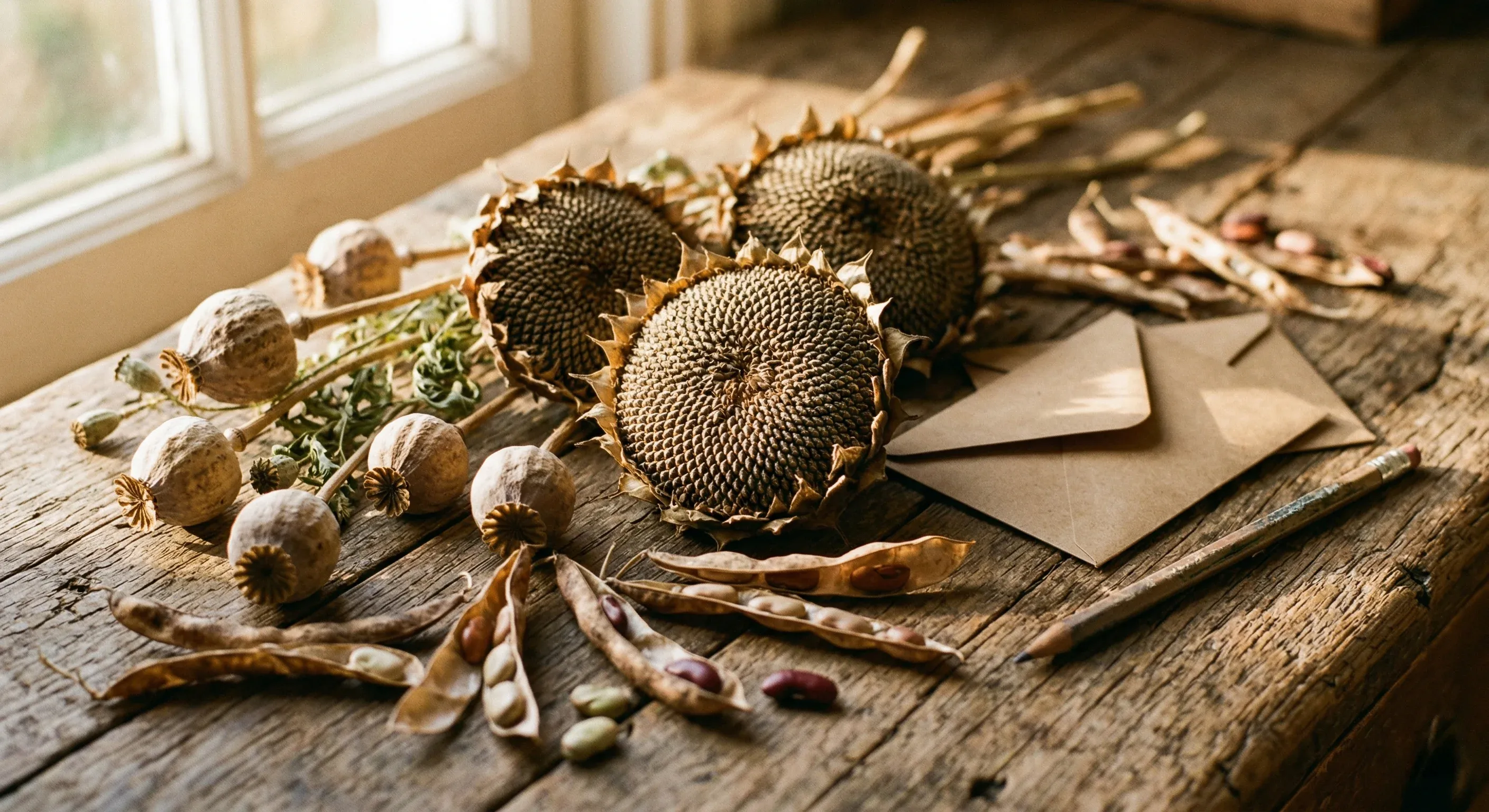
I did not set out to save seeds. It started because a tomato variety I loved disappeared from every catalogue I checked. It was a small, ridged Italian plum called Costoluto Fiorentino, and the supplier I had used for years simply stopped carrying it. I had grown it for three seasons, tracked its performance, noted that it outproduced everything else in the same bed, and then could not buy it again.
That was the moment I realised that relying entirely on seed companies meant someone else decided what I could grow. If I had saved seeds from the previous year, the problem would not have existed.
Since then, seed saving has become a quiet but important part of how I garden. The process is simple and needs no special equipment, yet it connects you to your plants in a way that buying a fresh packet each spring never does.
Why bother saving seeds at all
The practical reasons are obvious. Seeds cost money, and if you grow the same varieties year after year, saving your own eliminates that recurring expense. A single tomato fruit contains enough seeds to plant an entire row next season, and a single bean pod holds next year’s crop.
But cost is not the most interesting reason. The real value is adaptation. When you save seeds from plants that performed well in your specific garden, in your soil, with your microclimate and your watering habits, you are selecting for success in your conditions. Over several generations, those seeds become subtly better suited to where you grow them. Commercial seed is bred for broad performance across many climates. Your saved seed is bred, unintentionally but effectively, for your garden.
There is also the preservation argument. Many older, open-pollinated varieties are disappearing from commercial catalogues because they do not suit industrial agriculture. They bruise too easily, or ripen unevenly, or the yield per hectare is too low. None of that matters in a home garden. Saving seeds from these varieties keeps them alive.
Open-pollinated versus F1 hybrids
Before you save a single seed, you need to understand this distinction. It determines whether seed saving will work at all for a given variety.
Open-pollinated varieties breed true. If you save seeds from an open-pollinated tomato, the plants you grow next year will be essentially the same as the parent. These varieties have been stabilised over many generations, and their genetics are consistent. Heirloom varieties are a subset of open-pollinated types, usually with a longer history.
F1 hybrids are a cross between two distinct parent lines. The first generation (F1) is uniform and often vigorous, which is why seed companies sell them. But seeds saved from an F1 plant will not produce the same thing. The second generation splits into a messy mix of traits from both parent lines. You might get something usable, but you will not get the variety you started with.
Check the seed packet or catalogue listing before you plan to save. If it says “F1” or “hybrid,” buy fresh seed each year. If it says “open-pollinated” or “heirloom,” you are in business.
The easiest crops to start with
Not all seeds are equally simple to save. Some crops cross-pollinate freely, requiring isolation distances that are impractical in a small garden. Others produce seeds that need careful timing or processing. Start with the forgiving ones.
Tomatoes are the classic beginner crop for seed saving. They are self-pollinating, so cross-contamination is rare even when you grow multiple varieties close together. The seeds need a short fermentation step, which I will cover below, but the process is simple and reliable.
Beans and peas are even easier. They self-pollinate before the flowers even open, so you almost never get unwanted crosses. Leave some pods on the plant until they dry and rattle, then shell them out. That is the entire process.
Lettuce bolts and flowers readily, and the seeds are easy to collect once the flower heads dry. Because lettuce is self-pollinating, you can save from multiple varieties without worry.
Peppers are self-pollinating in most conditions, though bees can occasionally cause crosses if you grow sweet and hot varieties side by side. If you only grow one type, saving pepper seeds is as simple as scooping them out of a ripe fruit and drying them.
I would avoid brassicas (cabbage, broccoli, kale), squash, and sweetcorn for your first attempts. These cross-pollinate enthusiastically and need isolation distances or hand-pollination techniques that add complexity.
Dry seed processing
Most seeds fall into one of two categories: dry-processed or wet-processed. The distinction is straightforward. If the seeds develop inside a dry pod or husk, you use the dry method. If they are embedded in wet flesh, you use the wet method.
Dry processing covers beans, peas, lettuce, most herbs, and flowers. The approach is the same for all of them. Leave the seed heads or pods on the plant until they are thoroughly dry. For beans, this means the pods should be papery and brown, rattling when you shake them. For lettuce, wait until the fluffy seed heads look like tiny dandelion clocks.
Harvest the dry pods or seed heads on a warm day. Spread them on a tray indoors and leave them for another week to finish drying completely. Then shell, thresh, or rub the seeds free. Winnowing, gently blowing away the chaff while pouring seeds between two containers, cleans them well enough for home use.
Track which varieties are worth saving.
Free for up to 30 plants. No card needed.
Wet seed processing and the fermentation method
Tomatoes, cucumbers, and some melons have seeds surrounded by a gel coating that inhibits germination. In nature, this coating breaks down through fermentation in fallen fruit. You replicate that process at home.
For tomatoes, the method is simple. Cut a ripe fruit in half and squeeze the seeds and surrounding gel into a small jar or cup. Add a splash of water, just enough to make the mixture loose. Cover the jar with a cloth or paper towel secured with a rubber band, and leave it at room temperature for two to four days.
The mixture will start to ferment. A layer of mould may form on the surface. This looks unpleasant but is exactly what you want. The fermentation breaks down the gel coating and also kills some seed-borne diseases, which is a useful bonus.
After two to four days, add water to the jar and stir. Viable seeds sink to the bottom. Dead seeds and pulp float. Pour off the floating debris, rinse the good seeds in a sieve, and spread them on a plate or paper towel to dry. Do not use kitchen paper that the seeds will stick to permanently. A ceramic plate or a piece of parchment works better.
Let them dry completely, which takes about a week in a warm room. Once dry, they should feel hard and separate easily. If they are still slightly tacky, give them more time. Storing damp seeds is the fastest way to ruin them.
Drying and storing seeds properly
Moisture is the enemy. Seeds that are not thoroughly dry before storage will rot or lose viability quickly. The general rule is to dry seeds for at least a week in a warm, well-ventilated spot out of direct sunlight. Spread them in a single layer so air circulates around each seed.
For storage, the goal is cool, dry, and dark. Glass jars with tight lids work well. So do paper envelopes inside an airtight container. Adding a small sachet of silica gel to the container absorbs residual moisture and extends seed life.
Temperature matters. A cool cupboard is fine. A fridge is better for long-term storage, as long as the seeds are in an airtight container so they do not absorb moisture from the fridge environment. Avoid sheds and garages where temperatures swing between extremes.
Under good conditions, most vegetable seeds remain viable for three to six years. Tomato and pepper seeds are particularly long-lived. Onion and parsnip seeds are short-lived and best used within a year or two.
Labelling and record-keeping
This is where most seed savers, including me in the early years, fall short. You save the seeds, dry them carefully, store them properly, and then in February you find an unlabelled envelope of small brown seeds and have no idea what they are.
Label everything immediately. Write the variety name, the date you collected the seeds, and any notes about the parent plant. “Costoluto Fiorentino, August 2025, best producer in bed 3” tells you everything you need to know when you open that envelope next spring.
This is also where tracking what you grow pays off directly. If you have been recording which varieties performed well through the season, choosing which plants to save seeds from is not a guess. You already know which tomato was the most productive, which bean kept cropping the longest. Your harvest records become your seed selection criteria.
I keep a simple note for each saved variety: where the parent plant grew, how it performed, and how many seeds I saved. When planning the next season, that information feeds directly into decisions about what to grow and where. Combined with a succession planting schedule, you can plan not just what to grow but when to sow each batch, using your own adapted seed.
Choosing which plants to save from
Not every plant in the row deserves to contribute to next year’s seed stock. Save from the best performers, not the first to bolt or the weakest specimens.
For tomatoes, choose fruits from the most productive, healthiest plant. Pick fully ripe fruits from the middle of the season, not the first or last ones. For beans and peas, mark your best plants early and leave their pods to mature on the vine rather than harvesting them for eating.
For lettuce, save from the plant that was slowest to bolt. By selecting for late bolting over several years, you gradually develop a strain that holds longer in your conditions. This is gentle, practical plant breeding, and it works.
Avoid saving from plants that were diseased, stunted, or atypical. You are selecting genetics, even if informally, and you want to select for the traits that matter to you.
Know which plants earned their spot.
Free for up to 30 plants. No card needed.
A few things I have learned the hard way
Tomato seeds stuck to kitchen paper are almost impossible to separate. Use a ceramic plate or parchment paper instead.
Do not ferment tomato seeds for too long. Four days is the maximum. Beyond that, the seeds may start to germinate in the jar, which defeats the purpose entirely.
Label the jar during fermentation, not after. Three jars of fermenting tomato pulp all look identical, and you will not remember which variety is which.
Dry seeds further than you think they need. If they feel dry, give them two more days. The extra time costs nothing and prevents storage failures.
Start small. Save from one or two varieties your first year. Expand once you have the rhythm. Trying to save seeds from everything at once turns a pleasant autumn task into an overwhelming project.
Quick reference
| Crop | Processing method | Difficulty | Seed viability |
|---|---|---|---|
| Tomatoes | Wet (fermentation) | Easy | 4–6 years |
| Beans | Dry (leave on plant) | Very easy | 3–4 years |
| Peas | Dry (leave on plant) | Very easy | 3–4 years |
| Lettuce | Dry (collect seed heads) | Easy | 3–5 years |
| Peppers | Dry (scrape from fruit) | Easy | 2–5 years |
| Cucumbers | Wet (fermentation) | Moderate | 5–6 years |
The longer view
Seed saving is a slow practice. The rewards compound over years, not weeks. The first year, you simply have free seeds. By the third or fourth year, you have seeds that are genuinely adapted to your garden, selected from plants that thrived in your specific conditions. By the tenth year, you have something that no catalogue can sell you: a variety shaped by your soil and your decisions over a decade of growing.
That is worth the small effort of scooping some seeds into a jar and writing a label.
Sources and further reading
- Garden Organic: Seed Saving Guidelines. Detailed crop-by-crop instructions from the UK’s organic growing charity.
- Real Seeds. Practical seed saving advice from a small open-pollinated seed company.
- Seed Savers Exchange. US-based organisation dedicated to preserving heirloom varieties through community seed saving.
Related: What to Track in Your Garden Journal covers the broader principles of garden record-keeping. Garden Harvest Tracking explains how yield records help you decide which varieties to keep. Succession Planting Schedule shows how to plan sowing dates across the season.