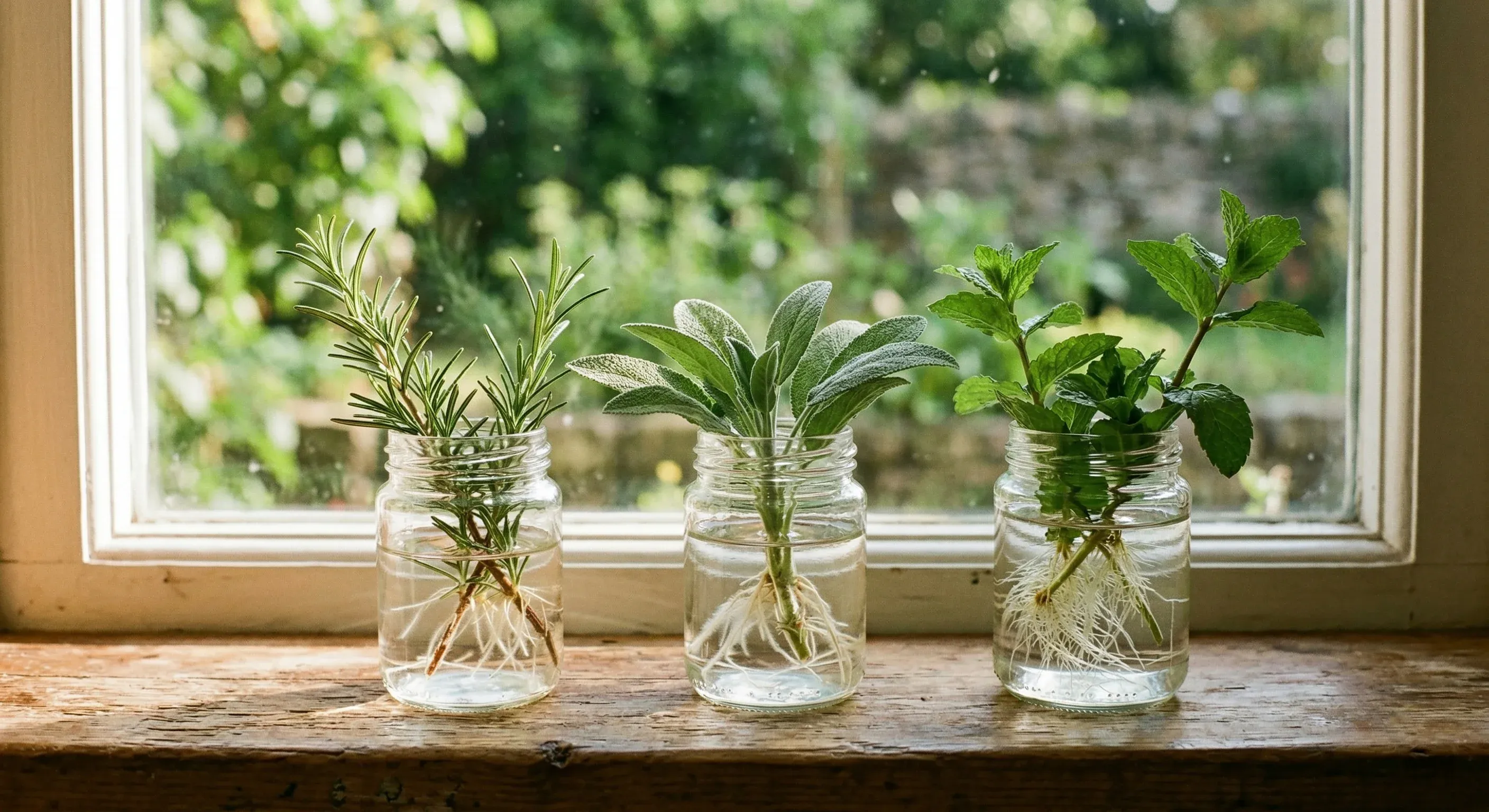
Last spring I counted the rosemary plants in my garden and realised that every single one of them came from the same parent bush. That original plant, bought from a nursery in 2020, has produced over a dozen offspring through cuttings I have taken over the years. Some I kept. Most I gave away. The parent plant cost me about four euros. The plants it has produced would have cost well over fifty.
This is the quiet magic of propagation. Not the dramatic kind you see in time-lapse videos of tissue culture labs, but the everyday kind that happens when you stick a rosemary stem in a pot of compost and forget about it for six weeks. Most edible garden plants are remarkably willing to reproduce if you give them the right conditions. The trick is knowing which method works for which plant, and when to do it.
I am not a propagation expert. I am a vegetable gardener who got tired of buying the same herbs every year and started experimenting. What follows is what I have learned from doing it, getting it wrong, and gradually getting it right.
Stem cuttings: the gateway method
If you have never propagated anything before, start with stem cuttings from herbs. The success rate is high and the technique is forgiving. You will see results fast enough to stay motivated.
The principle is simple: you cut a piece of stem from a healthy plant, remove the lower leaves, and encourage it to grow roots. Some herbs root so easily that you can do this in a glass of water on your kitchen windowsill. Others need a bit more care.
Basil is the easiest. Cut a stem about 10 centimetres long, just below a leaf node. Strip the lower leaves, put it in water, and wait. Roots appear within a week, sometimes sooner. Once they are a couple of centimetres long, pot it up or plant it straight into the garden. I do this throughout summer whenever my basil plants get leggy. Instead of composting the prunings, I root them. By August I usually have more basil than I started with, all from trimmings that would otherwise have been waste.
Mint is even more aggressive. It roots from almost any piece of stem, in water or in soil, at almost any time during the growing season. The challenge with mint is not getting it to root but stopping it from taking over. If you are propagating mint, plant the new starts in pots or a contained bed. I learned this the hard way when a single mint cutting colonised an entire raised bed within one season.
Rosemary, sage, and thyme need a slightly different approach. These woody Mediterranean herbs root best from semi-ripe cuttings taken in late spring or early summer. Cut a stem about 8 to 10 centimetres long, strip the lower two-thirds of leaves, and push it into a pot of gritty compost (I use a 50/50 mix of perlite and multipurpose compost). Keep it moist but not waterlogged. These take longer than basil, often four to six weeks, and the success rate is lower. I typically take five or six cuttings to guarantee at least two or three survivors.
The key with woody herbs is patience. They do not show much above ground while they are rooting. Resist the urge to tug on them to check for roots. Just keep the compost damp and wait. When you see new growth at the tips, roots have formed.
Dividing established plants
Division is the propagation method that feels least like propagation. You are not coaxing a cutting to root or nurturing a seedling. You are simply digging up a plant, splitting it into pieces, and replanting them. It is brutal and effective, and it works brilliantly for clump-forming herbs and perennials.
Chives are the classic candidate. A mature clump of chives can be lifted, pulled apart into smaller sections (each with roots attached), and replanted. Each section becomes a new plant. I divide my chives every two or three years, partly to propagate them and partly because they perform better after division. An old, congested clump flowers less and produces thinner leaves. Splitting it rejuvenates the plant.
Rhubarb is another excellent division candidate, though it requires more muscle. In late autumn or early spring, when the plant is dormant, dig up the crown and cut it into sections with a sharp spade. Each section needs at least one bud (the pink growing point) and a decent chunk of root. Replant immediately. Rhubarb divisions take a year to establish, so do not harvest from them in the first season. I divided a single rhubarb crown three years ago and now have four productive plants from what was originally one.
Lemon balm, oregano, and marjoram all respond well to division. Lift the clump in spring, tease it apart, and replant. These are forgiving plants that recover quickly. If you grow any of these and find yourself buying more, stop. You already have all the plant material you need.
For anyone tracking perennial plants in their garden, division dates are worth recording. Knowing when you last divided a clump helps you judge when it needs doing again, and tracking which divisions survived tells you something about timing and technique.
Track your propagation experiments in one place.
Free for up to 30 plants. No card needed.
Runners and layering: let the plant do the work
Some plants propagate themselves. Your job is simply to notice and take advantage of it.
Strawberries are the most familiar example. A healthy strawberry plant sends out runners, long stems that creep along the soil surface and produce baby plants at their tips. These plantlets root wherever they touch the ground. To propagate deliberately, pin a runner down into a small pot of compost placed next to the parent plant. Once the plantlet has rooted (you will feel resistance when you gently tug it), cut the runner and move the new plant wherever you want it.
Commercial strawberry growers multiply their stock this way, and home gardeners can use the same method to maintain a productive strawberry bed indefinitely. Strawberry plants decline after three or four years of fruiting. If you root runners from your best performers each summer, you always have young, vigorous replacements ready. I wrote more about this cycle in the berry bush tracking guide.
Layering works on a similar principle but with woody plants. Instead of a runner, you bend a low-growing branch down to the soil, wound the underside slightly, and bury the wounded section. Over several months, roots form at the wound. Once established, you cut the new plant free from the parent.
This works well with berry bushes like blackberries and some gooseberry varieties. Tip layering, where you bury just the tip of a long cane, is the traditional method for thornless blackberries. The tip roots over autumn and winter, and by spring you have a new plant ready to transplant.
Layering is slow compared to cuttings, but the success rate is very high because the new plant stays connected to the parent while it roots. It never has to survive on its own until it is ready.
Tomato suckers: free plants mid-season
This is my favourite propagation trick, and one that surprises people who have never tried it. Tomato suckers, the side shoots that grow in the leaf axils of indeterminate tomato plants, root easily and grow into full, fruiting plants.
Every tomato grower removes suckers. Most people compost them. Instead, put them in a glass of water. Within a week or two, roots appear. Pot them up, harden them off, and plant them out. You now have a free tomato plant that is genetically identical to the parent, and because it is already a mature cutting rather than a seedling, it grows fast.
I do this in June and July when my main tomato plants are producing suckers faster than I can remove them. The rooted suckers go into gaps in the garden or into pots on the patio. They will not produce as heavily as plants started from seed in spring, but they reliably give me a late crop of tomatoes well into autumn.
The only caveat: this works with indeterminate (cordon) varieties, not determinate (bush) types. Bush tomatoes do not produce the same kind of removable suckers.
When to propagate: timing by method
Timing matters more than technique for most propagation methods. A perfectly taken cutting at the wrong time of year will fail. A rough division at the right time will succeed.
Softwood herb cuttings (basil, mint): any time during active growth, roughly May to August. Earlier is better because it gives the new plant time to establish before autumn.
Semi-ripe cuttings (rosemary, sage, thyme): June and July, when new growth has started to firm up but is not yet fully woody.
Division (chives, rhubarb, oregano): early spring (March to April) or autumn (September to October), when plants are dormant or just waking up. Avoid dividing in the heat of summer.
Runners (strawberries): June to August, when plants naturally produce runners after fruiting.
Layering (blackberries, gooseberries): late summer to autumn. The buried section roots over winter and is ready to separate in spring.
Tomato suckers: June to mid-July for the best results. Later cuttings may not have time to produce fruit before the first frost.
Know when to propagate based on your local season.
Free for up to 30 plants. No card needed.
Quick reference
| Method | Best plants | When | Difficulty |
|---|---|---|---|
| Stem cuttings (softwood) | Basil, mint | May to August | Easy |
| Stem cuttings (semi-ripe) | Rosemary, sage, thyme | June to July | Moderate |
| Root division | Chives, rhubarb, oregano, lemon balm, marjoram | Autumn or early spring | Easy |
| Runners | Strawberries | June to August | Very easy |
| Layering | Blackberries, gooseberries | Late summer to autumn | Easy |
| Sucker rooting | Tomatoes (indeterminate) | June to mid-July | Very easy |
Recording what works
Propagation is partly science and partly trial and error. The science tells you that rosemary roots from semi-ripe cuttings. But only experience will teach you that your particular rosemary, in your particular soil, roots best from cuttings taken in the first week of July and stuck in the shadiest corner of your cold frame.
That kind of knowledge only accumulates if you write it down. I keep simple notes: what I took cuttings from, when, how many survived, and where I planted the survivors. Over a few seasons, patterns emerge. I now know that my sage cuttings do better in pure perlite than in compost. I know that dividing my chives in March works but dividing them in October does not, at least not in my garden. None of this is in any book. It is specific to my conditions, and I only know it because I recorded it.
If you are already tracking your fruit trees or seasonal plantings, adding propagation notes is a small step that pays off quickly. Knowing which parent plant produced your best offspring and which method had the highest success rate turns propagation from guesswork into a repeatable process.
The point is not really to buy fewer plants, though that is a pleasant side effect. It is to understand your garden well enough to multiply what works and stop repeating what does not. Every plant you propagate successfully is a small piece of evidence about what thrives in your specific conditions. Over time, that evidence adds up to something genuinely useful: a garden shaped by what you have learned, not just what the garden centre had in stock.