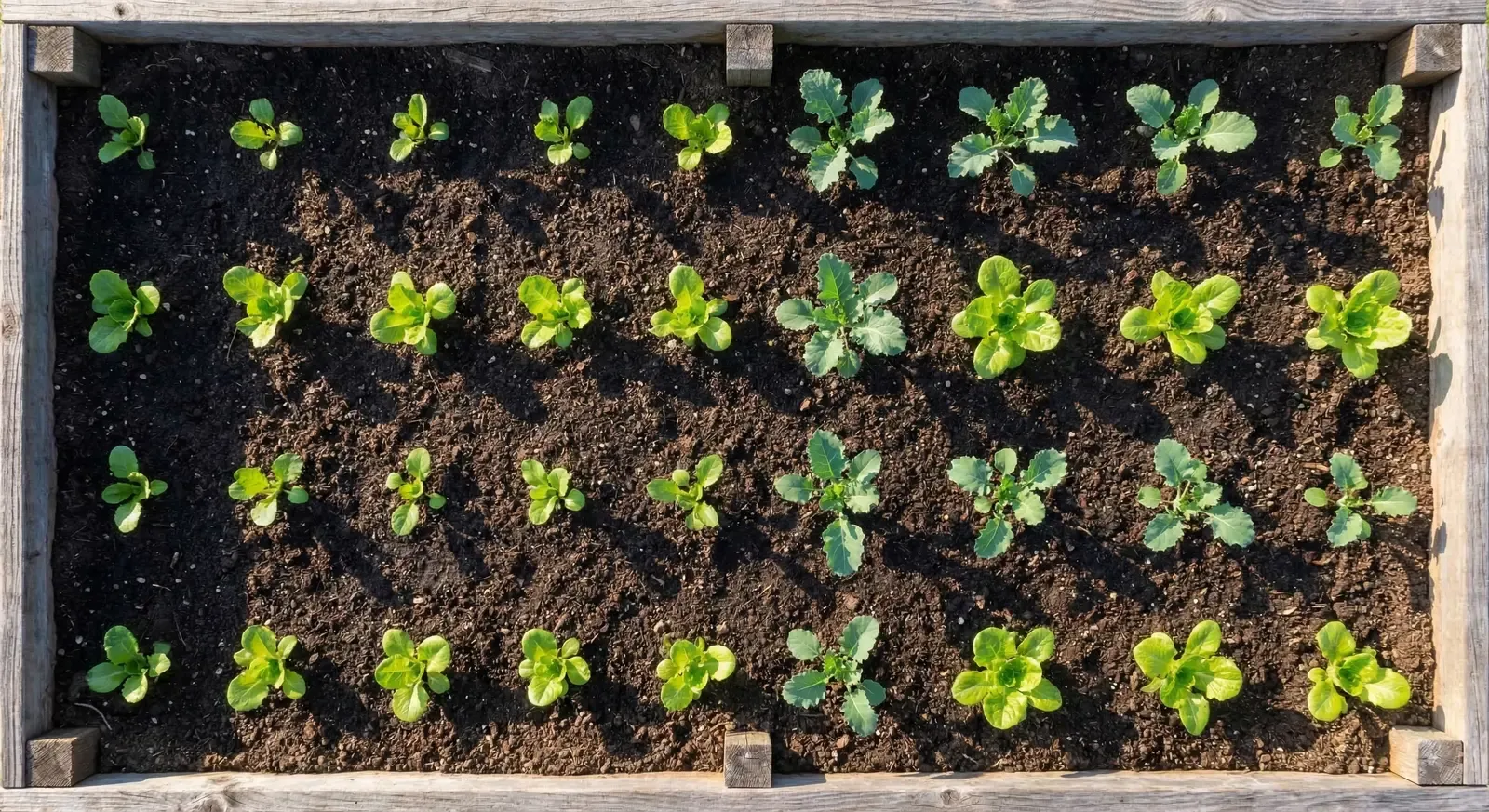
I lost an entire bed of carrots to overcrowding in my second year of growing. They looked fine as seedlings. By midsummer, every root was forked, stunted, and tangled with its neighbours. The tops were lush and green, which made it worse — all that foliage was competing for the same tiny patch of soil, and the roots paid the price.
Spacing is one of those things that seems obvious until you get it wrong. Too close and you get disease, poor airflow, and disappointing harvests. Too far apart and you waste growing space that could be feeding you. Getting plant spacing right depends on what you are growing, where you are growing it, and which method you follow.
This guide covers the practical spacing for vegetables, herbs, and hedges — the distances that actually work in real gardens.
Why spacing matters more than you think
Plant spacing is not just about giving each plant room. It controls four things that directly affect your harvest:
Light. Every leaf needs sunlight to photosynthesise. When plants are too close, the outer leaves shade the inner ones, and the lower leaves get almost nothing. The plant puts energy into growing taller to reach light instead of producing fruit or roots. Tomatoes crammed together grow leggy and produce less. Lettuce bolts faster in the shade of its neighbours.
Airflow. Fungal diseases need moisture to spread. When plants are packed tight, air cannot circulate between them, and morning dew or rain sits on the leaves for hours. Blight, powdery mildew, and botrytis all thrive in still, humid conditions. I have seen blight tear through a row of tomatoes planted at 30cm spacing while the same variety at 50cm stayed clean for weeks longer.
Root competition. Below the surface, roots are fighting for water and nutrients. Two courgette plants 40cm apart will each produce less than one plant with 90cm of space. The total harvest from the bed might even be lower, because both plants are stressed rather than thriving.
Disease transmission. Close planting means leaves touch. When leaves touch, diseases spread by contact — not just airborne spores, but splashing water carrying bacteria from one plant to the next. Proper spacing creates a gap that slows this down significantly.
The Real Cost of Overcrowding
Overcrowded plants do not just produce less per plant — they often produce less per square metre too. Two stressed courgettes in 80cm of space will usually yield less total fruit than one healthy plant with the same space to itself. More plants does not always mean more food.
Three spacing methods: which one fits your garden
There is no single “correct” spacing for any plant. The right distance depends on which growing method you use. Here are the three main approaches.
Row spacing (traditional)
This is what most seed packets describe. You plant in rows with a set distance between plants within the row and a wider distance between rows. The space between rows is for walking, weeding, and harvesting.
Row spacing works well for allotments and large plots where you need access paths. The downside is that a lot of your growing area is given over to paths rather than plants. In a typical row setup, 40 to 50 percent of the bed is walkway.
Best for: Large plots, allotments, crops that need regular access (beans, peas, brassicas).
Square foot gardening
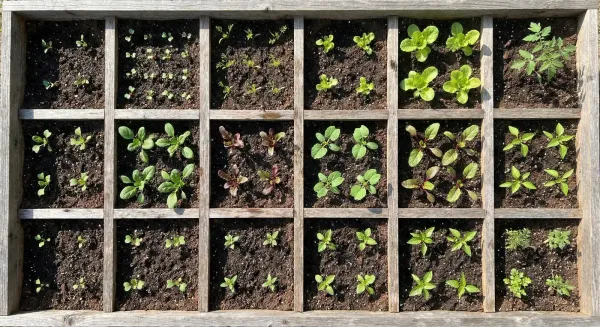
Developed by Mel Bartholomew, this method divides raised beds into 30cm (one foot) squares. Each square gets a specific number of plants based on their spacing needs. One tomato per square, four lettuce, sixteen radishes, and so on.
The grid eliminates wasted path space and makes planning visual. You can see exactly how many plants fit and where the gaps are. It works brilliantly for raised beds and small gardens.
Best for: Raised beds, small gardens, beginners who want a clear system.
Intensive and biointensive spacing
This takes square foot gardening further. Plants go in at the closest spacing that still allows healthy growth, arranged in offset rows (like a honeycomb) rather than a grid. This packs more plants into the same area by eliminating the dead space between grid squares.
Biointensive spacing assumes excellent soil, consistent watering, and good fertility. If your soil is poor or watering is irregular, plants will compete and you will get worse results than with wider spacing.
Best for: Experienced growers with well-prepared soil, intensive production gardens.
Intensive Spacing Needs Intensive Soil
Closer spacing only works if the soil can support it. Plants at biointensive distances pull more water and nutrients from every cubic centimetre of soil. If you have not built up your soil with compost and organic matter, start with standard spacing and tighten it as your soil improves.
Vegetable spacing quick reference
These are the distances I use in raised beds with good soil. If you are growing in rows with paths, add 30-40cm to the “between rows” distance for walking space. For a precise count of how many plants fit your specific bed, use the Spacing Calculator.
| Vegetable | Between plants | Between rows | Plants per sq ft |
|---|---|---|---|
| Tomatoes (cordon/indeterminate) | 45-60cm | 60-75cm | 1 |
| Tomatoes (bush/determinate) | 60-75cm | 75-90cm | 1 |
| Courgettes / Zucchini | 90cm | 90cm | 1 per 9 sq ft |
| Cucumbers | 45-60cm | 60cm | 1 |
| Peppers / Chillies | 40-50cm | 50-60cm | 1 |
| Runner beans | 15-20cm | 60cm | 4 |
| French beans (dwarf) | 15cm | 30-45cm | 9 |
| Peas | 5-8cm | 45-60cm | 8 |
| Lettuce (heading) | 25-30cm | 30cm | 4 |
| Lettuce (cut-and-come-again) | 15cm | 15cm | 4-9 |
| Carrots | 5-8cm | 15-20cm | 16 |
| Beetroot | 10-15cm | 20-30cm | 9 |
| Radishes | 3-5cm | 15cm | 16 |
| Onions | 10-15cm | 25-30cm | 9 |
| Garlic | 10-15cm | 25-30cm | 9 |
| Leeks | 15cm | 30cm | 4-9 |
| Kale | 45-60cm | 60cm | 1 |
| Cabbage | 45cm | 45-60cm | 1 |
| Broccoli / Calabrese | 40-45cm | 45-60cm | 1 |
| Brussels sprouts | 60cm | 75cm | 1 |
| Sweetcorn | 35-45cm | 45-60cm | 1 |
| Spinach | 15cm | 30cm | 9 |
| Chard | 25-30cm | 30-40cm | 4 |
| Broad beans | 20-23cm | 45-60cm | 4 |
| Potatoes | 30-40cm | 60-75cm | 1 |
| Squash / Pumpkins | 90-120cm | 120-180cm | 1 per 9-16 sq ft |
A few notes on this table. Cordon tomatoes can be planted closer than bush types because you train them vertically — the plant goes up, not out. Sweetcorn should be planted in blocks rather than single rows for proper wind pollination. And squash spacing looks extreme, but those plants will fill every centimetre by August.
If you are planning a full season and want to see how these crops fit together over time, the Crop Timeline Calculator shows when each crop occupies the bed so you can plan successions.
Herb spacing: closer than you think
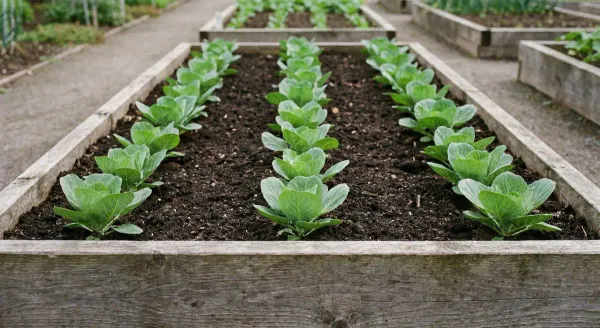
Herbs follow different rules from vegetables. Many are Mediterranean plants adapted to poor, dry soil — they do not need the same root space as a hungry courgette. Others, like mint, will take over everything if you give them room.
| Herb | Between plants | Notes |
|---|---|---|
| Basil | 15-20cm | Pinch regularly to keep bushy; closer planting is fine for cut-and-come-again |
| Parsley | 15-20cm | Biennial — will bolt in year two |
| Coriander | 10-15cm | Bolts fast in heat; sow thickly and harvest young |
| Chives | 15cm | Clump-forming; divide every 3-4 years |
| Thyme | 20-30cm | Spreads low; needs good drainage |
| Rosemary | 60-90cm | Gets large — most people underestimate this |
| Sage | 45-60cm | Woody shrub; give it room |
| Mint | 30cm (contained) | Always grow in a pot or buried container — it spreads aggressively |
| Oregano | 30-45cm | Vigorous spreader; trim hard to keep compact |
| Dill | 15-20cm | Tall and airy; does not shade neighbours much |
The biggest mistake with herbs is treating rosemary and sage like basil. A mature rosemary bush can reach a metre across. I planted one 20cm from a wall and spent three years fighting it. Give woody herbs the space they will eventually need, not the space they need as a small plant from the garden centre.
Herbs also make excellent companion plants. Basil near tomatoes, chives near carrots, and dill near brassicas all have documented benefits for pest management.
Hedge spacing: the distances that actually matter
Hedge spacing is a different world from vegetable spacing. You are planting for density, not individual plant health. The goal is a continuous barrier, which means planting closer than you would for a standalone shrub.
Most hedging is sold with a recommended planting rate per metre. Here are the standard distances for the most common hedging plants in the UK.
These distances are for common UK hedging species — US hedging plants follow similar principles at comparable spacings.
Single row hedges
| Hedging plant | Spacing | Plants per metre | Mature height |
|---|---|---|---|
| Privet (Ligustrum ovalifolium) | 30cm (3 per metre) | 3 | 1-4m |
| Box (Buxus sempervirens) | 20-25cm (4-5 per metre) | 4-5 | 0.3-1.5m |
| Beech (Fagus sylvatica) | 40-45cm (2-3 per metre) | 2-3 | 1-5m |
| Hornbeam (Carpinus betulus) | 40-45cm (2-3 per metre) | 2-3 | 1-5m |
| Cherry laurel (Prunus laurocerasus) | 60cm (1.5-2 per metre) | 1.5-2 | 2-6m |
| Yew (Taxus baccata) | 30-45cm (2-3 per metre) | 2-3 | 1-4m |
| Hawthorn (Crataegus monogyna) | 30-40cm (3 per metre) | 3 | 1-5m |
| Leylandii (x Cuprocyparis leylandii) | 75-90cm (1-1.5 per metre) | 1-1.5 | 2-6m+ |
| Mixed native hedge | 40-45cm (2-3 per metre) | 2-3 | 1-4m |
Double row hedges
For a thicker, denser hedge, plant two staggered rows. Space the rows 40-50cm apart and offset the plants so each one in the back row sits between two in the front row. Use the same plant-to-plant spacing within each row.
Double rows are standard for:
- Native mixed hedges used as boundary screening
- Beech and hornbeam where you want a thick, formal hedge
- Hawthorn for stock-proof agricultural hedging
A double row uses roughly 5-7 plants per metre of hedge length (both rows combined). It costs more upfront but fills in faster and creates a hedge that is genuinely impenetrable.
Hedge Spacing Shortcut
If you are unsure, 3 plants per metre in a single row works for most hedging species. It is the default recommendation from the RHS and most UK nurseries. Only go wider for large-leaved evergreens like laurel, and closer for small-leaved plants like box.
Bare root vs container-grown hedging
Bare root hedging plants are smaller and cheaper, typically 40-60cm tall. They establish quickly because the roots grow straight into the surrounding soil. Plant them at the standard spacing — they will fill the gaps within two to three growing seasons.
Container-grown plants are larger and give instant impact, but they cost three to five times more. You can space them slightly wider (add 10-15cm) because they are already bigger, but the saving on plants rarely offsets the higher unit cost.
For most hedges, bare root planted in autumn is the best value. You will wait a year or two longer for a full hedge, but the plants establish better and the cost per metre is a fraction of container-grown.
Container spacing: different rules for pots and raised beds
Containers change the spacing equation. The soil volume is fixed, water drains or evaporates faster, and roots cannot spread beyond the pot walls. This means you generally need to be more generous with spacing in containers, not less.
Single-plant containers. Most fruiting crops — tomatoes, peppers, cucumbers, aubergines — need their own pot. A single cordon tomato wants at least a 30cm pot, ideally 40cm. Trying to fit two tomatoes in one pot almost always results in two mediocre plants instead of one productive one.
Multi-plant containers. Leafy crops and herbs can share space. A 40cm pot can hold four to six lettuce plants, a cluster of spring onions, or a mix of herbs. The key is matching plants with similar water needs — do not put rosemary (dry) with basil (thirsty) in the same pot.
Raised beds. These sit between containers and in-ground beds. The soil is usually better than ground level (because you filled it), drainage is good, and there is no foot traffic compaction. You can reduce standard spacing by about 20 percent in a well-maintained raised bed. The Spacing Calculator handles this — enter your bed dimensions and plant spacing to see exactly how many fit.
Window boxes and troughs. These are shallow, so stick to shallow-rooted crops: lettuce, radishes, herbs, spring onions. Space at the tighter end of the range because you are harvesting young and small.
Common spacing mistakes
I have made most of these. Some of them more than once.
Spacing for the seedling, not the adult plant. A courgette seedling is 5cm across. A mature courgette plant is a metre wide. It is hard to leave 90cm gaps when the plants are tiny, but you must. The same applies to squash, Brussels sprouts, and any brassica. They look absurdly far apart in May and perfectly spaced by July.
Ignoring vertical growth. Cordon tomatoes, runner beans, and cucumbers grow upward. Their ground footprint is small, so they can be planted closer than bush varieties. If you are training plants vertically, you can tighten the spacing significantly. This is one of the best ways to increase yield per square metre.
Not thinning. Direct-sown crops like carrots, beetroot, and parsley need thinning. You sow more seeds than you need because germination is never 100 percent, but then you have to remove the extras. Skipping this step is how I ended up with those forked carrots. Thin early, thin ruthlessly.
Uniform spacing for everything. Not all plants need the same space in every direction. Onions can be 10cm apart within the row but need 25cm between rows. Runner beans are 15cm apart on the row but the rows need 60cm between them. The spacing is not a circle — it is a rectangle.
Planting hedges too far apart to save money. I understand the temptation. Hedging plants are not cheap, and planting at 30cm spacing for a 10-metre hedge means 33 plants. But planting at 60cm to halve the cost means waiting years longer for the hedge to fill in, and it may never be as dense. Buy the right number. Your future self will thank you.
How to actually measure and mark spacing
Theory is useless if you cannot translate it to the soil. Here is how I mark out spacing in practice.
For rows: Push two canes into the ground at each end of the bed and run string between them. This gives you a straight line. Measure along the string and mark each planting position with a small stick or a finger poke in the soil.
For grids (square foot method): Build a simple planting grid from string or thin wooden laths. Attach them to the bed frame at 30cm intervals in both directions. This gives you a permanent visual guide. Some people make a removable grid they can lift on and off.
For offset/honeycomb planting: Mark the first row as normal. For the second row, offset each plant by half the spacing distance. The easiest way is to cut a piece of bamboo to your spacing distance and use it as a measuring stick, placing it diagonally between two plants in the first row to find the position for the second row.
For hedges: Run a string line along the hedge position. Measure and mark every planting point before you dig any holes. This prevents the common problem of spacing drift, where you start at 30cm and gradually creep to 25cm or 35cm as you work along the row.
A planting board. For repetitive planting, make a board with holes drilled at your target spacing. Lay it on the soil, poke a dibber through each hole, and move it along. This is faster and more accurate than measuring every position individually. I use one for onion sets and garlic cloves — it turns a tedious job into a five-minute task.
The Bamboo Cane Trick
Cut a bamboo cane to your most-used spacing distance and keep it in the shed. Mine is 45cm — the spacing for most brassicas and tomatoes. When I am planting, I just lay it between plants to check the gap. No tape measure, no counting. It takes two seconds.
When to break the spacing rules
Spacing guides — including this one — give you a starting point. But gardens are not laboratories, and there are good reasons to adjust.
Succession sowing. If you are harvesting lettuce as baby leaf every three weeks, you can plant at half the mature spacing because the plants never reach full size. The same applies to radishes, spinach, and any crop you pick young. Timing matters here — knowing your last frost date helps you plan when each succession can safely go in.
Interplanting. Fast crops can share space with slow ones. Radishes between cabbages, lettuce between sweetcorn, spring onions between parsnips. The fast crop is harvested before the slow one needs the space. This is not overcrowding — it is using time as a dimension of spacing.
Microclimate differences. A sheltered, south-facing bed with rich soil can support tighter spacing than an exposed, north-facing plot with thin soil. If your plants are thriving at close spacing, there is no reason to widen it just because a chart says so.
Variety differences. A compact bush tomato like ‘Tumbling Tom’ needs far less space than an indeterminate ‘Sungold’ that will reach two metres tall. Seed packets sometimes give variety-specific spacing — use that over generic advice when available.
The spacing numbers in this guide are reliable defaults. But the best spacing for your garden is the one you discover by growing, observing, and adjusting. Keep notes on what worked. If your carrots were perfect at 8cm but your neighbour swears by 5cm, the difference is probably soil, watering, or variety — not a universal truth.
Spacing is just the start of a good plan.
Leaftide shows you how many plants fit, when to sow them, and how your whole season fits together. Plan your beds with real dates based on your climate — not guesswork.
Free for up to 30 plants. No card needed.
Putting it all together
Spacing is not complicated, but it is easy to get wrong when you are standing in the garden with a tray of seedlings and no plan. The fix is simple: decide your spacing before you plant, mark it out, and stick to it.
For vegetables, start with the table above and adjust based on your method — standard rows, square foot, or intensive. For herbs, remember that woody perennials need far more room than annual soft herbs. For hedges, buy the right number of plants for your chosen spacing and do not try to stretch them further apart.
If you want to skip the mental arithmetic, the Spacing Calculator does it for you. Enter your bed dimensions and plant spacing, and it shows you exactly how many fit with a visual layout. It handles rectangular beds, round pots, and custom spacing.
And if you want to see how spacing fits into the bigger picture — when to sow, what grows well together, and how your climate affects your timing — that is what Leaftide is built for.
Use the Spacing Calculator to plan your beds. Check companion planting before you finalise positions. And if you are planning your sowing dates, the Crop Timeline Calculator shows when each crop needs to go in based on your local climate.