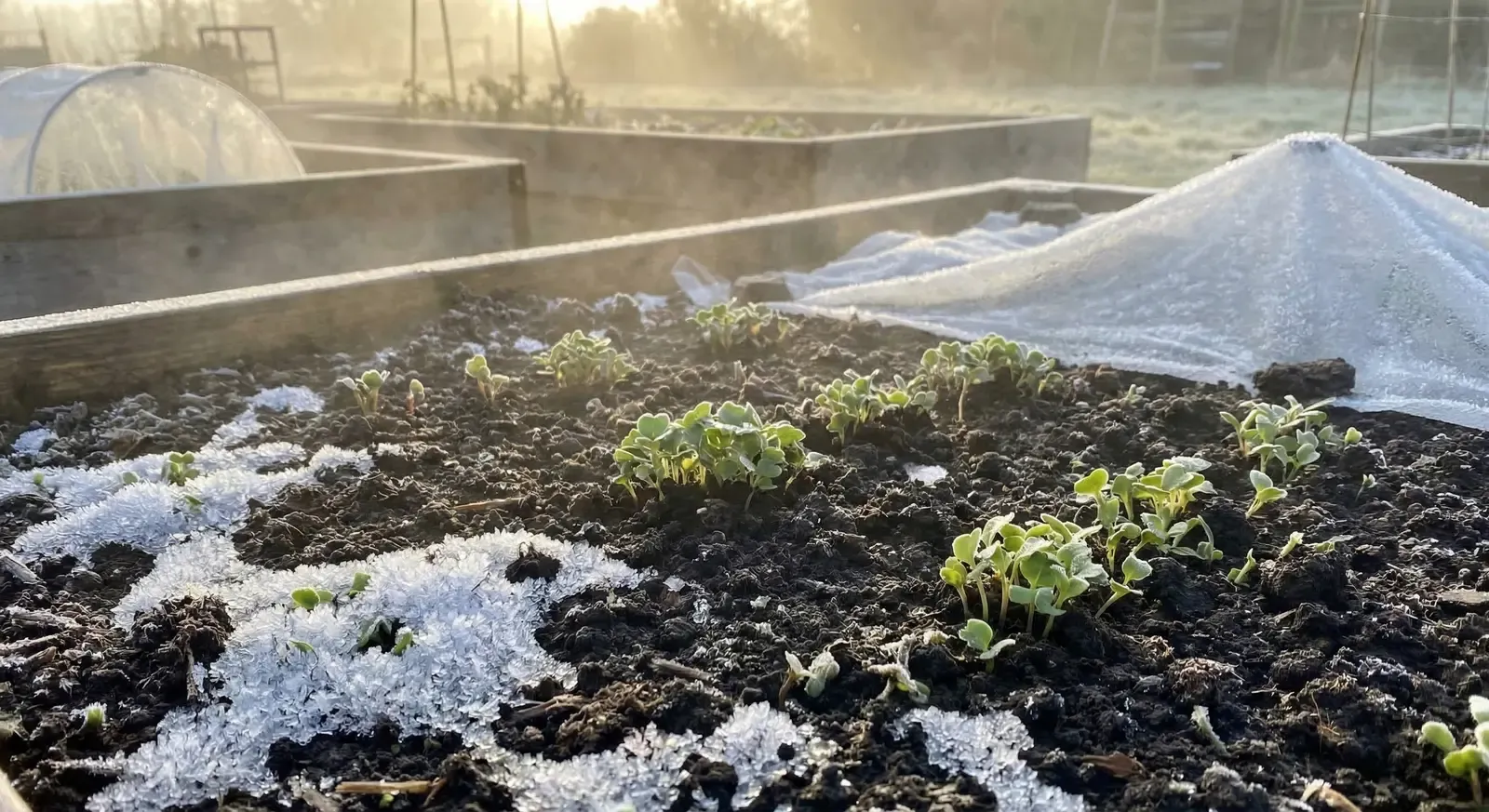
Every spring I check the forecast like it owes me money. Not because I enjoy weather apps, but because I need to know one thing: is tonight going to frost?
That question sits behind almost every planting decision I make. When to start tomatoes indoors. When to move peppers outside. When to direct sow beans. Whether that late cold snap is going to kill the courgette seedlings I hardened off too early. Again.
The answer to all of it starts with one number: your last frost date.
Your last frost date is not a date. It is a probability. And understanding that distinction changes how you plan your entire growing season.
What frost dates actually mean
Your last frost date is the average date after which there is a 50% chance of no more freezing temperatures in spring. Your first frost date is the same idea in reverse: the average date in autumn when frost becomes likely again.
Fifty percent. That is a coin flip. On any given year, the actual last frost could come two weeks earlier or three weeks later than the average. The number you look up online is the middle of a range, not a promise.
This matters because most planting advice treats frost dates as hard boundaries. “Plant tomatoes two weeks after your last frost date.” That sounds precise, but it is built on a number that is inherently fuzzy. Some years you will be fine planting on that date. Other years you will be covering everything with fleece at midnight.
Weather stations have been recording frost data for decades, and the averages are useful. They give you a centre point to plan around. But treating them as guarantees is how you lose a tray of seedlings to a late May frost that the averages said should not happen.
The 10% date is safer
Most frost date databases also publish the date at which there is only a 10% chance of frost. This is typically two to three weeks later than the 50% date. If you are risk-averse or growing expensive plants, use the 10% date as your planting benchmark instead.

Last spring frost vs first autumn frost
These two dates frame your entire growing season. The gap between them is your frost-free period, and its length determines what you can realistically grow.
The last spring frost date tells you when it is safe to move tender plants outside. Everything before that date carries frost risk. Everything after it is increasingly safe, though never guaranteed.
The first autumn frost date tells you when the season ends for tender crops. Once frost returns, tomatoes blacken, courgettes collapse, and beans turn to mush overnight.
The number of days between these two dates is your frost-free growing season. In southern England, that might be 200 days or more. In the Scottish Highlands, it could be under 120. In USDA zone 5 in the US, you might get 140 to 160 days. In zone 8, closer to 220.
This number matters more than most people realise. A pepper variety that needs 90 frost-free days to reach harvest is fine in a 180-day season. But if your season is only 130 days and you need 30 of those for transplant establishment, the maths gets tight. Knowing your frost-free period helps you choose varieties that actually have time to produce before autumn shuts everything down.
You can look up both dates for your location using the Frost Date Finder. It shows the spring and autumn dates together so you can see your full growing window at a glance.
How to find your frost dates
There are several reliable sources, depending on where you live.
United States
NOAA Climate Normals are the gold standard. The National Oceanic and Atmospheric Administration publishes freeze/frost probability data based on 30-year climate normals from thousands of weather stations. You can search by station or by state.
Cooperative Extension Services are your local experts. Every state has a university extension office that publishes frost date information specific to your county. These are often more practical than raw NOAA data because they account for local conditions and come with planting recommendations.
The Old Farmer’s Almanac publishes frost dates by zip code. The data comes from NOAA, but the interface is simpler. Good for a quick lookup.
United Kingdom
The Met Office provides regional frost risk data, though not as neatly packaged as the US sources. Their historical data and regional climate summaries give you a reasonable picture.
The RHS (Royal Horticultural Society) publishes general frost date guidance by region. They tend to be conservative, which is not a bad thing when you are deciding whether to plant out tender crops.
Local weather stations and gardening groups are often the best UK source. Frost dates vary enormously across Britain, and a local allotment society will know your area better than any national database.
Everywhere
Leaftide’s Frost Date Finder pulls from climate data sources and shows your local frost dates based on your location. It is the quickest way I know to get both your spring and autumn dates in one place, along with your frost-free season length.
Online frost date tools vary in quality
Some websites publish frost dates based on very old data or coarse geographic averages. If the tool only asks for your state or county and not your specific location, the result could be off by weeks. Always cross-reference with at least one local source.
Why frost dates vary so much within the same area
This is the part that catches people out. You look up your frost date, your neighbour looks up theirs, and you get the same number. But your garden frosts two weeks later than theirs. Or two weeks earlier.
The reason is microclimates. Your frost date is based on the nearest weather station, which might be at an airport five miles away, at a different elevation, in an open field with no shelter. Your garden is not that weather station.
Several factors create microclimates that shift your effective frost date:
Elevation. Cold air sinks. If your garden sits at the bottom of a slope, cold air pools there on still nights. A garden halfway up the same slope can be several degrees warmer. This is called a frost pocket, and it can shift your last frost date by two weeks or more compared to a site just 50 metres uphill.
Urban heat islands. Cities are warmer than the surrounding countryside. Buildings, roads, and concrete absorb heat during the day and release it at night. An urban garden in Manchester might have a last frost date two to three weeks earlier than a rural garden ten miles away.
Proximity to water. Large bodies of water moderate temperature extremes. Coastal gardens and those near large lakes tend to have later first frosts in autumn and earlier last frosts in spring. The water acts as a thermal buffer.
Shelter and aspect. A south-facing wall absorbs heat all day and radiates it at night, creating a warm microclimate. A north-facing exposed slope does the opposite. Fences, hedges, and buildings all create sheltered pockets that can be meaningfully warmer than open ground.
Soil type. Sandy soils warm up faster in spring than clay soils. This does not change the air temperature frost date, but it affects soil temperature, which matters for direct sowing and root development.
The practical takeaway: your official frost date is a starting point, not your actual frost date. Pay attention to your specific garden over several seasons. Note when you see frost and when you do not. After two or three years, you will have a much better picture of your real frost window than any database can give you.
How to use frost dates for planting
This is where frost dates become genuinely useful. Once you know your last spring frost date, you can count backwards and forwards from it to build your entire planting schedule.
Counting back for indoor starts
Most seed packets tell you to start seeds indoors “6-8 weeks before last frost” or “8-10 weeks before last frost.” This is the countdown method, and it works well once you know your date.
If your last frost date is May 15 and tomatoes need 6-8 weeks of indoor growing time, you count back to late March or early April for your sowing date. Peppers, which need longer, might go back to late February or early March.
The logic is simple: you want seedlings that are big enough to transplant but not so old that they become leggy and root-bound. Start too early and they outgrow their pots before it is safe to plant out. Start too late and they do not have enough growing season to produce a harvest.
Counting forward for direct sowing
Some crops go straight into the ground. Beans, courgettes, squash, sweetcorn. These are frost-tender and need warm soil, so you count forward from your last frost date.
Direct sow beans one to two weeks after your last frost date. The soil needs to be warm enough for germination, and the risk of a late frost needs to be low. Squash and courgettes are similar. Sweetcorn wants even warmer soil, so two to three weeks after last frost is safer. Once you know your sowing dates, the plant spacing guide helps you work out how much room each crop needs in the ground.
The transplant window
For crops started indoors, the transplant date is usually one to two weeks after your last frost date. This gives a buffer for late frosts and allows the soil to warm up. Tomatoes, peppers, aubergines, and cucumbers all fall into this category.
Some gardeners push this earlier by using cloches, fleece, or cold frames. That is a valid strategy, but it means you are managing frost protection rather than avoiding frost entirely. More on that below.
Leaftide’s Crop Timeline Calculator does this arithmetic for you. Enter your location and a crop, and it shows you the sowing window, transplant date, and expected harvest based on your local frost dates and climate data. It is the same counting-back logic, but adjusted for your specific conditions rather than a generic seed packet range.
Frost-free days and growing season length
Your frost-free period is not just about what you can grow. It is about what you can grow well.
A tomato variety that needs 80 days from transplant to first harvest sounds manageable in a 150-day frost-free season. But those 80 days assume warm, sunny conditions. In a cool, cloudy summer, the same variety might need 100 days. Suddenly your margin is thin.
This is why gardeners in shorter-season climates choose early-maturing varieties. A cherry tomato that fruits in 60 days is a safer bet than a beefsteak that needs 85. Not because the beefsteak cannot grow, but because the season might not be long enough for it to ripen reliably.
Growing degree days offer a more accurate picture than calendar days. Instead of counting days, they count accumulated warmth. A warm day contributes more than a cool one. This explains why the same variety ripens in July in the south of France but not until September in northern England. The calendar days are similar, but the accumulated warmth is very different.
Leaftide uses growing degree days to calculate its climate-based sowing dates, which is why its predictions adjust to your specific location rather than giving everyone the same generic window.
Light frost, hard frost, killing frost
Not all frosts are equal, and not all plants care about them equally.
Light frost (0 to -2C / 32 to 28F). Ice crystals form on exposed surfaces. Tender plants like tomatoes, basil, peppers, and courgettes suffer damage or die. Hardy crops like kale, spinach, and leeks are completely unaffected. Some, like parsnips and Brussels sprouts, actually taste better after a light frost because the cold converts starches to sugars.
Hard frost (-2 to -4C / 28 to 25F). More sustained freezing. Kills most tender plants outright. Damages semi-hardy crops like chard and beetroot. Hardy brassicas and root vegetables survive but may show some leaf damage.
Killing frost (below -4C / 25F). Prolonged, deep cold. Ends the season for nearly everything except the hardiest overwintering crops. Even some “hardy” plants struggle if the cold is sustained over several nights.
The distinction matters because your last frost date typically refers to light frost. If you are growing hardy crops, you can effectively ignore it and plant weeks earlier. If you are growing tender crops, even a light frost is a problem.
This is why experienced gardeners do not have one planting date. They have several, staggered by crop hardiness. Hardy crops go out first, sometimes a month or more before the last frost date. Semi-hardy crops follow a couple of weeks before. Tender crops wait until after.
Frost-tender vs frost-hardy plants
Understanding which plants care about frost and which do not saves you weeks of growing time every spring.
Frost-hardy (plant well before last frost date)
These crops tolerate frost and can go outside four to six weeks before your last frost date, sometimes earlier:
- Peas and broad beans
- Onion sets and garlic
- Lettuce, spinach, and rocket
- Kale, cabbage, and Brussels sprouts
- Carrots, parsnips, and turnips
- Radishes
Many of these actually prefer cool conditions and bolt in summer heat. Getting them in early is not just possible, it is better for the crop.
Semi-hardy (plant around last frost date)
These tolerate light frost but not hard frost. Plant them around your last frost date or a week before with some protection:
- Beetroot and chard
- Potatoes (the foliage is frost-tender, but you can earth up to protect emerging shoots)
- Celery and celeriac
Frost-tender (plant after last frost date)
These die at the first touch of frost. Wait until one to two weeks after your last frost date:
- Tomatoes, peppers, aubergines
- Courgettes, squash, cucumbers
- Beans (French and runner)
- Sweetcorn
- Basil
If you are unsure whether a specific variety is hardy enough for an early start, the Frost Date Finder combined with the Crop Timeline Calculator can show you the safe planting window for your location and setup.
Extending your season beyond frost dates
Frost dates are not walls. They are guidelines that you can push in both directions with the right tools.
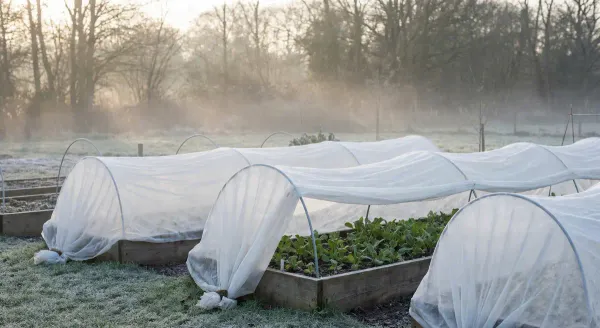
Row covers and horticultural fleece
A single layer of fleece draped over plants provides two to three degrees of frost protection. That is enough to survive most light frosts and effectively moves your last frost date forward by one to two weeks. Double-layered fleece gives even more protection.
I keep a roll of fleece by the back door from March onwards. When the forecast shows a frost, I drape it over anything tender that is already outside. It is not elegant, but it works.
Cold frames and cloches
A cold frame is essentially a box with a glass or polycarbonate lid. It traps heat during the day and insulates at night. Plants inside a cold frame can go out three to four weeks before the last frost date, depending on the frame’s construction and your climate.
Cloches, whether glass bell jars or plastic tunnels, do the same thing on a smaller scale. They are useful for protecting individual plants or short rows.
Walls and thermal mass
A south-facing brick wall is one of the best frost protection tools in any garden. The bricks absorb heat during the day and radiate it at night, creating a warm microclimate that can be several degrees warmer than open ground. This is why walled gardens have been used for centuries to grow tender crops in cool climates.
If you have a south-facing wall, use it. Plant your most tender crops there. It is free season extension.
Raised beds
Raised beds warm up faster in spring than ground-level soil because they are exposed to air on all sides. This does not change the air temperature frost date, but it means the soil is ready for sowing and planting earlier. For direct-sown crops where soil temperature matters, raised beds can give you a one to two week head start.
Layer your protection
The most effective season extension combines multiple methods. A tender plant in a raised bed, against a south-facing wall, with fleece on standby for cold nights, might effectively have a last frost date three to four weeks earlier than the official one. Each layer adds a small advantage, and they compound.
Frost dates in the UK
UK frost dates are less standardised than US ones, partly because the country is small enough that “look out the window” is almost viable advice, and partly because the maritime climate makes frost patterns less predictable than continental ones.
That said, there are broad regional patterns:
| Region | Typical last spring frost | Typical first autumn frost | Frost-free days |
|---|---|---|---|
| South West England, coastal | Late March | Late November | ~200-240 (mildest areas) |
| South East England | Mid April | Late October | ~190 |
| Midlands | Late April | Mid October | ~170 |
| Northern England | Early May | Early October | ~150 |
| Scotland, lowlands | Mid May | Late September | ~130 |
| Scotland, highlands | Late May to early June | Mid September | ~100 |
These are rough averages. Your specific garden could be weeks different in either direction.
RHS hardiness ratings
The RHS uses a hardiness rating system (H1 to H7) that maps loosely to frost tolerance:
- H7 (hardy in the severest UK winters): Survives below -20C. Think native trees and the toughest perennials.
- H6 (hardy in most places throughout the UK): Survives -15 to -20C. Native shrubs, many fruit trees.
- H5 (hardy in most of the UK even in severe winters): Survives -10 to -15C. Most established fruit trees and shrubs.
- H4 (hardy through most of the UK): Survives -5 to -10C. Many perennials and some evergreens.
- H3 (half-hardy): Survives 0 to -5C. Needs protection in cold winters. Penstemons, some salvias.
- H2 (tender): Survives 1 to 5C. Cannot tolerate frost. Tomatoes, peppers, dahlias.
- H1 (under glass): Needs heated protection. Tropical plants.
For annual vegetables, the H2/H3 boundary is the one that matters most. Everything rated H2 needs to wait until after your last frost date. Everything H3 and above can handle some frost.
If you are planning around UK frost dates, the Frost Date Finder covers UK locations and shows your local dates based on nearby climate data. It is more specific than the regional table above.
Frost dates are the starting point, not the whole plan
I have spent years refining my sense of when frost is likely in my garden. The official date gives me a baseline. My own observations narrow it down. And the forecast on any given night tells me whether to grab the fleece.
Knowing the date is the easy part. What matters is what you do with it. Count back for indoor starts. Count forward for direct sowing. Adjust for your microclimate. Choose varieties that fit your frost-free season. Layer protection when you want to push the boundaries.
Frost dates are the backbone of every planting schedule. But they are averages built on probability, not certainties carved in stone. The gardeners who do best are the ones who understand the number, respect its limits, and plan around it rather than treating it as gospel.
Know your frost dates. Plan your season.
Leaftide calculates your local frost dates and builds planting schedules around them. See your sowing windows, transplant dates, and harvest predictions based on your actual climate, not a generic chart.
Free for up to 30 plants. No card needed.
If you want to dig deeper into how climate data shapes planting decisions, the climate-based sowing dates article explains the full system. For a related concept that matters for fruit trees and perennials, see the chill hours guide. And if you are already past your frost date and wondering whether there is still time, is it too late? has you covered.
Find your local frost dates with the Frost Date Finder. Calculate sowing, transplant, and harvest dates for specific crops with the Crop Timeline Calculator.
Sources
- NOAA US Climate Normals — 30-year frost and freeze probability data from US weather stations.
- RHS Hardiness Ratings — the H1-H7 hardiness scale used throughout this article.
- Old Farmer’s Almanac Frost Dates — frost date lookup by US zip code, sourced from NOAA data.
- Met Office UK Climate Averages — regional temperature and frost data for the UK.