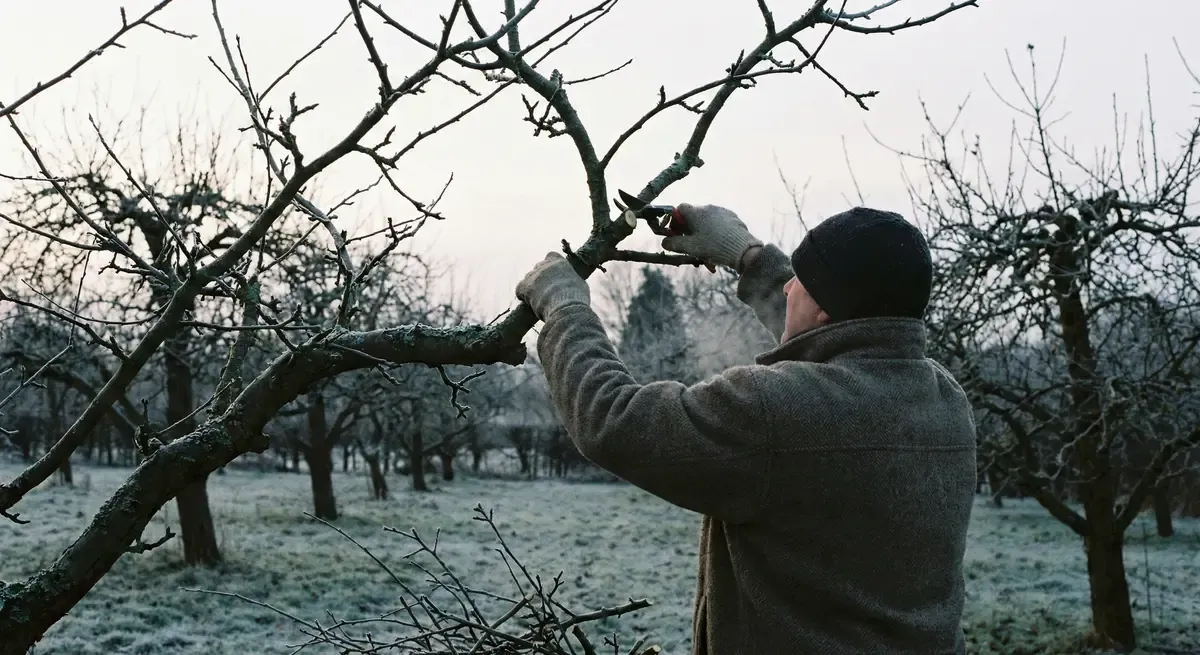
Every February I would stand in front of my apple tree, secateurs in hand, trying to remember what I had done the year before. Did I take out that big branch, or was that the year before? The tree had clearly responded to something. There were water sprouts everywhere. But I could not remember what I had done to cause it.
This is the problem with fruit tree pruning: the feedback loop is measured in months and years, not days. You make cuts in winter. The tree responds in spring and summer. By the time you see the results, you have forgotten precisely what you did. And next winter, you are guessing again.
I realised I needed a system for recording what I pruned, not just a guide on how to prune. The internet is full of the latter. This article is about the former.
Why a pruning log matters more than technique
Most gardening advice focuses on how to prune: where to make cuts, how to shape the tree. That information matters, but it only gets you so far. The real learning happens when you can look back at what you did last year and correlate it with what the tree did afterwards.
Trees are slow feedback systems. When you prune heavily, the tree does not immediately tell you whether that was a mistake. It takes weeks for new growth to appear. Months before you can assess whether the growth pattern is desirable. A full season before you know how it affected fruit production.
Your memory will fail you. “Did I prune hard last year or light?” becomes an annual question. You might remember the dramatic intervention from three years ago, but the moderate prune from last February? It blends together.
Patterns only emerge with data. After three years of keeping records, I learned that my Victoria plum fruits better with lighter pruning. My Bramley apple, on the other hand, seems to want a harder hand. I would never have discovered this without writing it down, because I would have kept making the same vague, unrepeatable decisions year after year.
What to record for each pruning session
A useful pruning log does not need to be complicated. You are not writing a research paper. You need enough information to reconstruct what you did when you look back in twelve months.
Date. The exact date, not “February sometime.” Weather patterns vary year to year, and knowing precisely when you pruned helps you correlate with what the spring was like.
Tree identification. Which tree did you prune? If you have multiple fruit trees, give them names or numbers. “The apple by the shed” works, but “Bramley #1” is clearer when you have three Bramleys.
What you removed. Break this down into categories:
- Dead wood (branches that were already dead)
- Crossing or rubbing branches
- Water sprouts (vigorous vertical shoots)
- Shaping cuts (reducing height, opening the centre, maintaining form)
This distinction matters because removing dead wood has different consequences than removing healthy growth.
How much you removed. Use simple terms: light, moderate, or heavy. Or estimate a percentage: “removed about 20% of the canopy.” This lets you compare intensity across years.
The tree’s condition before pruning. Was it vigorous? Weak? Did it have lots of dead wood? Was there canker or other disease? This context helps you interpret results later. A heavy prune on a vigorous tree has different implications than a heavy prune on a struggling one.
Photos. Optional but valuable. A quick phone photo before and after pruning creates a visual record that words cannot match.
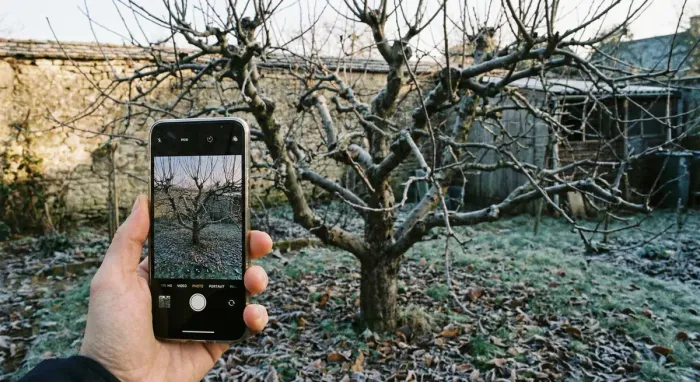
Notes. Anything unusual: storm damage you cleaned up, disease signs you spotted, changes to the surrounding area that might affect the tree.
A simple pruning log template
Here is a format you can copy and adapt:
| Date | Tree | What Removed | Amount | Condition | Notes |
|---|---|---|---|---|---|
| 2026-02-15 | Apple - Bramley | Dead wood, 3 crossing branches, water sprouts | Moderate | Healthy, some lichen on trunk | First prune since moving in |
| 2026-07-20 | Plum - Victoria | Light thinning, removed 2 damaged branches | Light | Vigorous, good fruit set | Summer prune to avoid silver leaf |
| 2026-02-17 | Pear - Conference | Heavy renovation, removed 4 large branches | Heavy | Overgrown, lots of water sprouts | Had not been pruned for years |
Each row is a single pruning session. The notes column is where you record context that might matter later.
The key is consistency. Whatever format you choose, use it every time. A log only becomes useful when it spans multiple years, and that requires a repeatable system.
Tracking the tree’s response
Recording what you pruned is only half the story. The other half is recording how the tree responded.
Check back in 6-8 weeks. After the initial flush of spring growth, return to each tree and note:
- New growth direction. Is the tree growing outward as you intended, or sending up vigorous water sprouts?
- Vigour. Is the new growth strong and healthy, or weak and sparse?
- Any dieback. Did the cuts heal cleanly, or is there die-back from the pruning points?
This mid-season check is where you start learning. If you pruned heavily and the tree responded with masses of water sprouts, that is information. If a light prune resulted in a good balance of new growth and fruit production, that is also information.
Review at harvest. Note fruit quality and quantity. Was the crop better or worse than last year? Were the fruits larger or smaller? Did you have problems with disease or pests that might relate to pruning decisions?
This is where the real learning happens. You are connecting the intervention (pruning) with the outcome (fruit production), with a written record to consult when making next year’s decisions.
Patterns that emerge over years
With three or more years of data, patterns start to reveal themselves. Here is what I discovered in my own orchard:
Year 1: Heavy prune on the Bramley. I thought it needed renovation after years of neglect. Result: masses of water sprouts, poor fruit set, vigorous but chaotic regrowth.
Year 2: Light prune, mostly removing the water sprouts from the previous year. Result: better fruit, but the tree started getting crowded in the centre.
Year 3: Moderate prune, taking out crossing branches and opening the centre. Result: the best balance so far. Good fruit set, manageable regrowth, open structure.
Without records, I would not have remembered the sequence. I would not have known that the water sprouts were a direct result of the heavy prune two years earlier. The log turned a vague sense of “I think I pruned too hard that one time” into a concrete understanding of cause and effect.
The specific patterns in your orchard will be different. Your climate, soil, varieties, and growing conditions all influence how trees respond. That is precisely why you need your own records, not generic advice. The log reveals what works for your trees in your situation.
Managing multiple trees
The challenge scales with the number of trees. Two or three are easy to remember. Ten becomes difficult. Fifty requires a system.
Naming conventions. Decide how you will identify each tree:
- Variety-based: “Bramley #1”, “Victoria”, “Conference”
- Location-based: “Front garden apple”, “Espalier by the wall”
- Simple numbering: “Tree 1”, “Tree 2” (works but harder to remember)
Whatever system you choose, be consistent. Map it if necessary. The goal is to unambiguously identify which tree you are writing about.
The paper problem. A notebook works for a few trees, but becomes unwieldy with a larger collection. Pages get lost. Information gets scattered. You cannot easily see a single tree’s history across multiple years without flipping back and forth.
Digital tracking helps at scale. Each tree can have its own record, with the full history in one place. You can search, filter, and compare without reorganising physical pages.
How Leaftide makes pruning logs easier
When I started tracking my vegetables in Leaftide, I realised it could solve my orchard problem too. Each fruit tree becomes a “permanent plant” with its own profile and history.
I created an entry for my Bramley, my Victoria plum, and my Conference pear. Each one has a name, variety, and location. From there, I can log tasks against each individual tree.
When I prune the Bramley in February, I record it as a task. The entry includes what I did, how much I removed, and any notes about the tree’s condition. I can attach before and after photos directly to the task. The date is captured automatically.
Six weeks later, I create another entry noting how the tree responded. At harvest, I record the fruit quality. Over time, each tree builds up a timeline of what happened to it and when.
The system handles the administrative burden of record-keeping. I do not have to maintain the log structure myself or remember where I wrote things down. Each tree has its own page with everything in chronological order.
When February comes around again, I look at the Bramley’s history. I can see what I did last year, how the tree responded, and what I noted at harvest. The guesswork disappears. I am making decisions based on actual data from my actual trees.
The pruning log most people never keep.
Track every tree in your orchard with its own profile and care history. See what you did last year, and learn what works for your trees.
Free for up to 30 plants. No card needed.
Learn more about tracking fruit trees in Leaftide →
Getting started
You do not need special tools to begin. A notebook works. A spreadsheet works. The format matters less than the habit of recording.
Start this pruning season. When you finish pruning each tree, spend two minutes writing down what you did. Use the template above or create your own. The important thing is to start.
Set a reminder to check back in six weeks. Note the tree’s response. At harvest, note the fruit. By this time next year, you will have a year of data. By the year after, you will start seeing patterns.
The fruit tree pruning log is not about perfection. It is about accumulating enough information to learn from your own garden. Trees respond slowly, but they do respond consistently. They just require you to remember what happened. Give yourself that memory.
Sources and further reading
For guidance on pruning technique (the “how to cut” rather than the “how to record”), these resources are authoritative:
Royal Horticultural Society:
Timing guides for specific trees:
- When to prune cherry trees — why cherries must be pruned in summer, not winter
General orchard management:
Remember: those guides tell you how to prune. This article tells you how to remember what you did. Both are necessary if you want to actually improve your results year over year.