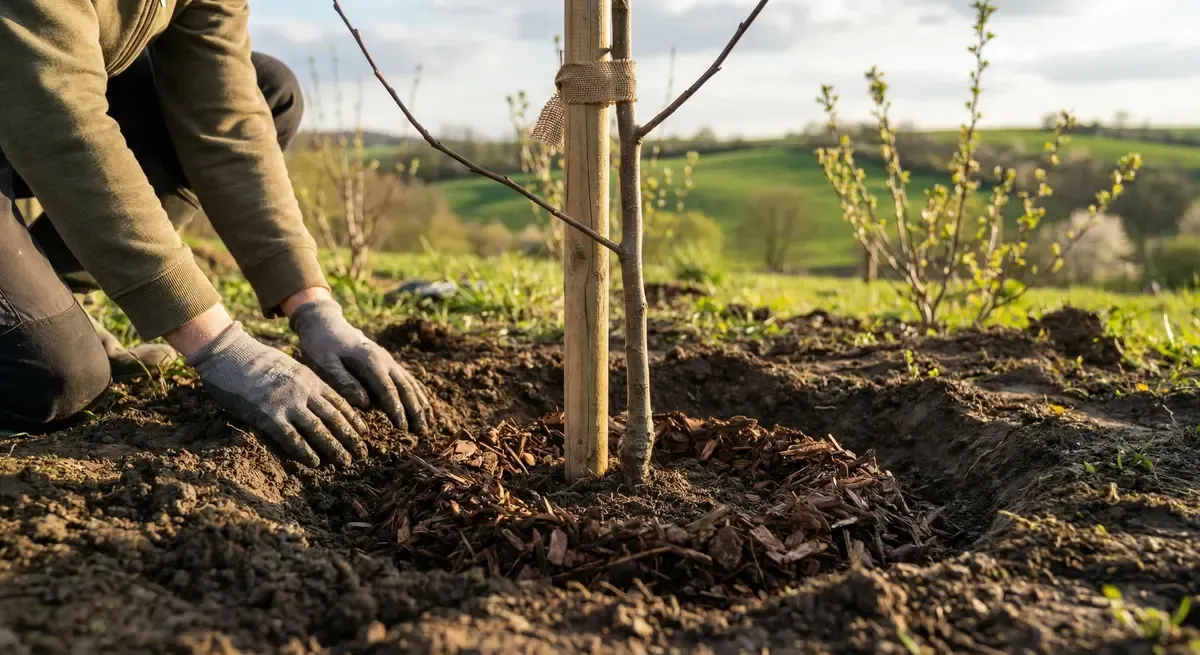
You have just planted a fruit tree. Maybe your first, maybe your tenth. Either way, the next twelve months will determine whether it thrives for decades or struggles forever.
That sounds dramatic, but it is true. I planted a Victoria plum in November 2019, and I did everything wrong in that first year. I watered sporadically in summer, let it fruit (two plums, which seemed harmless), and forgot to check the tie until it had cut into the bark. That tree is still alive, but it has never caught up with its neighbours. Five years later, I can see the damage from that first year in every undersized branch.
The good news is that first year care is not complicated. Water it properly. Remove the fruit. Check the stake. Prune in winter. That is most of it. The harder part is remembering to do these things, and recording what you did so you can learn from it.
This is also the best time to start keeping records. At planting, you have the label with the variety and rootstock. You know exactly where you bought it and when you planted it. This information is easy to capture now and almost impossible to reconstruct later.
Why the first year matters most
When a fruit tree goes into the ground, its entire root system has been severed. Container-grown trees have roots that spiralled around the pot. Bare-root trees were dug from a field and had most of their roots cut off. Either way, the tree arrives in your garden with a fraction of the root system it needs to support itself.
That first year is about root establishment. Every bit of energy the tree can muster should go into growing new roots out into the surrounding soil. If it succeeds, it has a foundation for decades of growth. If it fails, it will always be playing catch-up.
Stress in year one echoes through the tree’s entire life. A summer drought that the tree barely survives leaves it weakened going into winter. A heavy fruit load drains energy that should have built root mass. These setbacks compound. The tree that struggled in year one is more likely to struggle in year two, and by year five, it is permanently behind its peers.
There is another reason this year matters: information. Right now, you have the original label. You know where you bought the tree, what rootstock it is on, and exactly when you planted it. You know what soil amendments you added and how you prepared the hole. In three years, will you remember any of this? I never did.
What to record at planting
The moment you plant is the moment to start recording. Here is what to capture:
Variety and rootstock. This is on the label. Photograph it immediately, before weather fades the ink. I have a label from 2018 that now says something like “C…x Or…e P…n” where it once clearly read “Cox’s Orange Pippin.” The photo I took at planting is the only reason I know what that tree is.
Source. Which nursery did you buy it from? This matters more than you might think. After eight years of planting fruit trees, I have learned that some nurseries produce consistently healthier stock than others. When my Egremont Russet from one nursery thrived while an identical variety from another nursery struggled, the source was the obvious variable.
Planting date. Autumn-planted trees get established before spring growth. Spring-planted trees go straight into their most demanding season. The planting date tells you what to expect in the months ahead.
Soil preparation. What did you do to the planting hole? Did you add compost? Mycorrhizal fungi? Did you break up compacted soil or improve drainage? These details help you understand why one tree outperforms another, especially if they are in different parts of the garden.
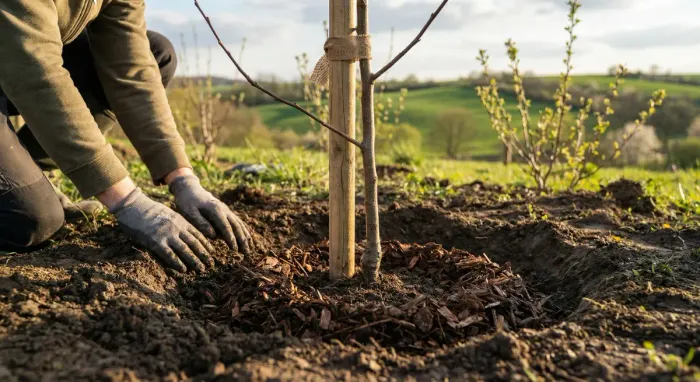
Stake and tie setup. What stake did you use? How high is the tie? This is your reference for the first two years when you will be checking and adjusting the support system.
Photos. Photograph the tree from a consistent angle. It looks tiny now. In five years, you will struggle to believe it was ever this small. The comparison photos are not just satisfying; they help you understand growth rate and spot problems that develop gradually.
First year care calendar
The first year follows a predictable pattern, though the details depend on when you planted.
Spring (if autumn-planted)
If you planted in autumn or winter, spring is when the tree wakes up. Watch for buds swelling and leaves emerging. This is your first sign that the tree survived the move.
Check the stake and tie. Winter weather may have loosened the stake or shifted the tree. The tie should hold the tree firmly but not be cutting into the bark.
Do not fertilise. It seems counterintuitive, but feeding a new tree encourages leafy growth at the expense of root development. The tree needs to build roots first. Fertilising comes in year two.
Summer
Summer is the critical period. New trees have not yet grown the root systems they need to find water, so they depend entirely on you.
Water deeply once or twice a week in dry weather. I say “deeply” because shallow watering encourages shallow roots. You want the water to soak down, so the roots follow it down. A thorough soaking every few days is far better than a light sprinkle every day.
Watch for stress signs: wilting leaves in the afternoon that do not recover by morning, or leaves turning brown at the edges. These mean the tree needs more water.
Remove any fruit that forms. I know it hurts. But fruit production is exhausting for a tree, and a new tree cannot afford that energy expenditure. More on this below.
Autumn
As growth slows, reduce watering. The tree is preparing for dormancy and does not need summer-level irrigation. But do not stop entirely if the weather is dry. Autumn drought stress weakens a tree going into winter.
Check the stake again. Autumn gales test the support system. Make sure the tree is still secure.
Winter
Winter is pruning time for most fruit trees. This is when you do formative pruning: shaping the framework the tree will carry for decades. Remove crossing branches, create an open centre for apples and pears, or establish the correct leader for a central-leader tree.
Check for damage. Winter reveals problems that were hidden under leaves: cankers, frost cracks, rabbit damage to the bark. Document what you find.
Watering: The make-or-break task
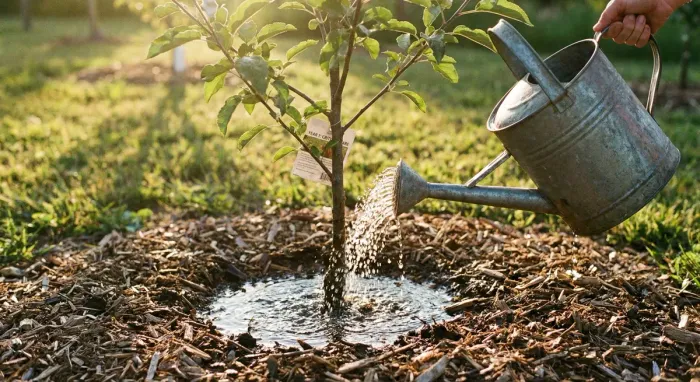
I cannot overstate how important watering is in year one. A new fruit tree has perhaps 10% of the root system it will eventually develop. It cannot reach water deep in the soil. It cannot survive a week of drought the way an established tree can.
How much: Enough to soak the root zone thoroughly. For a young tree, this is roughly 15-20 litres per watering. The goal is water penetrating 30cm or more into the soil, reaching all the new roots growing out from the rootball.
How often: Once or twice a week in dry weather. More often if the weather is hot and dry. Less often if it has rained substantially. The surface soil is a poor indicator; dig down 10cm to check if water is reaching where the roots are.
Signs of underwatering: Wilting leaves, especially in the afternoon. Leaf scorch (brown, crispy edges). Stunted growth. Leaves dropping early. A tree going into autumn stressed is a tree that will struggle through winter.
Signs of overwatering: Yellow leaves (not the autumn colour change, but a sickly yellow). Leaves dropping while still green. Waterlogged soil that stays soggy. Poor growth despite adequate water. This is less common than underwatering but possible in heavy clay soils or wet years.
What to record: I keep a simple log of watering with dates and approximate amounts. This helps me see patterns. That hot spell in July 2024 when I watered three times in one week? The tree came through fine. The week in August when I was away and nobody watered? That is when the leaf scorch appeared.
Should you let it fruit in year one?
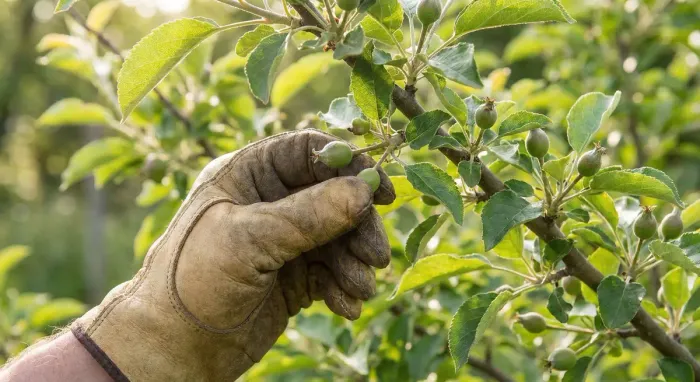
This is the advice nobody wants to hear: remove all the fruit.
Your new tree may flower. It may set fruit. Those tiny fruitlets are tempting. You planted this tree to grow fruit, after all. Why would you remove them?
Because fruit production is the most energy-intensive thing a tree does. Seeds are how trees reproduce, and they pour everything into successful reproduction. A tree with fruit is diverting energy from root growth, branch development, and building reserves for winter.
In year one, you want 100% of the tree’s energy going into establishment. Letting it fruit is like asking someone to run a marathon while recovering from surgery.
I let my Victoria plum fruit in its first year. Two plums. I thought it would be fine. It was not fine. That tree is measurably smaller than its neighbours today, and the only variable was those two plums in year one.
The exception: Some gardeners leave one fruit to confirm the variety. If you have any doubt about what you planted, one fruit at harvest time can settle the question. But just one. And remove it early if the tree shows any stress.
What to record: Note whether you removed fruit and when. If you left any, record how many and why. This becomes useful data for understanding tree performance in later years.
First year pruning
Winter pruning in year one is formative pruning: establishing the shape and structure the tree will carry for life.
For most apple and pear trees, you are creating an open centre or goblet shape. This means:
- Selecting 3-4 well-spaced branches as the main framework
- Removing branches that cross through the centre
- Removing any shoots growing straight up from the main branches
- Cutting back the selected branches by about one-third to an outward-facing bud
For plums and cherries, less is more. These trees are prone to bacterial canker, which enters through pruning wounds. Prune only what is essential, and do it in late summer rather than winter if possible. See our guide on when to prune cherry trees for the full timing breakdown.
For all trees, remove the “four Ds”: dead, dying, damaged, and diseased wood. This is sanitary pruning and should happen regardless of tree type.
What to record: Before and after photos are valuable. Note what you removed and why. Record the shape you are aiming for. This becomes your reference for pruning in year two and beyond. For more detail on building a pruning history, see Fruit Tree Pruning Logs.
Signs of trouble (and what to record)
Problems in year one need quick attention. A struggling new tree can spiral downward fast.
Leaf scorch. Brown, crispy edges on leaves usually mean water stress. Sometimes it indicates root damage. Record when it appeared and how you responded.
Yellow leaves. Could be overwatering, nutrient deficiency, or the tree adjusting to transplant. Note the pattern: is it all leaves, or just older leaves, or random leaves?
No growth. A tree that does not leaf out, or leafs out weakly and stalls, is struggling. This could be root damage, poor planting, or disease. Record what you observe and get expert advice if the tree does not improve.
Stake problems. A tree rocking in the wind is developing loose roots. A tie cutting into bark is strangling growth. Check regularly and adjust.
Pest damage. Aphids, caterpillars, and other pests can devastate young trees. Record what you find, what you did about it, and whether it worked.
For all problems, photos are invaluable. A photo of “weird spots on leaves” in May 2025 helps you identify the same problem if it returns in 2026 or 2027.
Setting up your tree’s record
Starting records on a new tree is easy because you have all the information to hand. Doing it later, after the label fades and memory blurs, is much harder.
Create a record for your tree that includes:
Identity: Variety, rootstock, source, planting date.
Location: Where in the garden, clearly enough that you could find it blindfolded.
Starting condition: Size at planting, any existing damage, soil preparation notes.
Photo: The tree at planting, with the label visible if possible.
Then update this record every time you do something: water, prune, check, observe a problem, harvest.
The value of this record becomes clear in year five, ten, twenty. When you are wondering why one tree outperforms another, you can look back at the first year care and see the difference. When you cannot remember what rootstock a tree is on, the record tells you. When a pest problem returns after three years, you can check what you did last time. If you have multiple trees, the system I describe in Home Orchard Record Keeping works well for managing them together.
My trees from before I kept records are mysteries. My trees from after are well-documented individuals whose histories I can trace from the first day.
How Leaftide tracks new fruit trees
When I plant a new tree now, I create a permanent plant profile in Leaftide the same day. The orchard tracking tools are designed exactly for this: following individual trees from planting through their productive years.
The profile captures everything: variety, rootstock, source, planting date. I photograph the label and attach it to the entry. The tree’s location goes on my garden map, so I always know exactly which profile belongs to which physical tree.
Every task logs against that specific tree. Watering notes, pruning records, problem observations. Each entry is timestamped automatically, building a chronological history.
I set reminders for first year care: check the tie in spring, remove fruit in summer, formative prune in winter. When the reminder appears, I do the task and log it. Nothing falls through the cracks.
The photo timeline is what I find most valuable. That tiny tree at planting, then three months later, then a year, then five years. The growth is obvious. The comparison helps me spot problems developing slowly that I might otherwise miss.
When you start in year one, you capture information that would otherwise be lost. That faded label, that forgotten planting date, that rootstock you can never quite remember. It is all there from day one.
Year one sets the pattern for the next twenty.
Track your new fruit tree from the day you plant it. Variety, rootstock, planting date, and every care task logged in one place. When year five arrives, you will know exactly what you did in year one.
Free for up to 30 plants. No card needed.
Sources and further reading
For detailed guidance on fruit tree care, these resources are authoritative:
Royal Horticultural Society:
- RHS: Growing Fruit Trees - General fruit tree guidance
- RHS: Planting Fruit Trees - Planting techniques
- RHS: Pruning Fruit Trees - Pruning basics
Specialist Nurseries:
- Keepers Nursery: Fruit Tree Care - Detailed care guides
- Ashridge Trees: Planting Guide - Planting and establishment
Related articles:
- Fruit Tree Pruning Logs - Recording your pruning history
- Home Orchard Record Keeping - Building a complete orchard record
The first year with a new fruit tree is an investment. Get it right, record what you do, and that tree will reward you for decades.