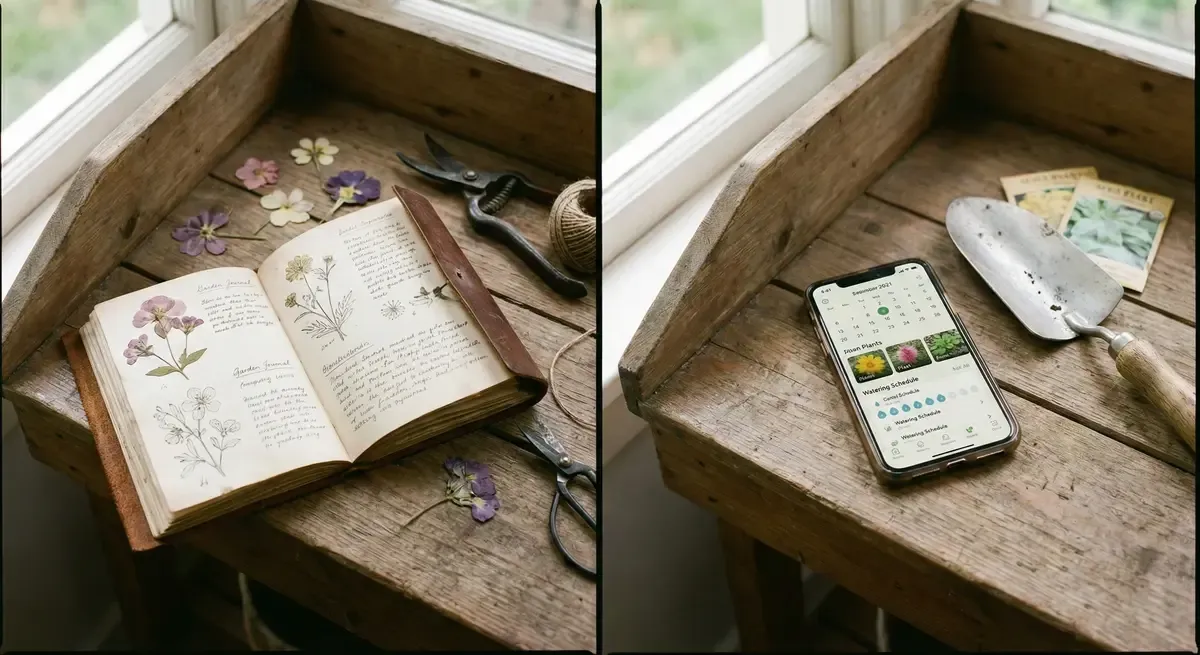
I have three beautiful garden journals on my shelf. Leather-bound, hand-stitched, lovely to hold. I have written in each of them exactly twice. Meanwhile, my phone has four years of garden notes I actually look at.
This is not a failure of discipline. It is a failure of format. Paper journals feel wonderful in the hand but terrible in practice. Digital journals lack romance but deliver results. After years of trying both, I have opinions about which works better and why.
This is an honest comparison. Paper has genuine advantages. Digital has genuine disadvantages. But when it comes to actually being useful years later, one approach wins decisively.
The case for paper garden journals
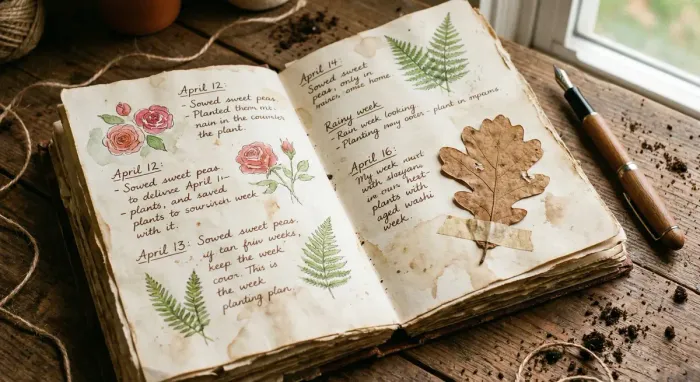
Let me be clear: paper garden journals are genuinely lovely. The appeal is not irrational.
The tactile satisfaction is real. Writing by hand engages your brain differently than typing. The scratch of pen on paper, the smell of the pages, the physical act of forming letters. There is a meditative quality to handwriting that tapping a screen cannot replicate.
No battery, no screen. A paper journal works in bright sunlight, in the rain, and when your phone is dead. It does not need charging or ping you with notifications.
They are beautiful objects. A well-made garden journal — leather cover, quality paper, ribbon bookmark — is a pleasure to own. It sits on your shelf looking handsome.
They work in the garden without worry. Muddy hands? Wet from the hose? You can write in a paper journal without anxiety about damaging an expensive device.
The ritual matters. Sitting down with a cup of tea, opening your journal, reflecting on the week. There is a deliberate slowness to paper that feels appropriate for gardening.
These benefits are real. But they come with costs that only become apparent over time.
Where paper journals fail
The problems with paper journals are not obvious in the first season. They emerge gradually, usually when you need information you thought you had recorded.
Paper is not searchable. When did I plant garlic in 2022? Which tomato variety got blight that wet summer? With paper, answering these questions means flipping through pages, scanning handwriting, hoping you can find the entry. With four or five years of journals, this becomes genuinely tedious.
I once spent twenty minutes searching three notebooks for the name of a bean variety that had performed brilliantly. I knew I had written it down. I could not find it. That information, carefully recorded, was effectively lost.
Paper can be lost, damaged, or filled up. Journals get left at the allotment. They get water damage. They get borrowed and not returned. They get full, and then you need a new one, and now your records are split across multiple volumes. A house move, a flooded shed, a curious toddler. Years of observations, gone.
Photos require printing and gluing. In theory, you can add photos to a paper journal. In practice, this means printing pictures, cutting them out, finding tape or glue, and sticking them in. Nobody does this consistently. The photos stay in your camera roll, disconnected from the written notes, and you never look at them again.
Paper is passive. A notebook does not remind you to write in it. It sits there, waiting, while weeks pass and observations go unrecorded. By the time you remember, you have forgotten what you meant to note. The journal that was supposed to capture your garden’s history captures only sporadic fragments.
Comparing year-on-year is difficult. One of the most valuable uses of garden records is spotting patterns across seasons. When does the blight usually arrive? How does this spring compare to last? With paper, making these comparisons means having multiple journals open simultaneously, flipping between them, trying to align dates. It is possible but cumbersome enough that you rarely bother.
The case for digital garden journals
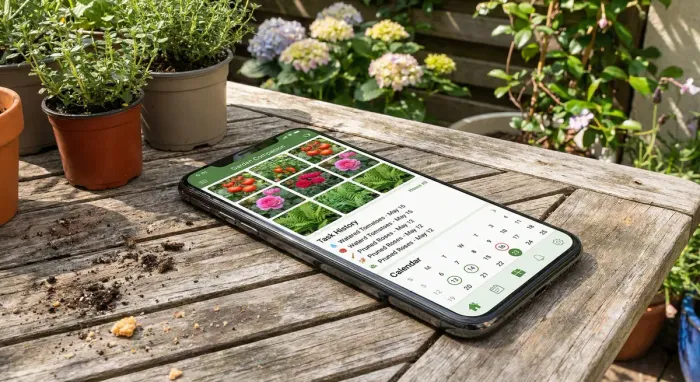
Digital garden journals fix this completely.
Search changes everything. Type “blight” and see every time you have dealt with it. Search “garlic” and find every planting date, every variety, every note. Last autumn I wanted to know which courgette varieties had produced well over the past three years. Thirty seconds. In paper journals, that same question would have taken half an hour of page-flipping.
Photos attach directly to entries. See something odd on a leaf? Take a photo and attach it to that plant’s record. Next year, when you see the same marks, you can compare. The photo has context — what plant, what date, what you observed — not lost in a camera roll of thousands of images.
Reminders and notifications. A digital journal can prompt you when you have not recorded anything in a week. It works with you instead of waiting passively.
Never runs out of pages. No splitting records across volumes. Everything in one place, growing over time.
Accessible from anywhere. Your records travel with you. Planning next year’s garden while visiting family? Check your phone.
Cannot be lost in a house move. Digital records can be backed up. A crashed hard drive or stolen laptop does not destroy years of observations if you have cloud sync enabled.
Where digital journals fail
Digital is not perfect. Pretending otherwise would be dishonest.
You need a device. Recording observations means having your phone or tablet with you. For some gardeners, the garden is a place to escape screens, not bring them.
Battery and connectivity concerns. Phones die. Apps need internet connections to sync. At an allotment with poor signal and a flat battery, your digital journal is inaccessible.
Less tactile satisfaction. Tapping a screen is not the same as writing by hand. There is no pressed flower, no handwritten sketch, no physical object that accumulates character over the years.
The app could shut down. If you invest years of records in an app that later closes, what happens to your data? This is why data export matters. Any serious garden journal app should let you export your records in a standard format.
The hybrid approach
Some gardeners find a middle path: paper for quick capture, digital for permanent storage.
Keep a small notebook in your pocket or garden bag. When you notice something — a pest, a first flower, a variety name on a plant label — jot it down. Then, once a week, transfer the important notes to your digital system. The paper is temporary; the digital record is permanent.
This approach preserves the tactile experience and works when your phone is inside or dead. But it requires discipline. Those paper notes need to actually get transferred. In my experience, the transfer step is where the system breaks down. The notebook fills with scribbles that never make it to the permanent record.
If you have the discipline to transfer consistently, the hybrid approach works well. If you are honest with yourself about your habits, one system used consistently beats two systems used inconsistently.
What to look for in a garden journal app
Not all digital tools are equal. A generic notes app is not a garden journal. Here is what actually matters.
Individual plant tracking. The app should let you create records for specific plants, not just general notes. “Sungold tomatoes planted 15 April” attached to a Sungold tomato entry is far more useful than a note floating in a general journal.
Photo attachments. You should be able to attach photos directly to plant records or observations. If photos live separately from your notes, you will never find them when you need them.
Task logging with dates. When you do something, the date should be recorded automatically or easily. “Pruned the apple tree” is useful. “Pruned the apple tree on 12 February 2024” is data you can use.
Search functionality. If you cannot search your records, you have a digital notebook, not a digital journal. The whole point is being able to find things later.
Reminders. The app should be able to prompt you. Remind you to record observations. Alert you to tasks. Work with you actively, not sit passively waiting.
Data export. You should be able to get your data out. CSV, PDF, something. If the app locks your records in a proprietary format with no export, your years of observations are hostage to that company’s continued existence.
How Leaftide handles garden journaling
I built Leaftide partly because existing tools did not solve these problems well. Generic notes apps lack plant-specific structure. Spreadsheets are tedious. Paper has all the limitations I have described.
In Leaftide, every plant gets its own profile. When I record an observation or complete a task, it attaches to that specific plant with the date logged automatically. I can search “blight” and see every instance across every plant and every year. I can open my apple tree’s record and see its complete history: when I pruned it, when it flowered, when I harvested, what problems I noticed.
Photos attach to plants, not to a general camera roll. When I see the same pest damage next year, I can compare it to the photo I took last time. The context is preserved.
The app nudges me when I have gone quiet. It prompts me to note the first harvest, to check on plants I have been tracking.
And yes, you can export your data. Your records belong to you.
The best garden journal is the one you actually use.
Leaftide tracks every plant individually, logs tasks with dates automatically, and makes your garden’s history searchable. The journal that actually gets used.
Free for up to 30 plants. No card needed.
The verdict
Paper garden journals are wonderful objects. They feel good in the hand. They look beautiful on the shelf. They offer a tactile, meditative experience that digital cannot match.
But they struggle at the one thing a journal is supposed to do: help you find information when you need it.
Digital garden journals are less romantic. They require a device. They lack the charm of handwritten notes and pressed flowers. But they are searchable, backed up, and actually useful years later.
Paper: great for the experience, poor for retrieval.
Digital: less romantic, but genuinely useful over time.
The best journal is the one you will actually use. For most gardeners, that means digital. The notes you can find are worth more than the notes you cannot.
I still have those three leather-bound journals on my shelf. They are lovely to look at. But when I want to know when I planted the garlic, I reach for my phone.
Related reading
- What to Track in Your Garden Journal — deciding what actually matters to record
- Start Your Garden Journal — how Leaftide makes garden record-keeping effortless