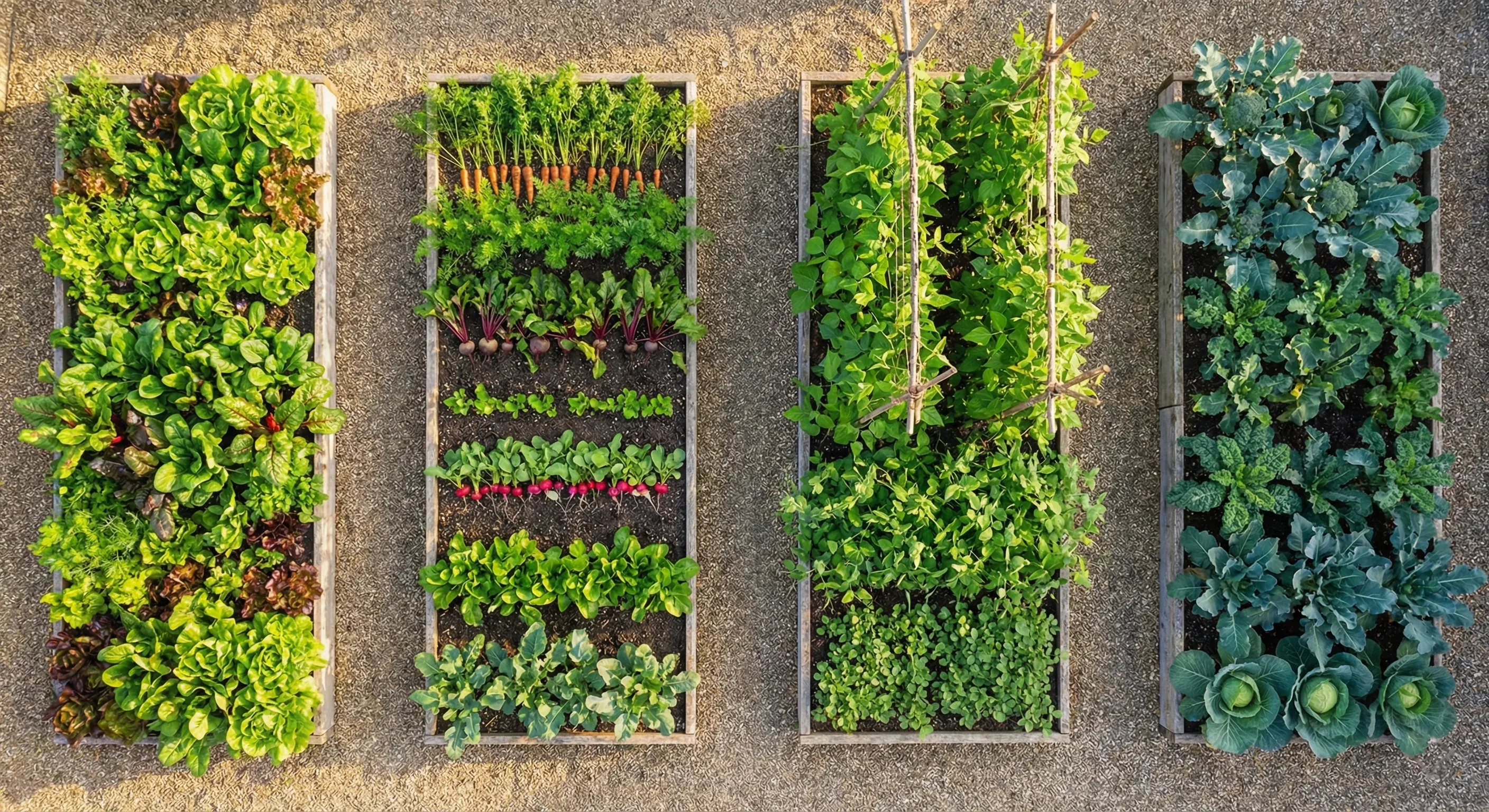
I ignored crop rotation for my first few years of growing vegetables. It sounded like something farmers worried about, not someone with four raised beds and a few pots. My tomatoes went in the same sunny corner every season because that was the warmest spot. My beans went where the bean frame already stood. Moving things around felt like unnecessary hassle.
Then the problems started. The tomatoes that had been reliable suddenly struggled. Leaves yellowed from the bottom up. The beans produced half of what they had the year before. I blamed the weather, then the seeds, then the compost. It took an embarrassingly long time to realise the soil itself was the issue. Three years of the same crops in the same spots had quietly depleted specific nutrients and let soil-borne diseases settle in.
Crop rotation is not complicated. But it does require a plan, and that plan needs to survive from one year to the next. That second part is where most home gardeners, myself included, fall down.
Why rotation matters in a small garden
The logic behind crop rotation is straightforward. Different plants take different nutrients from the soil and leave different things behind. Legumes fix nitrogen. Brassicas are heavy feeders that strip it out. If you follow brassicas with legumes, the soil gets a chance to recover. If you follow brassicas with more brassicas, you are draining the same nutrients year after year.
Then there are pest and disease cycles. Many soil-borne pathogens are specific to plant families. Clubroot targets brassicas. Fusarium wilt goes after solanaceae. These organisms survive in the soil over winter, waiting for their preferred host to return. If you plant the same family in the same bed, you are essentially feeding the problem.
In a large farm field, rotation happens across acres. In a home garden, the distances are smaller, but the principle still works. Moving your tomatoes even a few metres to a different bed breaks the cycle enough to make a real difference. The pathogens are still in the old bed, but without a host plant they decline over time.
The common objection is that home gardens are too small for rotation to matter. I thought the same thing. But the smaller your growing space, the more intensively you use it, and the more important it becomes to manage what goes where. A farm field might grow one crop per season. A raised bed might grow two or three in succession. That intensity makes rotation more necessary, not less.
The four year rotation explained
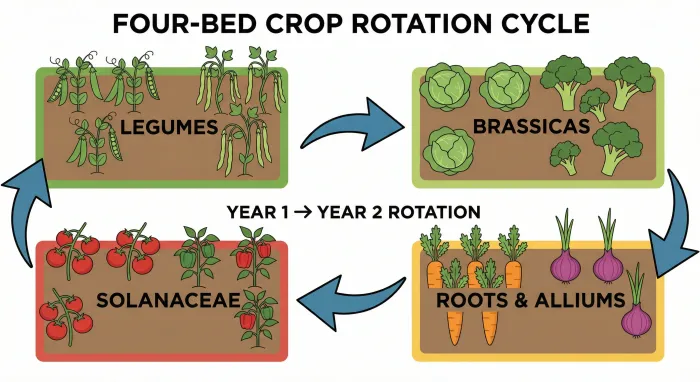
The classic four year crop rotation divides vegetables into family groups, then cycles each group through a different bed each year. After four years, every group has been in every bed, and the cycle starts again.
Here are the groups that work well for most home gardens:
Group 1: Legumes. Peas, broad beans, French beans, runner beans. These fix nitrogen in the soil through bacteria in their root nodules. When you clear them at the end of the season, that nitrogen stays behind for the next crop. Always leave the roots in the ground when you clear legumes. Cut the stems at soil level rather than pulling the whole plant out.
Group 2: Brassicas. Cabbage, broccoli, cauliflower, kale, Brussels sprouts, turnips, radishes. Heavy feeders that benefit from the nitrogen left by legumes. This is why brassicas traditionally follow legumes in the rotation. They also share vulnerability to clubroot, so keeping them together and moving them as a group is important.
Group 3: Solanaceae and cucurbits. Tomatoes, peppers, aubergines, potatoes, courgettes, squash, cucumbers. Some gardeners split these into two groups, but in a small garden with limited beds, combining them works fine. Potatoes are the most important ones to rotate because of blight risk.
Group 4: Alliums and roots. Onions, garlic, leeks, carrots, parsnips, beetroot, celery. These are generally lighter feeders and less prone to the soil-borne diseases that plague the other groups. They do well in soil that has not been freshly manured, which is why they often come last in the cycle, furthest from the legume bed that got the compost.
The sequence matters. Legumes first (they add nitrogen), then brassicas (they use it), then solanaceae (moderate feeders), then roots and alliums (light feeders in now-settled soil). Each bed moves one step forward each year.
When the textbook rotation does not fit
Four beds in a neat grid is the ideal. Real gardens are messier than that. I have one bed that gets full sun and three that get partial shade. Tomatoes need the sunny bed. They cannot rotate into a shady corner just because the chart says so.
This is where you have to be pragmatic. The most important rule is not “follow the four year plan exactly.” It is “do not grow the same family in the same spot two years running.” If you can manage a three year gap, even better. But even a one year break helps.
Some practical compromises that work:
If you only have two or three beds, rotate what you can and accept that some crops will return sooner than ideal. Prioritise rotating the disease-prone families: solanaceae and brassicas. Alliums and roots are more forgiving.
If one bed has significantly better conditions (more sun, better drainage), use it for the crop that needs it most each year, but still avoid repeating the same family. Tomatoes in the sunny bed this year, courgettes next year, peppers the year after. They are different enough within the solanaceae-cucurbit group to provide some benefit.
If you grow in containers, rotation is simpler in one way and harder in another. You can move the pots, but the soil stays the same. Refreshing or replacing container compost each season achieves a similar effect to physical rotation.
The Minimum Viable Rotation
If a full four year plan feels overwhelming, start with one rule: never put the same plant family in the same bed two years in a row. That single habit prevents the worst soil-borne disease problems and gives you most of the benefit with almost no planning overhead.
Keeping track across years
The hardest part of crop rotation has nothing to do with understanding the theory. It is remembering what you grew where last year. And the year before that. By the time January comes around and you are planning the new season, the details of two summers ago are genuinely hazy.
I have tried paper maps, photos of the beds, and scribbled notes on the back of seed packets. They all worked for one season and then got lost or forgotten. Recording the information was never the problem. Finding it again six months later was.
This is one of the things I built Leaftide to handle. The plot designer lets you lay out your beds visually and place plants into them. Because each layout is tied to a yearly plan, you can look back at previous years and see exactly what grew where. When you are planning the new season, that history is right there. No digging through notebooks or trying to remember whether the potatoes were in the left bed or the right one.
The journal is useful here too. If a bed had disease problems, or a particular crop did badly, noting that down means you have context when you are deciding rotations for next year. “Brassicas in bed 3 got clubroot in 2025” is the kind of note that saves you from repeating a mistake. Harvest tracking adds another layer: knowing which beds produced well helps you see whether the rotation is actually improving yields over time.
Year-over-year tracking sounds like a small thing. But it is what separates a rotation plan that works on paper from one that actually happens in practice. The plan is only as good as your ability to follow it across seasons.
Building your first rotation plan
If you are starting from scratch, here is a practical way to set up a rotation without overthinking it.
Start by listing what you actually grow. Not what you might grow someday, but what you plant most years. Group them by family. You will probably find that you grow more from some families than others. That is fine. The groups do not need to be equal in size.
Then sketch your beds or growing areas. Note any constraints: which beds get the most sun, which have the best soil, which are closest to the house (handy for salad crops you pick daily). These constraints will shape your rotation more than any textbook diagram.
Assign each family group to a bed for this year. Write down where each group will go next year, and the year after. You do not need to plan all four years in detail. Just knowing the next move for each group is enough.
The last step, and the one most guides skip, is to actually record what you planted where. A plan that exists only in your head will not survive until next spring. Whether you use an app, a spreadsheet, or a labelled photo of your beds, the record needs to be somewhere you will find it in January.
Do Not Forget Potatoes
Potatoes are the crop that benefits most from strict rotation. Blight spores and eelworm cysts survive in soil for years. If you grow potatoes, make sure they get the longest possible gap before returning to the same bed. Three years minimum. Four is better.
The hardest part of rotation is remembering what went where.
Free for up to 30 plants. No card needed.
Companion planting and rotation
Companion planting and crop rotation are often discussed separately, but they overlap in useful ways. Some companion planting combinations align naturally with rotation groups. Carrots and onions are both in the allium-and-roots group, and they do benefit from being planted together (the onion scent confuses carrot fly). The Companion Planting Checker can help you find pairings that work within each rotation group.
Other combinations cross rotation boundaries. Tomatoes and basil are a classic pairing, but basil is not a solanaceae. In practice, this does not matter much. Herbs are small enough to tuck in anywhere without disrupting the rotation. Think of them as guests that move with whichever group they complement, rather than permanent residents of a rotation slot.
The one thing to avoid is letting companion planting override rotation logic. If you always plant marigolds with your tomatoes (a good idea for pest deterrence), make sure the marigolds move with the tomatoes to the new bed. Do not let the marigolds become an excuse to keep the tomatoes in the same spot.
Common mistakes
A few things I have seen go wrong, both in my own garden and in conversations with other growers.
Rotating individual plants but not families. Moving your tomatoes to a new bed but putting peppers in the old tomato bed achieves nothing. They are the same family. The soil-borne diseases that affect one will affect the other. Always rotate by family group, not by individual crop.
Ignoring volunteer plants. Self-seeded tomatoes or potatoes from missed tubers count as a planting. If volunteers pop up in a bed, they are resetting the rotation clock for that family in that spot. Pull them or accept that the rotation has been disrupted.
Overthinking it. A rough rotation that you actually follow is worth more than a perfect plan that you abandon because it is too complicated. Start simple. Refine over the years as you learn your garden.
Crop rotation is one of those gardening practices that rewards consistency over perfection. Even a loose system, applied year after year, builds healthier soil and fewer pest problems than no system at all. The key is having a way to track what went where, so that each year builds on the last rather than starting from a blank slate.