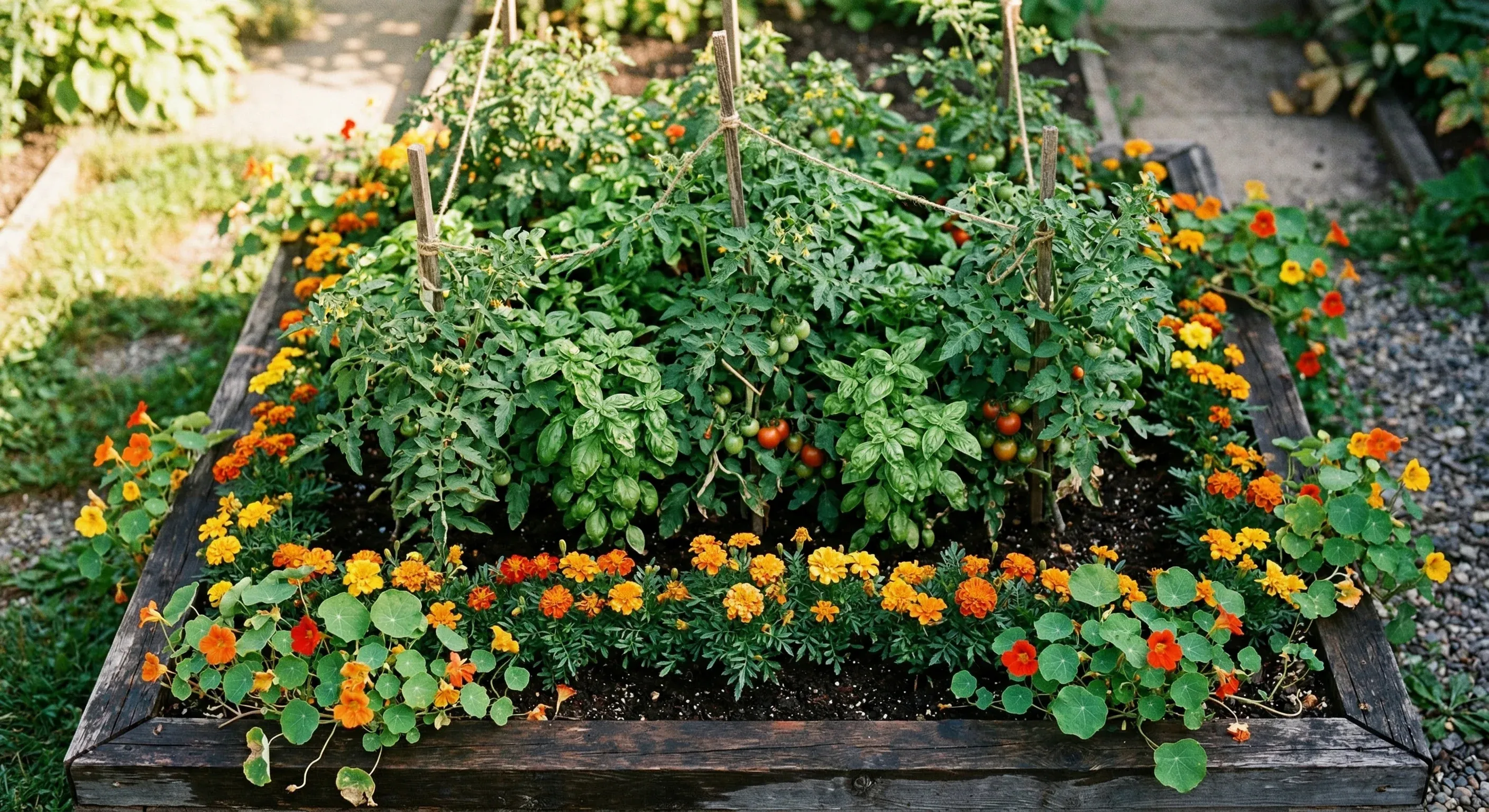
I planted my first tomatoes next to a row of cabbages because that was where the space was. The tomatoes grew fine. The cabbages grew fine. I did not think much of it. The following year, I put basil between the tomato plants because someone at the allotment told me it helped. The tomatoes still grew fine. The basil grew fine. I still did not think much of it.
It was only in my third year, when I started paying closer attention to pest damage, that I noticed something. The tomato plants interplanted with basil had noticeably fewer aphids than the ones growing alone at the other end of the bed. That was not proof of anything on its own. But it made me curious enough to start paying attention and keeping better records.
Companion planting is one of those gardening topics where folklore and science get tangled together. Some of it is genuinely useful. Some of it is wishful thinking repeated so often it sounds like fact. This guide is my attempt to separate the two, based on what I have grown and tracked over several seasons, and what the research actually says.
What companion planting actually is
At its simplest, companion planting means growing certain plants near each other because the combination produces better results than growing them separately. “Better results” can mean higher yields, fewer pests, improved pollination, or more efficient use of space.
The concept is ancient. Indigenous peoples across the Americas practised the three sisters method (corn, beans, and squash together) long before European agriculture existed. Cottage gardeners in England mixed flowers with vegetables for centuries. The idea that plants interact with their neighbours is not new or controversial.
What is more recent is the attempt to catalogue every possible pairing into rigid charts of “good companions” and “bad companions.” Those charts are useful as starting points, but they oversimplify things. Whether two plants benefit each other depends on soil, climate, spacing, and what pests actually show up in your garden. A pairing that works brilliantly in a Mediterranean climate might do nothing in northern England.
The science behind it
There are several real mechanisms that make companion planting work. Understanding them helps you make better decisions than blindly following a chart.
Nitrogen fixation. Legumes (peas, beans, clover) host bacteria in their root nodules that convert atmospheric nitrogen into a form plants can use. Growing legumes near nitrogen-hungry crops like brassicas or sweetcorn measurably improves their growth. This is not folklore. It is well-documented biology. The three sisters combination exploits this directly: the beans feed nitrogen to the corn and squash.
Pest confusion through scent. Many pest insects find their host plants by smell. When you interplant strongly scented herbs or alliums among vegetables, the mixed scents make it harder for pests to locate their target. Carrots and onions are the classic example. Carrot fly navigates by the scent of carrot foliage. Onions mask that scent. The effect is real, though it reduces pest pressure rather than eliminating it entirely.
Physical effects. Tall plants can shelter shorter ones from wind or provide shade for crops that bolt in full sun. Sweetcorn shading lettuce in midsummer is a practical example. Ground-covering plants like squash suppress weeds and keep soil moist. These are straightforward physical interactions, not chemistry.
Allelopathy. Some plants release chemicals from their roots or decomposing leaves that inhibit the growth of nearby plants. Black walnut trees are the most famous example, but fennel and sunflowers also have mild allelopathic effects. This is the science behind the “bad companion” lists. Fennel does suppress the growth of most vegetables planted near it.
Trap cropping. Planting something that pests prefer even more than your main crop can draw them away. Nasturtiums attract aphids away from beans. Sacrificial brassicas can lure cabbage white butterflies away from your main crop. This works, but you have to be willing to sacrifice the trap crop.
Combinations that work
These are pairings I have grown myself or seen work consistently in other gardens. They are grounded in the mechanisms above, not just tradition.
Tomatoes and basil. Basil planted between tomato plants helps mask the scent that attracts aphids and whitefly. Some gardeners also report improved tomato flavour, though that is harder to verify. At minimum, it is an efficient use of space since basil thrives in the same warm, sunny conditions tomatoes need.
Carrots and onions. The onion scent confuses carrot fly, and the carrot foliage may help deter onion fly in return. Plant them in alternating rows within the same bed for the strongest effect. This is one of the most reliable companion pairings and one I use every year.
Sweetcorn, beans, and squash (the three sisters). The corn gives the beans a climbing structure. The beans fix nitrogen. The squash shades the ground. It is an elegant system, but it needs space. Each group of three sisters wants at least a square metre. It does not work well in small raised beds unless you scale it down significantly.
Lettuce under taller crops. Lettuce bolts in hot sun. Growing it in the partial shade of tomatoes, beans, or sweetcorn extends the harvest window by weeks. This is a space-efficiency pairing as much as a companion one.
Marigolds among vegetables. French marigolds (Tagetes patula) release compounds from their roots that suppress root-knot nematodes in the soil. This is one of the few companion planting claims backed by peer-reviewed research. The effect builds over time, so growing marigolds in the same beds year after year is more effective than a single season.
Beans and brassicas. The nitrogen fixed by beans benefits heavy-feeding brassicas. This works both as a companion planting strategy within a season and as a crop rotation strategy across years. Grow beans in a bed one year, follow with brassicas the next, and the residual nitrogen gives them a strong start.
Not sure which plants grow well together?
Free for up to 30 plants. No card needed.
Combinations to avoid
Some pairings cause real problems. These are worth knowing so you do not learn them the hard way.
Fennel near almost anything. Fennel is allelopathic. It inhibits the growth of beans, tomatoes, and most other vegetables. Grow it in a pot or at the far edge of the garden, well away from your main beds.
Tomatoes and potatoes together. They are the same family (solanaceae) and share the same diseases, particularly blight. Planting them near each other makes it easy for blight to spread from one to the other. Keep them in separate beds, ideally with some distance between them.
Onions and beans. Alliums (onions, garlic, leeks) can inhibit the growth of legumes. The effect is not dramatic, but if you have the choice, keep them apart. This is one reason they end up in different rotation groups.
Brassicas and strawberries. Brassicas are heavy feeders that will outcompete strawberries for nutrients. Strawberries also attract slugs, which will happily move on to your cabbages. Not a good combination in a small space.
Dill and carrots. They are in the same family (umbelliferae) and can cross-pollinate if both go to seed. More practically, mature dill can inhibit carrot growth. Young dill is fine as a short-term companion, but remove it before it matures.
Quick reference
| Plant A | Plant B | Effect | Why |
|---|---|---|---|
| Tomatoes | Basil | Good | Basil masks scent, reducing aphids and whitefly |
| Carrots | Onions | Good | Onion scent confuses carrot fly |
| Sweetcorn | Beans | Good | Corn supports beans; beans fix nitrogen |
| Squash | Sweetcorn | Good | Squash shades soil, suppresses weeds |
| Lettuce | Tall crops | Good | Shade from taller plants prevents bolting |
| Marigolds | Vegetables | Good | Suppress root-knot nematodes in soil |
| Beans | Brassicas | Good | Beans fix nitrogen for heavy feeders |
| Nasturtiums | Beans | Good | Nasturtiums lure aphids away from beans |
| Fennel | Most vegetables | Avoid | Allelopathic; inhibits nearby plant growth |
| Tomatoes | Potatoes | Avoid | Same family, share blight |
| Onions | Beans | Avoid | Alliums inhibit legume growth |
| Brassicas | Strawberries | Avoid | Brassicas outcompete; slugs spread between them |
| Dill | Carrots | Avoid | Same family; mature dill inhibits carrots |
Planning companion planting in a small garden
In a large garden, you can dedicate entire beds to single crops and place companions in adjacent beds. In a small garden, you need to interplant within beds, and that requires more thought about spacing and light.
Start with your main crops. What are the three or four vegetables you grow every year? Those are your anchors. Then look at what companions fit around them without competing for the same resources.
Think vertically. Tall crops (tomatoes, beans, sweetcorn) create microclimates below them. Use that shade for lettuce, spinach, or radishes. Use the vertical space for climbing beans on corn or a trellis.
Think about timing. Not all companions need to be in the ground at the same time. Early-season radishes can mark rows and break up soil before slower crops like carrots fill in. Quick-growing lettuce can occupy space between tomato plants that will not need it until midsummer.
Do not try to optimise every square centimetre on your first attempt. Pick two or three companion combinations and see how they work in your conditions. Add more the following year based on what you observed. The companion planting checker is useful here for quickly verifying whether a pairing you are considering is a good idea before you commit to it.
Common mistakes
Following charts without understanding why. A companion planting chart that says “tomatoes and basil: good” is only useful if you know the mechanism (scent masking for pest reduction). Without that understanding, you cannot adapt when your specific situation differs from the chart.
Expecting companion planting to replace pest control. Companion planting reduces pest pressure. It does not eliminate it. If you have a serious aphid infestation, interplanting basil will not solve it on its own. Think of companions as one layer in a broader approach that includes physical barriers, crop rotation, and predatory insects.
Overcrowding in the name of companionship. Planting basil between tomatoes works when the basil has enough space to grow without competing for light and water. Cramming six different companions into a single square metre creates competition, not cooperation. Respect the spacing each plant needs.
Ignoring your own observations. The best companion planting data comes from your own garden. What works in your soil and your microclimate matters more than any generalised chart. Keep notes on what you planted together and what happened. Over a few seasons, you will build a personalised guide that is more useful than anything you will find online.
Your garden is the best experiment.
Free for up to 30 plants. No card needed.
It is not magic, but it is real
Companion planting is not a silver bullet. It will not turn a neglected garden into a paradise, and it will not replace good soil and sensible crop rotation. But it is a useful tool that, applied thoughtfully, makes your garden more productive and more resilient.
The best approach is to start simple and build on what works. A few well-chosen pairings, tracked over several seasons, will teach you more than any chart. And once you see the difference a good companion makes, you will find it hard to go back to planting in isolation.